PS6 Leaks Reveal Sony Bets Big on AI Graphics and Ray Tracing
Korean leaks place PS6 tapeout at TSMC with a confirmed late 2027 launch, RDNA 5 architecture delivering 2-3x rasterization and up to 12x ray tracing gains over PS5. Sony's entire next-gen strategy hinges on AI-driven rendering.
A Korean Source, a Confirmed Tapeout, and a Console War in Motion
The next-generation console cycle is no longer speculative. PlayGameGPU contributor Kepler_L2, a source with a track record of accurate SoC leaks, confirmed this week that AMD’s custom processor for Sony’s PlayStation 6 has passed the critical tapeout milestone. Manufacturing masks have been transferred to TSMC for initial production wafers. The implication is unambiguous: Sony will launch PS6 in late 2027, and the silicon roadmap is now locked.
This detail — the tapeout stage in the semiconductor industry — is the point of no return for a console. Design can no longer change. Core silicon specifications are final. Internal studios and third-party developers will now pivot from speculation to low-level software stack debugging. The machine Sony is building is real.
The Numbers Are Misleading, the Architecture Is Not
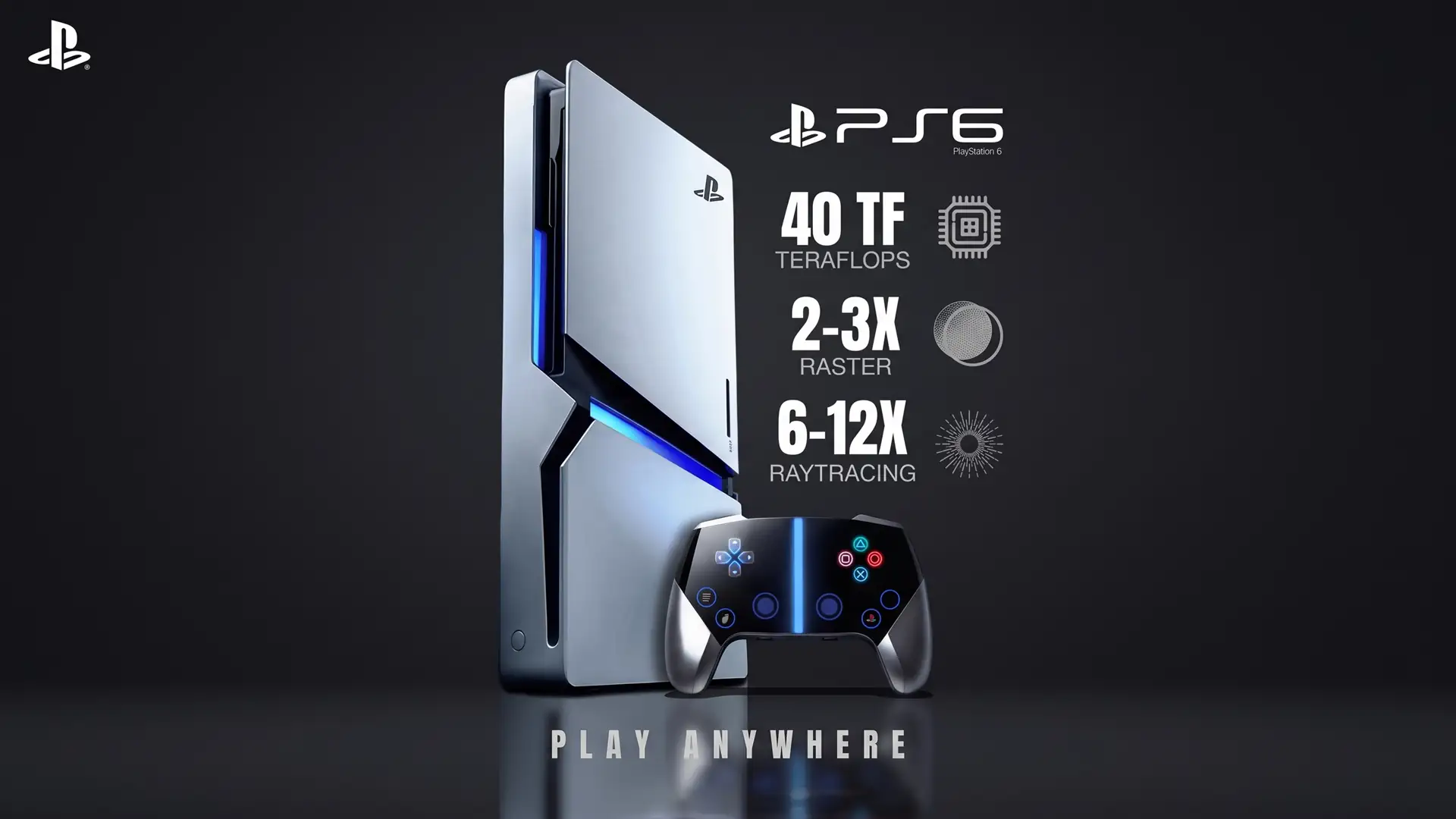
The headline figure floating through Korean gaming forums is 40 TFLOPS of theoretical peak performance. On paper, that sounds underwhelming compared to the raw power wars of previous generations. But the source explicitly warns that the TFLOPS number does not reflect actual game performance gains.
That warning matters. The leap from PS5 to PS6 is not primarily about FLOPS. It is about architectural efficiency.
Sony’s PS6 is built on AMD’s RDNA 5 GPU architecture. Rasterization performance — the traditional rendering of polygons and textures without ray tracing — is expected to improve 2 to 3 times over PS5. That is a solid generational step, roughly consistent with the jump from PS4 to PS5 in raw raster throughput.
But the real story is in the lighting. Hardware ray tracing and path tracing efficiency is claiming a 6 to 12 times improvement over PS5. If that range holds, it is a staggering leap. PS5’s ray tracing was always its weak point — functional in select titles but nowhere near a practical rendering technique for most games. A 12x improvement would fundamentally change what a console can render in real time, moving path tracing from a tech demo to a plausible target for AAA titles.
AI Is the Engine, Not the Accessory
The PS6’s rendering strategy appears to be built around hardware-accelerated AI and neural network-based PSSR (PlayStation Spectral Super Resolution). PSSR is already live on PS5 through a software update, using a dedicated AI accelerator on the current chip to upscale lower-resolution renders to 4K with measurable quality gains. The PS6 version will be more integrated and likely more aggressive.
This is the architecture’s defining move. Rather than relying solely on brute-force rasterization and ray tracing, Sony is betting that machine learning inference — running denoising, upscaling, and frame generation on dedicated silicon — can deliver visual fidelity that raw horsepower alone cannot achieve. The source declined to confirm whether the chip includes dual-issue instruction execution or specific AI scaling ratios, but the direction is clear.
The same trajectory is visible on the PC side. AMD’s RDNA 5 is expected to appear in desktop GPUs as well, and NVIDIA is pushing DLSS 4 with similar AI-assisted rendering. Console hardware is converging with PC hardware in methodology, even if the PS6’s closed ecosystem keeps it architecturally distinct.
Backward Compatibility as a Weapon
Perhaps the most strategically significant detail is not a performance number but a guarantee: PS6 will offer full backward compatibility with the entire PS4 and PS5 libraries, including physical media. Games will run without interruption across both digital and disc formats. More importantly, the source states that architecture-level optimizations will deliver frame rate improvements, faster data loading, and sharper image quality for older titles on new hardware.
This is a deliberate countermove against Microsoft’s Game Pass ecosystem. Sony cannot match Xbox’s subscription volume, but it can claim the largest coherent library any next-gen console has offered. A player who owns 40 PS5 games is a player locked into the Sony ecosystem. The backward compatibility promise reinforces that lock-in while offering tangible performance uplifts that make upgrading feel essential rather than optional.
The physical media point is also notable. Sony remains the only major console maker still shipping disc drives as a standard option. That decision — still debated in an era where digital-only consoles are the trend — signals Sony’s commitment to a market segment that Microsoft abandoned and that still commands significant share in Japan and Korea.
What This Means for the Console War
Microsoft has been notably quiet on Xbox Series Z or next-generation hardware details. The PS6 tapeout confirmation forces Sony into a position of strength. If the 6-12x ray tracing improvement is real, Sony’s PS6 will be the most capable console for visually ambitious titles — particularly in the narrative and cinematic genres where Sony’s first-party studios specialize.
The 2027 launch window also creates timing pressure. Any Xbox announcement in 2026 or early 2027 will be measured against confirmed Sony specs. Sony gets to set the bar first.
The Caution
These are leaks from a single source on a Korean gaming forum. Kepler_L2 has been accurate before, but the tapeout stage is a real milestone — and the performance claims, especially the upper bound of the ray tracing range, should be treated as targets rather than guarantees until independent verification arrives. The TFLOPS figure is almost certainly not the performance metric to watch.
What is certain is that Sony’s next console is being built, the silicon is real, and the architecture bet is on AI-assisted rendering rather than raw power. The console war’s next chapter is being written in TSMC fabrication plants.