The 50-Year Hunt for the Pure-Force Particle May Be Over
A Japanese research team found compelling evidence that X(2370) is a glueball — a particle made entirely of gluons, with no quarks at all. If confirmed, it would be the first direct observation of force crystallized into matter.
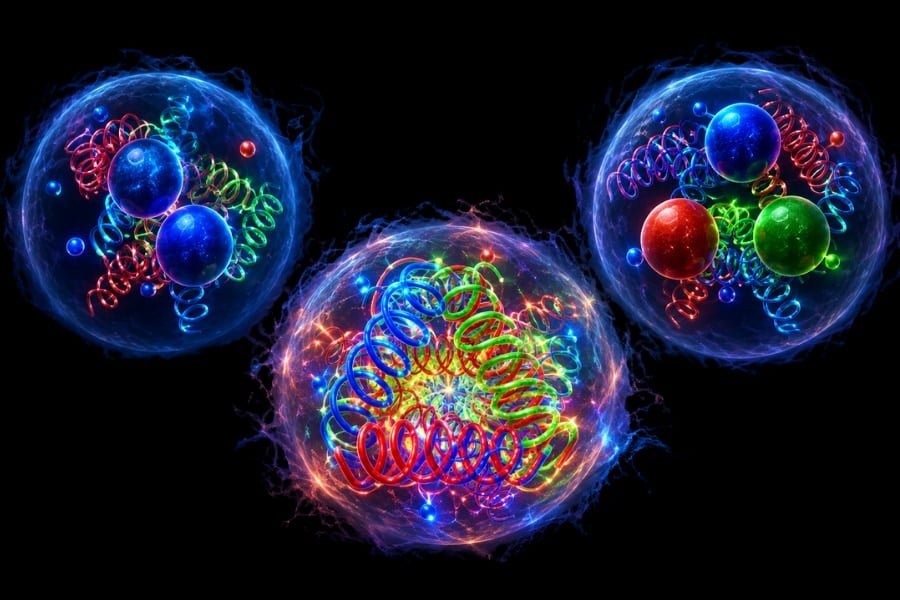
The particle physicists have been hunting for half a century may finally have a name.
A Japanese research team has found what looks like the strongest evidence yet for a glueball — a particle composed entirely of gluons, the carriers of the strong nuclear force, with zero quarks inside it. If the finding holds up, it means they have caught force itself condensing into matter, exactly as quantum chromodynamics predicted in the early 1970s.
The candidate is X(2370), a particle first spotted in 2011 that has defied easy classification ever since. The new work came from analyzing roughly 10 billion J/psi decay events and finding that X(2370) refuses to decay in ways that every other known particle of similar mass happily does. That refusal, the team argues, is the smoking gun.
Why gluons count as matter too
The standard model draws a bright line between matter particles — quarks and leptons — and force-carrying particles — gluons, photons, W and Z bosons. Quarks make up protons and neutrons. Gluons are the invisible glue that binds quarks together inside those nucleons. But quantum chromodynamics, the theory of the strong force, has always allowed for a third possibility: that gluons can bind to each other without any quarks at all, forming a composite particle made purely of field energy.
Such a state would be exotic in the most literal sense. It would be matter born from force. Theoretical physicists predicted glueballs decades ago, but they have never been unambiguously observed. The problem is that glueballs are supposed to mix with ordinary quark-antiquark states, blurring the distinction. A glueball candidate always looks like something else dressed in a strange costume.
How to tell a glueball from a quark ball
The Japanese team’s logic rests on a clean theoretical difference between quark-based particles and glueballs — one that comes down to how they break apart.
When a particle containing quarks decays, it typically spits out fragments that carry some of those original quark flavors. A particle built around a strange quark, for example, tends to produce phi mesons, which also contain strange quarks. The decay products remember the parent. It is like smashing a watermelon and finding that the scattered pieces still carry seeds.
A glueball has no quarks to begin with. When it decays, any quarks that appear in the fragments must be created from the decay energy itself, not inherited from the parent. That means the resulting quarks should show no flavor bias — light quarks of all types should emerge equally, with no preference. It is like smashing a melon that has no seeds at all and watching nothing seeded spray out.
And critically, there are specific decay channels that a quark-based particle can access but a glueball cannot. These are not merely unlikely — they are forbidden by the rules governing how flavorless gluonic states can couple to quark-antiquark pairs. Finding the absence of these decays is therefore decisive.
What X(2370) did and did not do
The team focused on whether X(2370) decays into a K*(892) resonance and a kaon — a channel that every ordinary quark-based particle of comparable mass can populate. In nearly 10 billion J/psi decay events, the researchers found no trace of this signature.
That null result is not a minor gap. For a quark state sitting at 2370 MeV, this decay should be prominent. Its absence is the melon-without-seeds moment.
But the team did not rely on one absence alone. X(2370) has been measured along multiple axes since its discovery: its mass, its spin, how easily it is produced, and now its decay pattern. Each measurement, taken separately, could be coincidental. Taken together, they converge tightly on a single point — the region of parameter space where quantum chromodynamics says a glueball should sit.
The more properties lined up, the fewer alternative explanations survived. By the end, the only coherent picture was that X(2370)’s main component is gluonic.
Why this matters beyond Japan
Japan has long been a serious player in charmonium physics through the Belle experiment at KEK and its successor Belle II at KEK’s new accelerator. The J/psi dataset behind this analysis likely traces back to those facilities, which produce enormous samples of charmonium states precisely because the J/psi is copiously generated in electron-positron collisions at the right energy. This is not a side project — it is the kind of high-statistics program where glueball evidence can finally be separated from noise.
The result also matters because it resolves a chronic ambiguity in the hadron spectrum. Lattice QCD calculations have become precise enough to predict glueball masses with small error bars, but experimentalists have struggled to match predictions to data because every heavy meson candidate overlaps with several others. A clean glueball identification would give theorists a real anchor point — experimental confirmation that lattice methods are not just numerically consistent but physically correct.
What comes next
The cautious read is that this is highly suggestive evidence, not yet a discovery in the strict particle-physics sense. The collaboration will need to publish the full analysis, and other groups will want to check the result against independent datasets — potentially from LHCb or BESIII, both of which produce large samples of charmonium decays.
If the pattern holds across experiments and analysis methods, the implication is straightforward: textbook sections on hadron spectroscopy will need a new category. Glueballs were always on the menu. Until now, they lived only in equations. X(2370) may be the first one pulled off the page.
The longer implication is subtler. A confirmed glueball proves that the strong force can self-bind into a detectable object — that pure field energy can condense into a particle just as quarks do. It is a direct demonstration that the distinction between force and matter, so central to how physics describes the world, is more porous than it appears. That idea has been theoretical for over fifty years. The Japanese team’s result suggests it is time to treat it as empirical.