Putin's Birthday Strike Reveals a Calculated Infrastructure Siege
Russia's mass missile and drone attack on Ukraine's birthday marks more than cruelty — it's a systematic campaign against critical infrastructure with wider European implications.
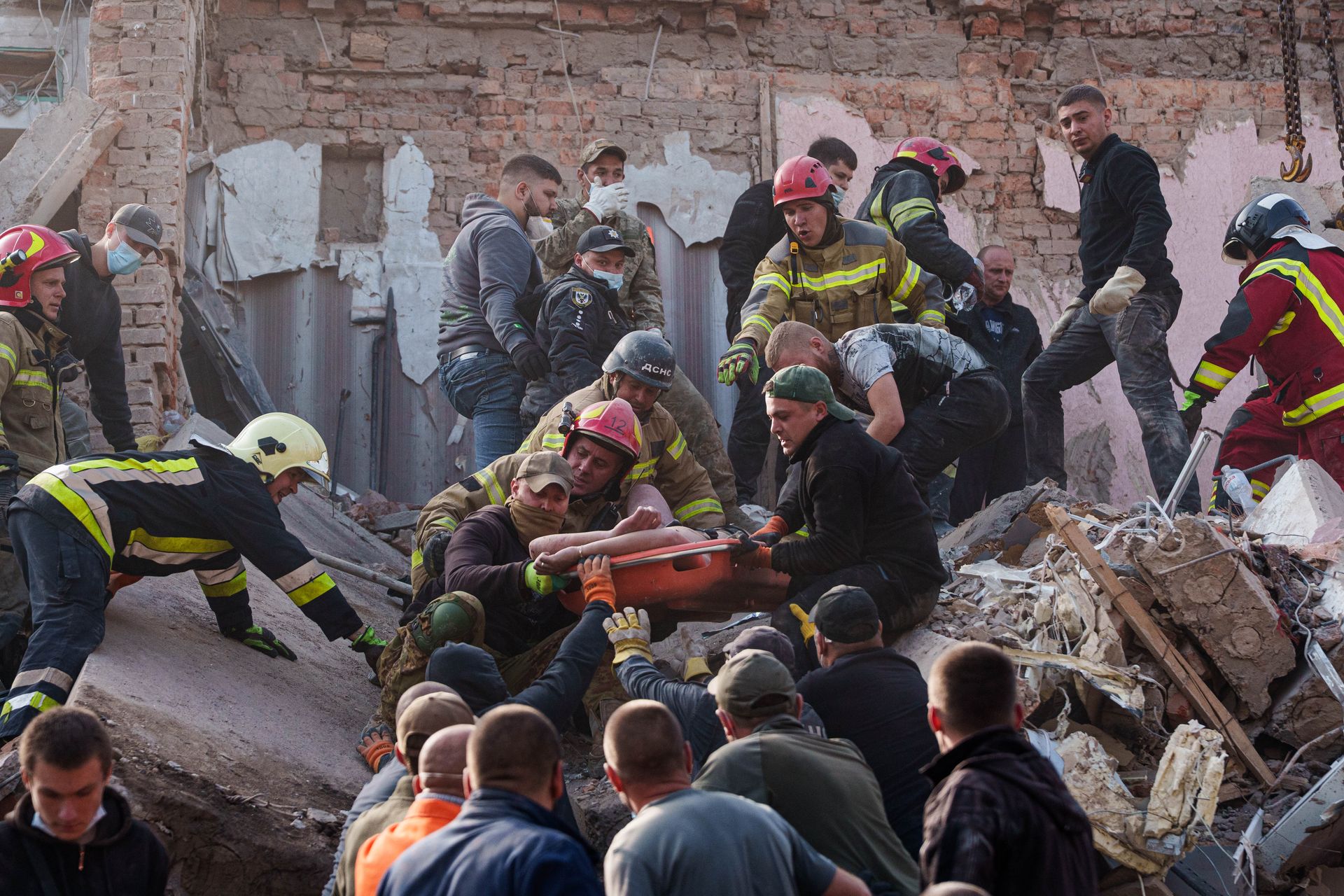
A Birthday Present of Rubble
Russia did not limit itself to symbolic targets this time. On Vladimir Putin’s 74th birthday, October 7, 2026, a coordinated missile and drone campaign killed at least 26 people across western and central Ukraine, with the worst single strike hitting a five-story residential building in Pryluky, a town in Chernihiv Oblast. Twenty people died there, including five children — three of them one year old. Another child, eight-year-old Maksym, was also killed. At least 55 others were wounded.
What makes this attack distinct from the steady rhythm of strikes Ukraine has endured for over two years is not just the death toll. It is the pattern. Russia has been systematically dismantling Ukraine’s transport corridors — specifically its bridges — in recent days, and the overnight barrage hit Kyiv hard enough to knock out electricity at water pumping stations, triggering supply interruptions on the western bank of the city.
This is no longer about terrorizing civilians on a schedule. It is about isolating them.
The Bridge Campaign
Kyiv’s bridges are not mere crossings. They are the veins of a city of nearly three million people, channels for emergency vehicles, commercial trucks, and commuters. The damage to warehouse facilities in Podil and the unspecified non-residential target in Obolon — reported by Mayor Vitali Klitschko — suggests a deliberate effort to disrupt logistics chains within the capital itself.
When bridges fall, the economy stalls before the bombs even finish their work. Supply routes narrow. Prices climb. Fuel becomes scarce. And all of this happens in plain sight, documented by rescuers pulling children from rubble while the world watches.
The targeting of bridges represents something new in a conflict already defined by infrastructure warfare. This is not the first time Russia has struck crossing points — Kakhovka was destroyed in 2023, and numerous bridges across southern and eastern Ukraine have been damaged or collapsed since the full-scale invasion began. But the recent concentration of bridge strikes across multiple regions, combined with the precision aimed at urban logistics hubs, signals a shift from sporadic destruction to structured strangulation. Each fallen bridge adds a detour of tens or even hundreds of kilometers to freight routes. For a country where winter supply chains are already stretched thin, those added kilometers translate into delays that compound throughout the season.
Beyond the Obvious Read
The conventional story here is simple: Russia strikes on Putin’s birthday as a demonstration of power. But that framing misses the operational logic. This is a war of attrition fought against infrastructure because fighting against the Ukrainian military on the front lines has not produced the results Moscow expected.
The numbers from Ukraine’s Air Force tell a story of both sides struggling. Of 48 cruise missiles launched, 39 were intercepted or suppressed. Of 130 attack drones, 117 were brought down. Five ballistic missiles were intercepted or suppressed out of an unspecified total. That means nine cruise missiles, 13 drones, and possibly more ballistic missiles got through — enough to cause exactly the kind of concentrated damage seen in Pryluky, Dnipro, Kremenchuk, and Kyiv.
Russia is not winning this exchange. But it does not need to. It needs only to land enough blows to keep Ukrainian society fraying.
Who Wins, Who Loses
The winners of this strike are unclear. Putin may claim a symbolic victory for his birthday, but the fact that over 90 percent of the incoming ordnance was intercepted suggests limited military gain. The Russian Defense Ministry claimed 117 targets were hit across Ukraine — a figure that is impossible to verify independently.
The losers are immediate and concrete. The families in Pryluky, whose building has collapsed. The residents of Kremenchuk, where a 72-year-old woman and a 40-year-old man were killed and 47 others injured. The people of Kyiv, who lost power and water on the western side of the city. The broader Ukrainian economy, which now faces another winter with transport corridors under active threat.
There is also a losing side that is easier to ignore: the European security architecture. Every bridge destroyed in Ukraine is a reminder of how fragile continental infrastructure can be when confronted with a determined adversary willing to target civilian lifelines. The ripple effects extend beyond Ukraine’s borders — energy markets jitter, insurance premiums rise, and allied governments face mounting pressure to accelerate military aid that is already being stretched across multiple theaters.
The psychological dimension should not be understated either. An attack timed to a foreign leader’s birthday and executed with such geographic coordination sends a message that reaches far beyond Ukraine’s front lines. It tells audiences in Brussels, Washington, and London that Russia still possesses the capacity to inflict pain on demand, and that the war is not entering a manageable stalemate but rather a new phase of calculated pressure.
What Comes Next
President Volodymyr Zelensky made a pointed appeal on the evening of October 7. He urged world leaders not to remain silent and warned that Russia intends to continue escalating — not toward negotiation, but toward more killings and more attacks. He cited intelligence that a large-scale attack was already in preparation, which proved accurate.
The question now is whether the international response will match the escalation. Kyiv has received air defense systems, but the interception data shows that Russia still manages to penetrate. More missile shields help, but they do not solve the underlying problem: Ukraine’s infrastructure is being systematically degraded while its defenses are being tested beyond their design limits. Every intercepted missile is a system that cannot be reused elsewhere. Every drone downed consumes resources that could have reinforced another sector.
Winter is approaching. Bridges are falling. And the next birthday cycle for Russia’s leadership may bring more of the same — perhaps worse. The pattern established on October 7 is clear: when Putin’s regime wants to send a message, it will hit wherever it can hurt the most. The challenge for Kyiv and its partners is not merely to survive each strike but to ensure that the cost of these campaigns accumulates in ways that eventually constrain the attacker’s own capacity to wage them. The siege is ongoing. The question is who blinks first.