Putin's Mobilization Silence Is the Point
Russia's UN envoy says mass mobilization is 'not planned' — but deliberately leaves the door open after September's election. That ambiguity is a weapon.
The Art of Not Deciding
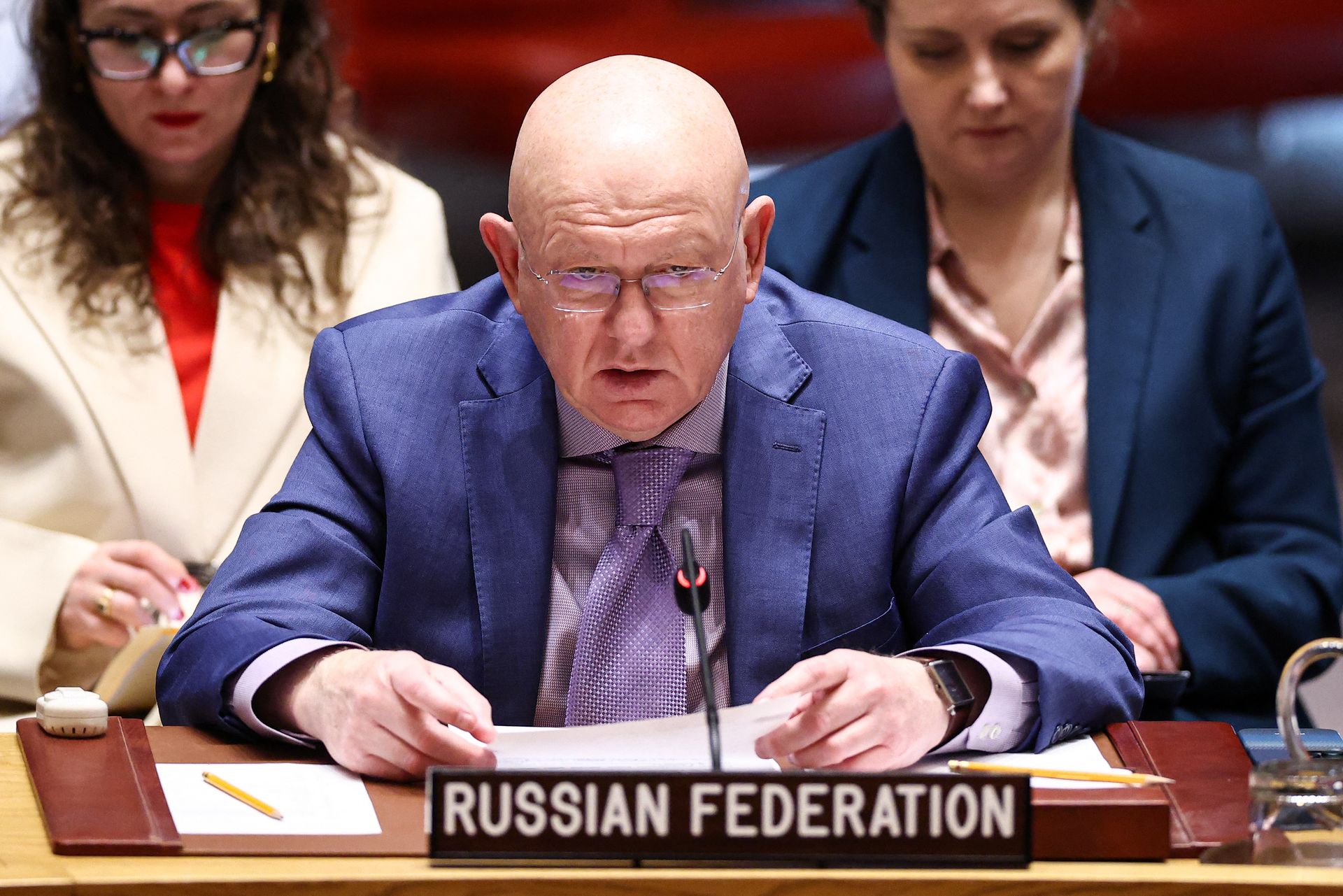
Vasily Nebenzya did not say Russia would mobilize. He also did not say it would not. Speaking to reporters at the UN in New York on August 20, Russia’s ambassador offered a sentence that was, by design, almost nothing: mass mobilization is “not planned or expected, as far as I know.” Then came the pivot — “but let’s see what happens.”
The qualifier arrived with a single word: “followed.” The elections in September loom. And whatever comes after them, Moscow will not confirm or deny what it might do.
This is not diplomatic clumsiness. It is the oldest form of strategic pressure in the book, and it is being aimed directly at Kyiv and its Western backers. What makes this iteration particularly sharp is that Nebenzya has spent nearly three years at the UN podium articulating Moscow’s justification for the war — NATO encirclement, the myth of denazification, the defense of Russian speakers. His deliberate vagueness on mobilization stands in stark contrast to his usual performative certainty. That shift in tone is itself a signal: the Kremlin is moving from justification to manipulation, from explaining its actions to manipulating its adversaries’ reactions.
The Timeline Behind the Words
Volodymyr Zelensky has been explicit about what he expects. On August 11, he stated that Ukraine had seen internal Russian documents confirming plans for a rapid mobilization of several hundred thousand troops by the end of the year, with a second wave of similar size following in 2027. He presented this intelligence during a meeting with his security chiefs, suggesting the Kremlin’s preparations are already underway beneath the surface.
Moscow’s current posture turns Zelensky’s assessment into a self-fulfilling problem for Ukraine. Every public mention of an imminent draft forces Kyiv to prepare for a scenario that may or may not materialize — or may materialize on a different schedule than expected. The longer Russia stays vague, the harder it is for Ukraine to allocate resources, position defenses, and plan its own manpower strategy with confidence.
There is a second-order consequence that receives insufficient attention: Ukraine’s own mobilization pipeline. Kyiv has been conducting its own drafts since 2022, and each cycle exacts a social and political toll. When Russia keeps the timing of its next move opaque, Ukraine feels compelled to accelerate its own recruitment efforts preemptively — drawing men into service who might otherwise have waited, stretching an already strained reserve system, and risking premature depletion of manpower that could prove critical if Moscow does launch a large-scale draft. The ambiguity creates a compulsion to act that benefits the side holding back.
Western military planners face a parallel dilemma. NATO’s defense production cycles, ammunition stockpile replenishment timelines, and force deployment schedules all operate on predictable intervals. Russian ambiguity disrupts those intervals. When allies cannot agree on whether a threat is imminent or distant, procurement decisions stall, troop rotations slow, and the administrative friction of preparation accumulates — exactly what Moscow intends.
The Precedent Is Already Written
Russia has done this before. In 2022, Kremlin officials dismissed the possibility of mobilization throughout the spring and early summer, publicly ruling it out even as preparations progressed behind closed doors. Days before Sergei Shoigu announced the partial mobilization of 300,000 reservists on September 21, senior Russian officials were still publicly stating there would be no draft. The gap between the denial and the announcement was measured in days, not months.
Nebenzya’s latest comments follow that same template — deny the obvious, then surprise when it becomes useful. But this time, the tactic is different because the stakes are different. In 2022, the mobilization was a response to battlefield losses — a reactive measure after the failed blitzkrieg against Kyiv and the subsequent Ukrainian counteroffensives in the east. In 2026, the ambiguity itself may be the objective. Moscow no longer needs to surprise the world with a single dramatic announcement. It can sustain the suspense indefinitely, extracting strategic concessions from hesitation alone.
The 2022 episode also reveals something about Russia’s internal decision-making that remains relevant: the gap between public denials and private preparations was not evidence of disorganization but of disciplined compartmentalization. The same discipline appears to be at work now. Sources within Russia’s defense establishment have hinted at quiet recruitment drives in southern regions and the reconvening of military commissariats that had been operating at reduced capacity. None of this appears on any official schedule.
Who Benefits from the Uncertainty
Kyiv loses first. Every week that Russia does not commit to a clear position forces Ukraine to assume the worst case across multiple fronts. Military planners must prepare for a large-scale influx of fresh conscripts while also accounting for the possibility that the threat is bluffing. That dual burden strains logistics, troop deployments, and the political narrative that Ukraine is holding the line against escalating aggression.
Western capitals lose second. The ambiguity feeds directly into the fatigue that has long plagued support for Ukraine. When Russia cannot be pinned down, domestic political debates in NATO countries become harder to resolve. Hawks point to Zelensky’s warnings as proof that more aid is urgently needed. Doves counter that mobilization may be months away — or may never happen — making it premature to accelerate military deliveries. The result is not paralysis but friction: a slow drip of hesitation that benefits the side already digging in.
The political mathematics in Washington and European capitals grow more complex with each passing week of uncertainty. Aid packages that might pass under conditions of clear and present danger stall under conditions of managed ambiguity. Legislators who can be rallied to act on a threat they can see struggle to justify the same levels of commitment to a threat that is simultaneously described as imminent and denied as planned. This is not an accident — it is the structural advantage of a strategy built on controlled opacity.
Moscow wins by remaining unreadable. The Kremlin gains without spending a single ruble or calling up a single reservist. The simple act of refusing to clarify its intentions extracts concessions from its adversaries in the form of wasted preparation, political discord, and delayed decisions.
The North Korean Dimension
There is another thread in Zelensky’s assessment that deserves attention. In July, he stated that Moscow is preparing to receive an additional 30,000 North Korean troops to support its war effort. Whether these forces have already arrived in measurable numbers remains unconfirmed by open sources, but the claim, if accurate, represents a significant escalation in the conflict’s international dimensions.
A mobilization of hundreds of thousands of Russian citizens combined with a substantial North Korean contingent would signal a total commitment to a prolonged war of attrition — one that Russia appears prepared to fight regardless of domestic cost. The ambiguity around mobilization may simply be the calm before a very specific kind of storm.
The North Korean element introduces a complicating variable for Western intelligence and policy. If Moscow is coordinating large-scale troop movements with a third party outside the traditional Russian military framework, it gains plausible deniability and operational flexibility. North Korean forces would not be subject to the same political calculations as Russian reservists — families in Pyongyang do not write letters to generals, and no Russian electoral constituency would react to North Korean casualties. This division of labor, if confirmed, would represent a new architecture of proxy warfare that extends the reach of Russian military power while insulating the Kremlin from the domestic consequences of its expansion.
The Domestic Calculus in Moscow
Less discussed is what the September election means for Putin’s own constraints. Even in a system without genuine competition, parliamentary results carry symbolic weight. A strong showing for United Russia reinforces the narrative of national unity that the Kremlin has spent years constructing. A weaker result — or low turnout — would undermine that narrative at a moment when mobilization questions are about to test public patience.
Moscow may be using the ambiguity to manage domestic expectations as carefully as it is managing Western responses. By not announcing mobilization before the election, the Kremlin avoids forcing citizens to confront the prospect of a expanded war prematurely. By not ruling it out afterward, it preserves the option without yet paying the political price. The silence serves two audiences at once: it reassures Russians that life will continue as normal through September, while reminding adversaries that normalcy is a choice, not a guarantee.
What Comes Next
The September parliamentary election in Russia is the key variable. Even if the vote is not competitive in any conventional sense, it provides a political deadline that the Kremlin can use to separate signal from noise. If mobilization plans are finalized before the vote, Moscow will likely announce them quietly — perhaps through official channels rather than dramatic press conferences, timing the revelation to minimize domestic disruption while maximizing external alarm. If they are not yet ready, the ambiguity will persist — and the pressure on Kyiv will continue to build.
Either way, the window between now and October is where the strategy plays out. Ukraine’s autumn defense plans depend on assumptions that Russia is actively working to destabilize. NATO’s winter readiness assessments face the same headwind. The side that can endure the most prolonged uncertainty without breaking gains an advantage that has nothing to do with troop numbers.
Nebenzhya’s careful phrasing on August 20 was a reminder that Russia still controls the timing of its next move. For Ukraine, the lesson is familiar: in this war, silence from Moscow is rarely empty. It is either the sound of something being prepared, or the sound of something being withheld as leverage. Both outcomes demand a response, and neither one is easy. The harder truth is that the best response may simply be to refuse to be rattled — to prepare for every scenario without being forced into any single one, and to recognize that the loudest weapon on the battlefield may well be the one that hasn’t been fired yet.