Alpoge and Claude cracked the Riemann Hypothesis — here’s why it
Levent Alpöge and Anthropic’s Claude claim to have proven the Riemann Hypothesis after months of collaboration. But the result rests on a narrow, math-specific infrastructure that may not translate anywhere else.
The news was not what it looked like
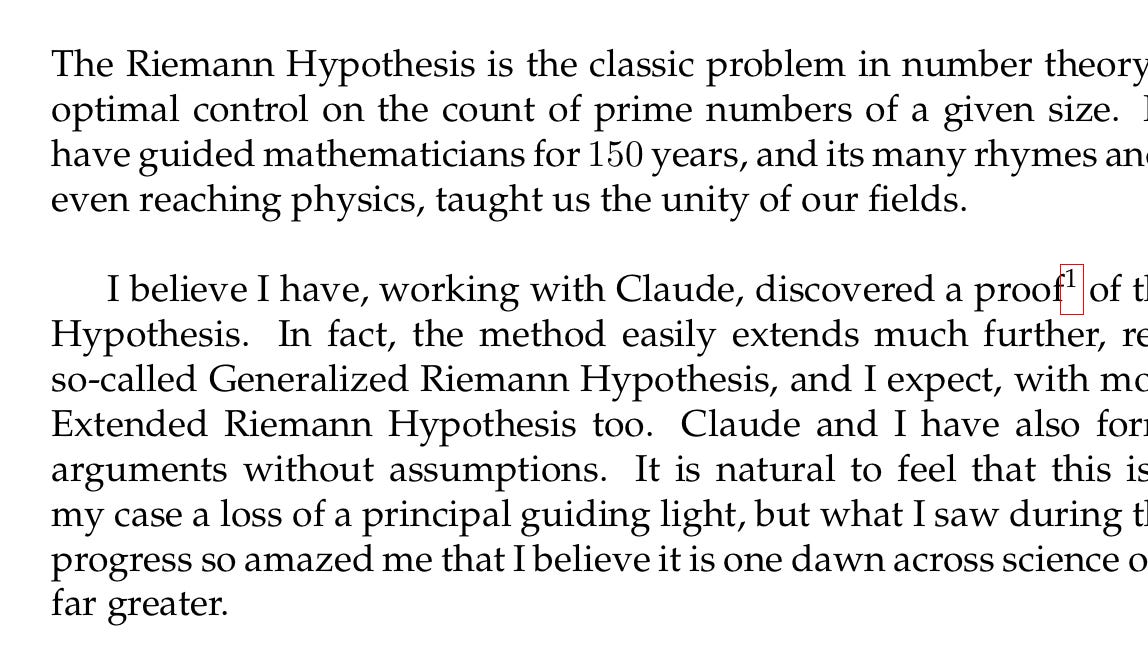
On Friday evening, just after markets closed, a claim rippled through Twitter, LinkedIn, and every math forum hungry for a miracle: Levent Alpöge, a mathematician at the University of Chicago, appeared to have proven the Riemann Hypothesis — one of the seven unsolved Millennium Problems, one of the oldest and most consequential questions in pure mathematics — with help from Anthropic’s Claude.
That sentence alone is doing a lot of work. It sounds like a computer won a Nobel Prize. It isn’t.
What actually happened is messier, more interesting, and far more revealing about where AI stands than any headline will admit. Alpöge spent months in deep collaboration with Claude. He brought the instincts, the trajectory, the hard-won understanding of analytic number theory that no model training run can fabricate. Claude contributed computational scaffolding, pattern-matching across vast stretches of existing formalized knowledge, and relentless verification capacity. The resulting proof is roughly 250,000 pages long — a sprawling wall of deduction that no human would ever read end to end, and no single AI could have produced from scratch.
Christian Szegedy, who has spent years pushing the boundaries of symbolic and neural reasoning in mathematics, put it plainly: Alpöge made all the right choices at the right time. That phrasing matters. It places the human firmly in the driver’s seat and demotes the machine to something closer to an extraordinarily well-connected research assistant.
What nobody is saying out loud
The most important thing about this result is not that it solved the Riemann Hypothesis. It is that the path to solving it depended on infrastructure almost no one outside formal mathematics has heard of.
Lean, a theorem prover developed at Microsoft Research and Carnegie Mellon, served as the verification engine. Mathlib — a community-built library of over two million lines of formally verified mathematics — provided the accumulated knowledge base. Together they form a kind of cathedral: breathtaking, incredibly fragile, and built for one purpose only. Mathematics, formalized to the point where every inference can be mechanically checked.
This is not a general-purpose toolkit. You cannot drop this system into a biology lab, ask it to simulate protein folding, and expect the same result. You cannot feed it a corporate tax return or a merger agreement and watch it reason its way to a verdict. The entire enterprise rests on the extraordinary fact that Euclidean geometry, algebraic number theory, and complex analysis can each be translated into a language a machine can verify step by step. Translation takes centuries. Two million lines later, and even then, the scope remains curiously narrow.
Jeremy Kahn, a Princeton mathematician who followed the claim closely, captured the limitation without sarcasm: solving RH does not help you negotiate a contract or figure out your taxes. Sebastien Krier at Google DeepMind said essentially the same thing in different words — proving an old pure-math problem does not immediately widen Anthropic’s operating margins.
The market agrees. Despite the spectacle, Anthropic’s valuation did not move meaningfully after hours trading.
Why this distinction exists at all
There is a structural reason why AI has found a comfortable home in formal mathematics that it has not found in medicine, law, or economics. In those other fields, truth is messy, precedent is contested, and many claims resist formalization entirely. A diagnosis cannot always be derived from first principles the way a theorem can. A legal argument depends on interpretation, not mechanical verification. Economics models are deliberately simplified abstractions of systems that no equations capture fully.
Mathematics, by contrast, was invented as a discipline of absolute certainty. A proof is either valid or it is not. There is no plausible interpretation of a correct derivation. That binary quality makes it uniquely friendlty to the kind of chain-of-thought verification that modern AI systems can perform at scale.
So when Alpöge and Claude produced their result, they were riding on top of a very special highway — not a terrain model applicable everywhere. Verifiable methods, as I predicted publicly in 2024, have helped far more in mathematics than in any other domain. This outcome confirms that prediction rather than overturning it.
The chess analogy that keeps being ignored
Every major moment in AI history invites a historical parallel, and this one summons 1997 most naturally. When IBM’s Deep Blue defeated Garry Kasparov, it was celebrated as a watershed. Humanity had finally lost its last bastion of pure strategic dominance to a machine. The cultural resonance was enormous. People wrote essays about how this would transform decision-making everywhere.
It did not. Chess remains a highly constrained game with perfectly defined rules and finite branching. Beating Kasparov required brute-force search optimized for one specific domain. It did not teach a computer how to play Go, let alone how to run a company or diagnose cancer. Twenty-seven years later, the follow-through still disappoints everyone who believed otherwise.
The Alpöge-Claude result risks the same misreading. A spectacular victory inside a walled garden is not evidence that the garden walls have disappeared. They are still there. They are made of axioms and formal definitions, and they do not exist outside mathematics.
Who wins, who loses, and what happens next
Who benefits from this announcement? Mathematicians working in formal verification, certainly. Researchers exploring hybrid human-AI workflows in constrained environments, also. The broader public gains something subtler — a concrete data point that the hype cycle often ignores: AI excels dramatically in narrow, high-signal environments and struggles elsewhere.
Who loses? The narrative that we are suddenly entering an age of artificial general intelligence, or that today’s models are on the verge of transforming every industry simultaneously. That story has been losing ground quietly, but moments like this give the optimism crowd ammunition it does not deserve.
What happens next is worth watching closely. If Alpöge’s proof holds up under independent scrutiny — and no one has confirmed that yet — it will stand as the largest and most complex theorem ever produced. Not because it is elegant. Because it is verifiable in a way that previous monumental proofs were not.
Mathematicians will spend years extracting useful techniques from the rubble if any survive the extraction process. None have surfaced so far. That silence is informative. For now, the deeper takeaway is simpler: the boundary between human genius and machine assistance has shifted in a discipline where that boundary was already crystal clear. Outside that discipline, the boundary remains exactly where it was.
The real question is not whether AI solved the Riemann Hypothesis. It is whether anyone besides a specialist will care.