Robot Games Show Sprinting Records and On-Stage Meltdowns
The World Humanoid Robot Games in Beijing paired world-record sprint times with spectacular crashes, revealing a gap between flashy competition and real utility. The less glamorous tasks — laundry, hammering nails, firefighting — tell a more honest story about where robotics actually stands.
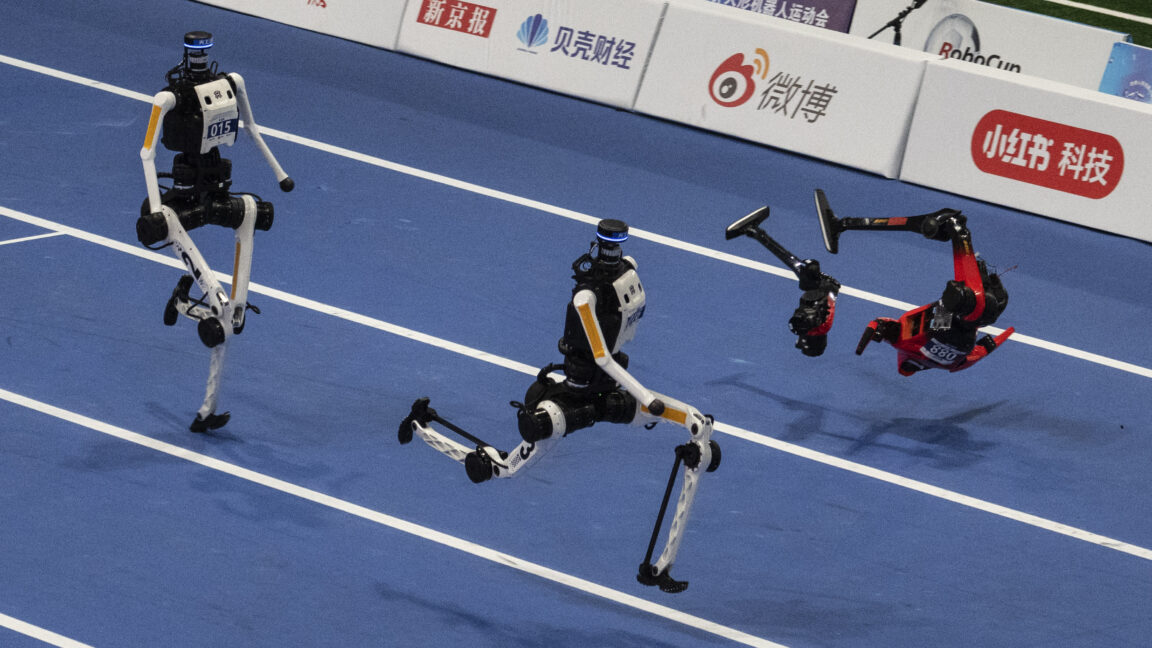
They sprinted faster than Usain Bolt, then couldn’t stop.
At the second World Humanoid Robot Games in Beijing last month, robots crossed the 100-meter finish line at speeds that would make any human track star nervous. A few meters later, they plowed into barriers. Some toppled over. A Honor robot broke at the waist in a shower of sparks. Another burst into flames.
The spectacle was exactly what you’d expect from an event that blends Olympic-style athletics with the current state of robotics engineering: impressive when it works, embarrassingly fragile when it doesn’t.
What made this year’s games — held August 22 to 26 at the National Speed Skating Oval — particularly instructive wasn’t the viral crash footage. It was the contrast between the fast, simple tasks and the slow, messy ones. The robots that blew past human sprint records were engineered for one job. The robots asked to wash laundry, fold clothes, or hammer a nail straight into corkboard looked like they were still learning what a nail was.
That gap is the real story here.
Sprinting is easy. Life isn’t.
Dipam Patel, a PhD candidate in computer science at Purdue University and research assistant at the US Army DevCom Army Research Lab, put it plainly. The robots that dominated the sprinting and high-jump events displayed significant progress in whole-body control — coordinating dozens of joints, limbs, and balance systems to accomplish a narrow, well-defined task. That’s real engineering. But it’s also a parlor trick in the broader sense.
“If you cross the finish line, that’s the goal — it doesn’t matter if you stop and it doesn’t matter if you fall into different pieces,” Patel said.
The robots ran in straight lines. They couldn’t decelerate safely. They couldn’t recover if they stumbled. They were optimized for a single burst of motion in a controlled environment, not for the open-ended, unpredictable demands of actual work.
This isn’t new — it’s the central tension in robotics right now. Every company claiming leadership in humanoid robots has demonstrated something spectacular at a competition or demo day. None of them have demonstrated anything that looks like an eight-hour shift doing varied tasks in a real environment. The algorithmic gap between “move fast in a straight line” and “do whatever needs doing” remains enormous.
The boring events told the truth
This year’s games introduced a new category: practical, household-style challenges. Robots were asked to wash and hang laundry, clean living rooms, move luggage in a hotel, reassemble beds, shelve books in a library, and — in one of the more vivid scenarios — identify hazardous substances, close three different types of valves, locate a fire, find an extinguisher, and put it out within 30 minutes.
Only three out of twelve teams completed the firefighting challenge. The laundry and cleaning tasks were slower than typical human performance. The hammering events exposed fundamental precision problems. These were the events that mattered.
The firefighting exercise, in particular, revealed how far autonomous decision-making still has to go. Identifying a hazard, recognizing three distinct valve types, locating a fire source, and selecting the right extinguisher requires perception, reasoning, and adaptability that no robot at the games demonstrated convincingly.
And here’s the uncomfortable detail: many competitors in these practical events were still being teleoperated by human controllers, penalized but not disqualified. That tells you everything you need to know about where autonomy actually sits.
Reinforcement learning and the simulation trap
One of the more intriguing entries was a robot from Beijing-based X-Humanoid that won the small-group 400-meter race in an odd, arms-up posture that the Global Times described as resembling “a shy person hiding behind their hands.” Its developers said reinforcement learning in simulation had pushed the robot away from a natural arm swing toward this hip-driven, arm-protective gait that happened to be faster.
That’s a genuine result of modern robotic training — algorithms finding counterintuitive solutions that humans wouldn’t design. But it’s also a reminder of how narrow the training domain was. That robot learned to win a 400-meter race. It didn’t learn to live in the world.
Patel flagged the core problem: you can simulate 100,000 scenarios for hammering a nail, but that’s one task out of millions in the real world. Gathering demonstration data — the visual feed of humans performing tasks that AI models now use for training — remains expensive and slow, despite companies paying ordinary people to strap cameras to their heads and go about their routines.
The cloud crutch
There’s another layer to the autonomy problem that didn’t get enough coverage. According to the South China Morning Post, many of the competing robots relied on 5G modules to offload computation to cloud-based “embodied intelligence systems” rather than running AI models on onboard hardware. The robot senses the world, sends the data to a server farm, and receives instructions back.
That’s not autonomy. That’s puppetry with better latency. A real-world deployment — in a factory, a warehouse, a home — can’t guarantee constant 5G connectivity. The robots that can’t think without a phone signal aren’t ready for the jobs investors are betting on.
Where the money is going
Investors poured more than $6 billion into humanoid robot companies in 2025 alone. Chinese firms are moving aggressively, testing and deploying at a pace that has alarmed US policymakers — who have since banned imports of foreign-made robots, including China’s most popular models. Boston Dynamics and Agility Robotics are ramping up their own commercial plans in American warehouses and factories.
The World Humanoid Robot Games is partly a showcase for that investment ecosystem. Spectacular sprint times and dramatic crashes generate headlines. Headlines attract attention. Attention attracts capital. That’s not cynical — it’s how technology ecosystems build momentum.
But the headline numbers obscure the underlying reality. Beating a human sprint record on a flat, measured track is not the same as building a robot that can work a shift. The games proved the former and highlighted the absence of the latter.
What comes next
Patel’s own research points toward a different solution than building better humanoid bodies: software that lets many kinds of robots — not just human-shaped ones — switch between tasks seamlessly. The industry is currently obsessed with the humanoid form factor because it’s visually compelling and arguably versatile. But the most productive robots in operation today come in shapes that have nothing to do with humans.
The next iteration of the World Humanoid Robot Games would be more telling if competitors had to run the same race ten times in a row, or handle an unexpected interruption mid-task, or operate without a 5G connection. Until then, the record times are real but narrow, and the flaming crashes are the honest part of the story.