The RTX 5090 Demands Per-Game Tuning — And That Is a Warning Sign
RTX 5090 owners are finding that a single underclocking profile doesn't stabilize across games. Steel Nomad runs fine while Space Marine 2 crashes every 20 minutes at the same settings — a sign that NVIDIA's speed ambitions may be outpacing silicon reality.
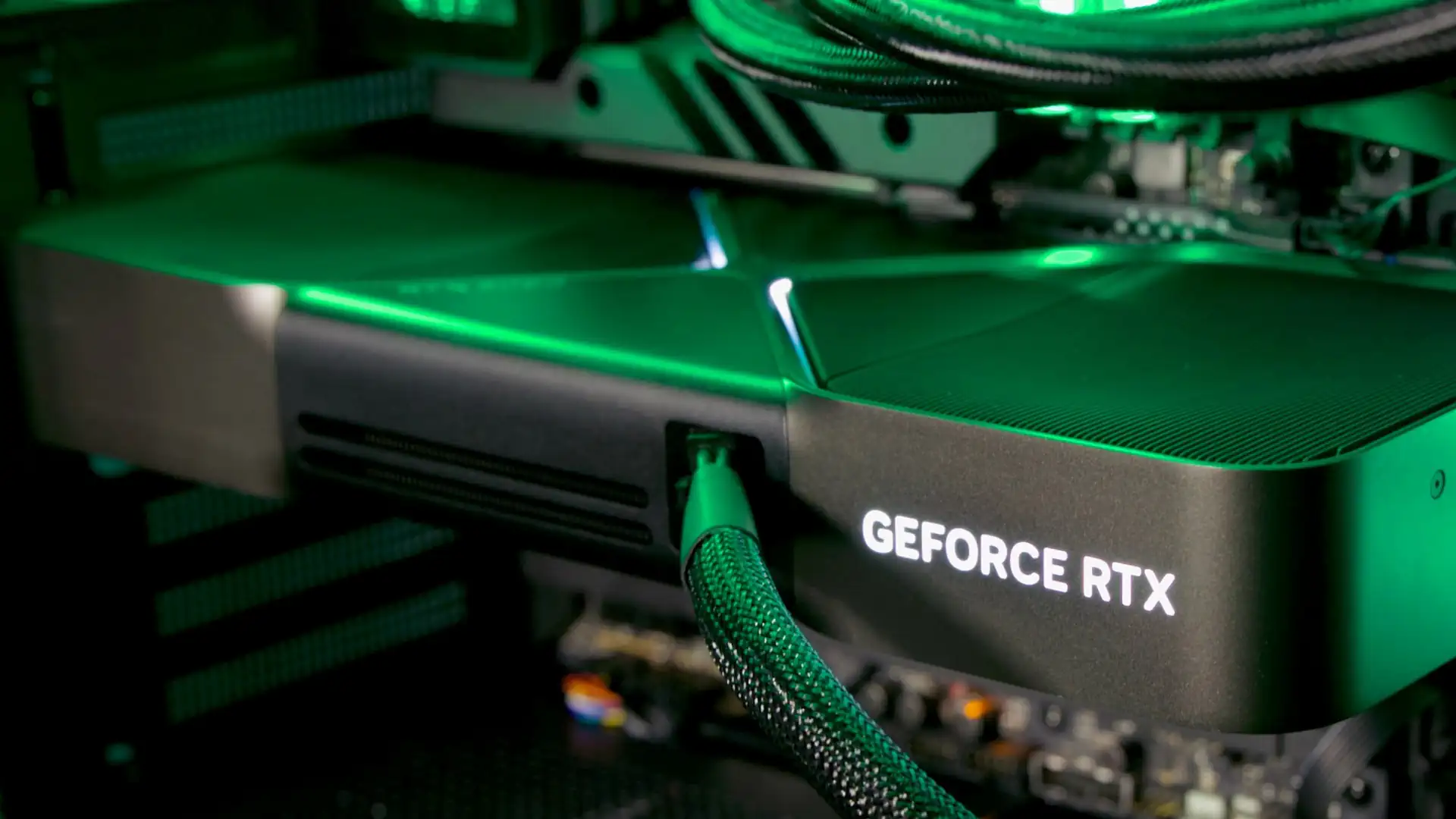
The RTX 5090 Won’t Set It and Forget It
NVIDIA’s flagship GPU arrived with a promise of effortless performance. Early data from South Korean enthusiasts, where benchmarking culture runs deeper and faster than most markets, suggests that promise may not survive first contact with real games.
The GeForce RTX 5090 Founders Edition, running at what should be a conservative 2827 MHz clock and 0.895V — with power limited to 100 percent — scores a respectable 14,671 in the Steel Nomad benchmark. Play Kingdom Come: Deliverance II for 45 minutes under that same profile and everything runs clean. Switch to Warhammer 40,000: Space Marine 2 at 4K with DLSS Quality enabled and the card starts crashing every 20 to 30 minutes.
That is not a driver bug. That is silicon.
The pattern has emerged from scattered forum posts, Discord channels, and independent testing by hardware reviewers who looked past the launch-day hype. Users report that the same voltage-frequency curve that sustains some workloads bails out under others — even when the power draw appears identical on paper. The crashes are not consistent. They do not follow a simple temperature threshold. They appear and disappear based on rendering patterns that vary from game to game, sometimes between different modes within the same title.
The Curve That Doesn’t Fit All Workloads
The same MSI Afterburner voltage-frequency curve that sustains Steel Nomad bails out under Space Marine 2’s more aggressive rendering demands. Gamers are now manually creating separate profiles — raising voltage to 0.91V for some titles, dropping clock to roughly 2650 MHz with 0.885V for others — to keep frame rates stable. One working configuration for Space Marine 2’s Horde mode holds 80 to 100 fps at approximately 450 watts, but that number shifts from game to game. Cyberpunk 2077 with path tracing demands a different balance entirely. Even within a single game, switching between ray-traced and non-ray-traced settings can break a previously stable profile.
The community takeaway, confirmed through testing across multiple cards and PCB variants, is stark: there is no universal underclocking profile for the RTX 5090. Each card’s silicon lottery characteristics and each game’s unique rendering load interact in ways that resist a one-size-fits-all approach. Some cards tolerate tighter curves. Others require more voltage headroom across the board. The variance between individual chips is wider than recent flagship generations, and it is not distributed evenly across clock speeds.
What this means in practice is that the unboxing experience has changed. Instead of plugging in a card and playing, owners are expected to become part-time hardware engineers — mapping voltage curves, testing workloads, and maintaining separate profiles for different games. The manual tuning burden that was supposed to be eliminated by architectural improvements has, in this case, intensified.
Why This Matters Beyond Enthusiast Circuits
A few thousand hobbyist users tweaking voltage curves in a forum thread does not immediately make headlines in Seoul, but it should. The RTX 5090 sits at the top of NVIDIA’s product stack and its behavior sets the tone for how the broader market perceives the Blackwell generation. When the flagship struggles with stability, the entire lineup inherits suspicion.
The immediate implication is practical: early adopters who bought the 5090 expecting a plug-in-and-play experience are now spending time diagnosing per-game stability rather than playing. That frustration compounds in small-form-factor builds, where thermal headroom is thinner and manual tuning is less accessible. SFF builders, already a niche segment, face the steepest penalty here. A compact chassis limits airflow, which limits how aggressively a card can be pushed, which means SFF owners may need even more careful tuning just to avoid thermal throttling on top of the voltage instability.
The second-order implication is market-wide. When flagship GPUs require per-title voltage optimization just to remain stable, it signals that the silicon pushing envelope-popping clocks may be running closer to its thermal and electrical limits than consumers are being told. NVIDIA has long marketed the idea that newer architectures deliver better performance-per-watt with less manual intervention. The RTX 5090’s behavior contradicts that narrative at launch. It raises the question of whether the company is extracting more performance from the Blackwell architecture than the current manufacturing process can reliably support at commercial voltages and temperatures.
There is also a reputational dimension. Flagship GPUs are halo products. They exist partly to validate the entire product stack and justify premium pricing across the range. If the halo requires homework, the halo dimishes — and with it, the perceived value of lower-tier cards that share the same architectural foundations.
What This Reveals About NVIDIA’s Strategy
NVIDIA’s approach to the RTX 50-series has emphasized raw clock speed and AI-driven feature sets like DLSS. The company’s marketing frames Blackwell as a generational leap in efficiency. Yet the need for manual underclock profiles at launch suggests that the architecture’s theoretical efficiency gains have not fully translated into broad real-world stability without user intervention.
This is not unprecedented in GPU history. Flagship cards have always required some calibration. The GTX 1080 Ti demanded attention from early adopters. The RTX 3090 had its own quirks. But the scale of variation across games on a single card — one profile handling Steel Nomad perfectly while failing under Space Marine 2 — points to something more pronounced than typical silicon variance. It suggests that the 5090’s voltage-frequency relationship is unusually sensitive to workload characteristics, and that NVIDIA may have pushed clocks higher than the current power delivery design comfortably supports across all scenarios.
The timing is notable. NVIDIA is competing against AMD’s upcoming RDNA 4 lineup and Intel’s growing presence in discrete graphics. The pressure to deliver generational leaps is intense. Launching with a card that requires manual tuning for basic stability may reflect a product that was rushed to market rather than one that was sufficiently validated across diverse workloads. Alternatively, it may reflect deliberate conservatism in NVIDIA’s own testing — perhaps the company’s benchmarks do not exercise the same rendering paths that Space Marine 2 demands, creating a gap between lab results and real-world performance.
Who Wins and Who Loses
NVIDIA wins the attention cycle. The RTX 5090 generates discussion, debate, and benchmark coverage regardless of whether the tuning problem is widespread. That is how flagship launches operate. Controversy, even negative controversy, keeps the product in the conversation.
Gamers lose time and confidence. The expectation of a premium product working out of the box is not met. Those who lack the patience or knowledge to research and apply per-game adjustments are left with either instability or the decision to undervolt and accept lower clocks than advertised — effectively paying flagship prices for mid-range reliability. The psychological impact is real: owners who spent over a thousand dollars on a card are now expected to diagnose and fix problems that should not exist at launch.
The cooling and power supply industries may indirectly benefit. Users struggling with stock configurations will upgrade PSUs and cooling solutions in search of stability, creating a secondary market around a problem NVIDIA introduced. Third-party coolers, aftermarket thermal pads, and higher-wattage power supplies will see renewed demand from 5090 owners trying to compensate for design shortcomings.
AMD and Intel, meanwhile, watch closely. Any stability concerns around NVIDIA’s flagship create openings for competitors to position their own offerings as more mature or more reliable, even if their raw performance lags.
What Happens Next
NVIDIA typically responds to these issues with driver updates that adjust voltage curves or power delivery logic. If the pattern holds, a patch could reduce the manual tuning burden within a few months. But the fundamental issue — that per-game workload characteristics vary enough to break a single underclock curve — is architectural, not software-level. A driver can nudge the curve; it cannot change how different games load the silicon. A proper resolution would require either a manufacturing binning revision that produces more consistent silicon or a design refresh that addresses the voltage-frequency sensitivity at the architecture level.
For buyers considering the RTX 5090, the practical advice is straightforward: expect to spend time tuning, budget for robust cooling and a quality power supply, and temper expectations about out-of-box stability at maximum clocks. The card’s potential is real, but the path to unlocking it is more work than the price tag suggests. Wait-and-see buyers may find that a six-month delay yields a significantly smoother experience, as both drivers and potential hardware revisions address the instability.
The broader lesson is harder to ignore. NVIDIA has spent years positioning itself as the company that makes high-performance hardware simple. The RTX 5090’s launch behavior suggests that simplicity was aspirational rather than achieved — at least at the very top of the stack. If the flagship cannot deliver a stable experience without manual intervention, the promise of effortless performance rings hollow. And in a market where consumers are increasingly scrutinizing the relationship between price and reliability, that hollowing-out matters beyond the enthusiast community. It shapes how people will view every GPU NVIDIA releases for the foreseeable future.