Russia's Drone Strike Near Poland Wasn't Random — It Was a Message
A Russian drone hit a train carrying Western dignitaries minutes after their motorcade cleared Yahodyn station. The precision suggests calculated escalation designed to test NATO's nerve on its own doorstep.
The Target Wasn’t the Train — It Was the Alliance
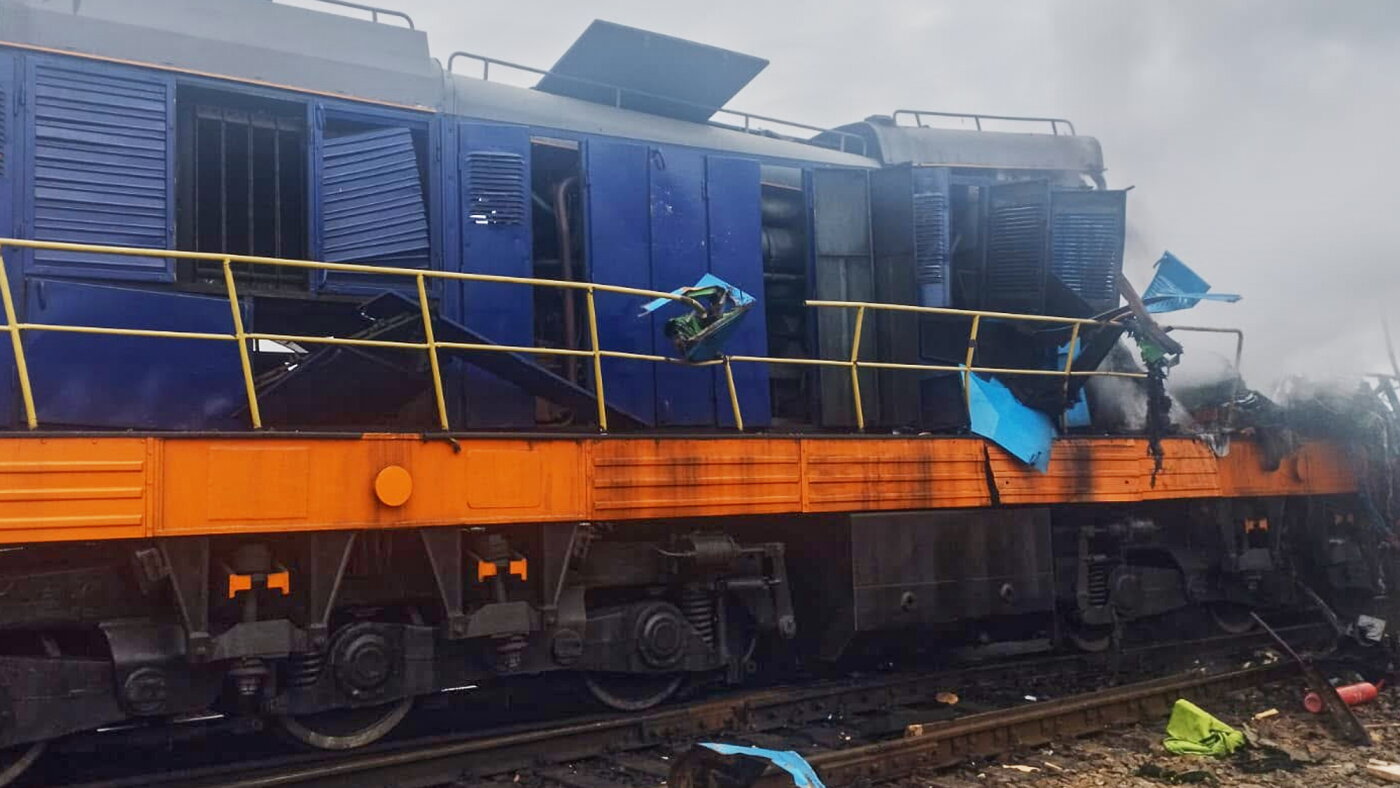
A Russian drone tore through a locomotive at Yahodyn station on Sunday, September 13th, just minutes after a diplomatic train carrying Boris Johnson, Carl Bildt, and EU security advisers had cleared the platform. The timing wasn’t coincidence. The precision was.
Ukrainian state rail operator Ukrzaliznytsia said it was “highly probable” the drone intended to hit the diplomatic train. The visitors had departed early from Kyiv after the Yalta European Strategy conference. Bildt posted video of the strike himself, noting the system worked: “This wasn’t our train, but the one just minutes after us.” Another train on the tracks — carrying former CIA Director David Petraeus — was still at the station when the weapon arrived.
No one died. The evacuation protocols held. But the message behind the drone was unmistakable, and it arrived within yards of Polish territory.
The locomotive struck was not in motion. It sat idle on a siding, unoccupied, a metal husk waiting for its next assignment. That detail matters. It means the operator on the other end of that guidance system had target confirmation — or enough confidence in its reading of the station’s layout to commit a munition to a stationary object minutes away from the European Union’s physical boundary.
Testing the Red Line in Real Time
This was not typical Russian drone behavior. Moscow has struck Ukrainian railways before — routinely, brutally — but rarely this close to a NATO border and never with such apparent calibration. The strike came hours after an earlier drone hit a truck less than a mile from Polish soil, forcing temporary closure of the Yahodyn-Dorohusk crossing.
Two attacks in one day, both probing the same geographic threshold. Both landing in the immediate vicinity of Western officials. Both carefully measured to escalate without triggering Article 5.
The logic is transparent: Moscow is mapping how far it can push NATO’s eastern flank before the alliance breaks. Each drone that lands within a kilometer of Polish territory is a probe, a test of whether Washington and Berlin will respond, and if so, how. The answer from Western capitals has been silence — uncomfortable, reluctant silence.
Johnson captured the absurdity of the moment publicly: “I don’t know what warped logic drove Putin to blow up a stationary Ukrainian locomotive on the Polish border this morning.” What he missed in that characteristically flustered delivery is that the logic wasn’t warped. It was surgical. The target wasn’t a locomotive. It was the illusion of safety around NATO’s borders — the assumption, still partially held in Western capitals, that this war stays contained on Ukrainian soil.
Behind closed doors, NATO officials are reportedly convening emergency consultations on border defense coordination. Leaked fragments suggest Poland has requested accelerated deployment of additional Patriot battery elements along its eastern corridor. Whether those requests translate into visible reinforcement remains uncertain. But the mere fact that Poland is asking — rather than simply absorbing another near-miss — signals a shift in posture that Moscow is clearly tracking.
Who Wins and Who Loses
Moscow wins credibility at home. After months of stalemate, the Kremlin needs victories it can sell to a war-weary public. Striking a train occupied by Western leaders — even accidentally — is the kind of image that circulates in Russian state media as proof of capability and defiance. Analysts at the Moscow-based Center for Analysis of Strategies and Technologies noted that the strike “demonstrates Russia’s ability to project force precisely where it chooses, including areas previously considered outside the conflict zone.”
Ukraine loses nothing materially but gains enormous political exposure. Every strike near the Polish border reinforces the argument Kyiv has made for two years: this war threatens Europe directly, and Europe must act. The problem is that argument has failed to move markets, electorates, or militaries fast enough. Each new incident near the border chips away at the very credibility Kyiv needs preserved — if Western audiences grow numb to border provocation, the moral urgency that underpins continued aid erodes with it.
NATO loses the most — invisibly. Each drone that lands near its borders without consequence makes the alliance’s eastern members feel smaller. Poland, the Baltics, Romania: they see Russia testing thresholds they cannot control, and they see Washington and Brussels watching from safe distance. The psychological toll of living beneath a flight path that has proven willing to cross your border on a technicality is something no press statement can offset.
The Timing Was the Point
Consider what happened right before the strike. Senior Western officials — a former British prime minister, a former Swedish prime minister, a former American general — sat on a train in Kyiv attending a security conference. Their motorcade departed Yahodyn ahead of schedule. Minutes later, the station was hit.
That sequence matters. Either Russian intelligence tracked the diplomatic train in real time and misjudged its timing, or Moscow deliberately struck a station knowing Western figures were passing through and accepted collateral risk. Either scenario is alarming.
If it was the first, Russia is better informed about Western movements in Ukraine than NATO would like to admit. Open-source intelligence trackers quickly noted that the Yalta European Strategy conference had been publicly listed for weeks, and the delegation’s travel itinerary — including rail schedules — was coordinated through official Ukrainian channels. That information, broadly available, may have been all the targeting data Moscow required.
If it was the second, Putin is willing to risk hitting European officials on Ukrainian soil — a dangerous precedent regardless of intent. The distinction between deliberate and incidental in this context is almost academic. The effect is identical: Western leaders now understand that their movements in Ukraine carry a measurable risk of lethal proximity to Russian strikes.
Ukrzaliznytsia confirmed the railway already adjusts schedules constantly to avoid strikes. Trains run at odd hours, routes shift without notice, and passenger manifests are treated as operational security documents. The question is whether that adaptability holds when the Kremlin decides to accelerate and aim higher — not at infrastructure, but at the symbolic weight of who travels it.
Second-Order Effects
The immediate consequences extend beyond the shattered locomotive. Freight operators along the Ukraine-Poland corridor are already reporting requests from shippers for guaranteed departure windows — a concept that didn’t meaningfully exist before Sunday. When private companies begin paying for certainty in a theater defined by uncertainty, the economics of the aid pipeline change. Delivery timelines lengthen. Costs rise. Every delay compounds the logistical bottleneck that already strains Ukraine’s war effort.
Polish border communities, long accustomed to the economic boost of sustained cross-border traffic, face an anxious recalibration. The Yahodyn-Dorohusk crossing handled thousands of freight movements daily before the war. Now each closure — brief as Sunday’s was — sends ripple effects through supply chains that have become vital lifelines. Insurance premiums for logistics firms operating in the region are expected to increase, and some smaller operators may simply withdraw from the corridor altogether, consolidating risk onto larger players who can absorb the cost.
Within NATO, the strike is likely to accelerate debates that have simmered for months about forward air defense positioning. Germany’s recent hesitation to approve long-range air defense systems for Ukrainian territory may face renewed pressure. France is expected to propose a formal review of border protection protocols at the next EU-Canada strategic partnership meeting. The question on every defense ministry desk in Warsaw, Riga, and Bucharest is the same: what does Article 5 look like when the violation is fractional, deniable, and repeatedly reversible?
What Comes Next
Border crossings between Ukraine and Poland will face increased scrutiny. Yahodyn-Dorohusk closed temporarily after Sunday’s truck strike; similar disruptions are likely recurring. Cargo flows into Ukraine — ammunition, humanitarian aid, commercial goods — depend on these routes. Delays hurt both economies.
Western diplomats will return home and debate. Some will call for tighter airspace defense around the Polish border. Others will warn against actions that could be seen as provocative. The tension between those positions will define policy for months. Expect a push for enhanced radar coverage and integrated early-warning systems along the entire Ukraine-NATO border, funded through a combination of bilateral arrangements and NATO cohesion mechanisms.
Russia’s calculus is straightforward: keep pushing until NATO flinches. So far, the flinching has been minimal. That will change. The question is whether it changes before Moscow decides the cost of pushing further is worth accepting.
The drone didn’t miss by much. And it won’t be the last to try. What distinguishes this strike from the dozens that have preceded it is not its violence — it is its geometry. This was an arrow shot from Russian territory that landed so close to NATO soil that the alliance’s members can no longer pretend the conflict has edges. The boundary between Ukraine and Europe, once drawn in ink on maps, is now being redrawn in real time by guided munitions, and every impact point near the border adds a new coordinate to a map that Moscow is clearly learning to read with increasing precision.