Russia’s Hitting What Matters in Ukraine Most Now
A Russian drone strike killed at least 15 people at a shopping center in Zelensky's hometown, with a second wave deliberately targeting rescuers. The attack exposes a new phase in Russia's war strategy and a widening gap in Ukrainian civilian air defense.
The Second Strike Wasn’t an Accident
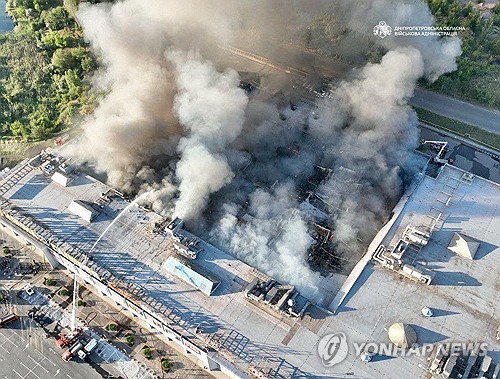
At 4:30 p.m. on August 21, a drone hit the Sun Gallery shopping center in Kryvyi Rih, the Ukrainian city where President Volodymyr Zelensky grew up. Thirty minutes later, a second wave came in low — Shahed-type drones with jet engines, flying below the altitude that most point-defense systems track effectively. By then, firefighters and rescue crews had already deployed. This was not imprecision. It was target selection.
Ukrainian prosecutors confirmed at least 15 dead and more than 130 injured. Twenty-three of the wounded are children. Twenty-nine people, including five children, remain in critical condition. A third of the mall’s total floor area burned.
Zelensky called it terrorism. The International Committee of the Red Cross and UN agencies use that word with more frequency now than at any point since the full-scale invasion began in February 2022.
What happened in Kryvyi Rih is part of a pattern Russia has refined over the last eighteen months: identify soft targets in populated areas, strike them with coordinated drone waves, and follow up once emergency responders converge. The tactic is resource-light for Moscow and devastatingly effective at producing casualties that saturate Ukrainian hospitals and fracture public morale.
Kryvyi Rih Is Not a Military Target. That’s the Point.
Kryvyi Rih sits in Dnipropetrovsk Oblast, roughly 300 kilometers from the front lines in eastern Ukraine. It has been bombed sporadically since 2022, but never with the kind of concentrated, phased intensity displayed this week. The city hosts iron ore processing plants that contribute to Ukraine’s industrial base, which makes it a legitimate secondary target under Russia’s declared logic of economic warfare. But a shopping mall is not an industrial plant. The distinction matters because it reveals a deliberate escalation in what Moscow is willing to strike and where it is willing to draw the line.
Russia’s targeting doctrine has shifted since the early months of the war, when missile strikes focused on energy infrastructure and military logistics. Today, the emphasis is on civilian population centers — not just to destroy, but to demonstrate that nowhere is safe. That psychological dimension is as important as the body count.
The second wave hitting Kryvyi Rih at low altitude is also a technical challenge for Ukrainian defenders. Most of the air defense systems Ukraine has received from Western partners — including NASAMS and Patriot batteries — are optimized for higher-altitude threats and ballistic trajectories. Low-flying drones are harder to detect with standard radar profiles and require interceptors or electronic warfare assets that Ukraine simply does not have in sufficient numbers to cover every city.
Who Wins, Who Loses
Russia wins by forcing Kyiv to choose between dispersing limited air defense resources across dozens of cities or concentrating them in specific zones and accepting attacks elsewhere. Every interceptor launched at a Shahed drone costs roughly $3 to $5 million in combined system and ammunition expenses. The drones themselves cost a fraction of that. The economics favor the attacker.
Ukraine loses because it cannot defend everything. The 21 deaths reported across multiple cities on August 21 — including strikes in Mykolaiv and Kharkiv — show that Russia is spreading its strikes geographically while concentrating them temporally. Multiple cities hit in a single afternoon is a strain no air defense network can absorb without gaps.
The children in that shopping center on Saturday are the most immediate losing side. Twenty-three injured minors. Five in critical condition. Their presence in the casualty figures will dominate coverage, but it also illustrates the operational reality: Russian planners know that malls, schools, and transit hubs draw crowds, and they are targeting those crowds deliberately.
The Western Response Gap
Western governments have spent eighteen months debating what weapons to send Ukraine and in what sequence. The debate has largely focused on fighters, long-range missiles, and air defense systems designed to counter ballistic missiles and cruise missiles at altitude. None of that debate has adequately addressed the problem of low-altitude drone saturation strikes against civilian infrastructure.
The U.S. has begun discussing deployments of additional Patriot batteries and medium-range interceptors, but deployment timelines are measured in months, not days. Europe’s own air defense stocks are thinner still. The U.K. has committed to additional systems, but those systems are optimized for different threat profiles than the ones Russia is currently exploiting.
The real gap is not hardware alone. It is the absence of a coordinated defensive doctrine for soft targets in urban areas. Shelters exist in Kyiv and other cities, but Kryvyi Rih is not Kyiv. The infrastructure for mass civilian sheltering is uneven across Ukraine’s larger cities, and the timing of this attack — a mid-afternoon shopping hour — suggests Russia has learned to exploit the moments when civilian concentration is highest.
What Comes Next
The attack on Kryvyi Rih will harden Western rhetoric. Zelensky’s appeal for international pressure will be echoed in capitals. But rhetoric does not intercept drones.
What changes depends on whether Western governments treat the low-altitude drone threat as a priority matching the urgency they applied to long-range missile defense earlier in the war. It does not. Right now, the policy conversation remains tilted toward offensive capabilities — ATACMS, Storm Shadow, F-16s — while the defensive problem of civilian protection against cheap, swarm-capable drones goes largely unaddressed at the scale the conflict demands.
Russia is adapting faster than the alliance is defending. The second strike on Kryvyi Rih thirty minutes after the first was not improvisation. It was a playbook. And the bodies in that shopping center are what comes next.