Samsung's DX Union Escalates After Rare Public Protest
Some 2,000 Samsung Electronics DX division workers staged a rare public demonstration demanding stock grants and pay parity with the semiconductor division. The union now signals follow-up actions and possible legal challenges — a split that could reshape chaebol labor dynamics.
The Divide Inside Samsung’s Greatest Asset
Samsung Electronics has long operated on an unspoken hierarchy: the semiconductor division writes the checks, and every other division budgets against them. On August 21, that hierarchy stopped being unspoken.
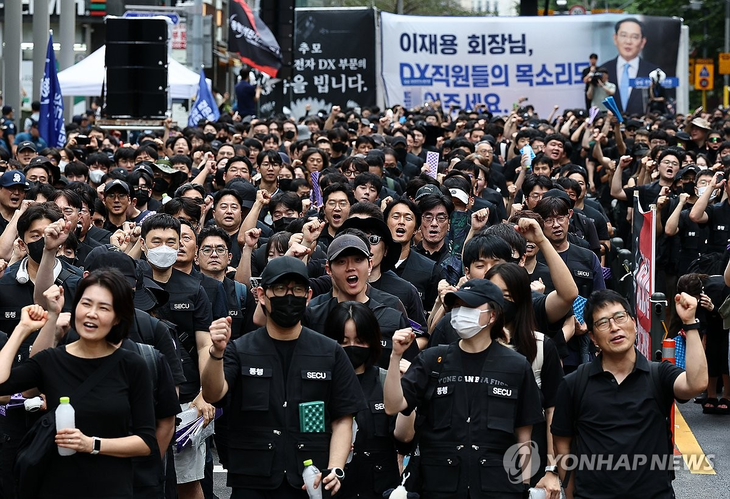
Around 2,000 workers from Samsung’s DX division — the consumer electronics arm that makes home appliances, TVs, and smartphones — gathered outside the company’s Seocho office in central Seoul. They came not to strike but to testify. Their demand was simple and sharp: equalize base salary increases across all divisions, grant each DX worker 1,000 shares of Samsung stock, and create a shared performance bonus pool drawn from company-wide profits rather than division-specific results.
The number of attendees varied by source — police estimated 2,000, the company said 1,800, and union organizers claimed 4,500 — but the symbolism was unmistakable. Samsung’s DX workers, who generate revenue from products consumers recognize but do not drive the company’s profit engine, had publicly declared that the current compensation model was broken.
Why This Is Not Normal
Samsung’s labor landscape has historically avoided the kind of public confrontations seen in other chaebols. The company’s two main unions have operated with a degree of coordination that kept internal rivalries from spilling into open conflict. The initial-level union, dominated by DS (semiconductor) workers, has functioned as the senior negotiating body, setting terms that the DX union typically followed rather than challenged.
That arrangement is now fracturing.
The DX union, known as “Donghaeng” or “Walking Together,” argued that the union representingDX members this year failed to adequately reflect DX interests during wage negotiations. Some workers reported being reassigned to roles unrelated to their positions, adding to job insecurity complaints that ran through the protest. The union is now considering filing a formal complaint alleging that its negotiating representatives violated their duty of fair representation — a procedural escalation that could alter how Samsung’s labor negotiations are conducted going forward.
Meanwhile, the DS-side initial-level union announced it will not form a joint bargaining unit with DX for next year’s wage talks. That decision transforms a compensation dispute into an organizational one. Two divisions, two unions, two negotiating tables.
What Samsung’s DX Workers Are Asking For
The three demands carry specific weight. The request for 1,000 shares per DX employee represents a direct equity stake — a shift from treating workers as salary recipients to treating them as partial owners of the company’s success. The common performance fund would pool a percentage of company-wide results and redistribute them, effectively meaning semiconductor profits help offset consumer electronics weakness. Uniform base salary increases would eliminate the formula that currently allows DS workers to receive larger raises based on divisional profitability.
The union’s argument is that DX’s recent profitability decline stems from management decisions and supply chain failures, not workforce performance. Workers are being asked to absorb the cost through wage restraint and headcount reductions while the division that generated those profits faces no equivalent pressure. That framing —责任错位 — places blame squarely on leadership and redirects it toward the company’s highest decision-makers rather than the floor workers.
Who Wins and Who Loses
If Samsung concedes, the precedent reshapes chaebol compensation everywhere. Other divisions at other companies that feel underweighted relative to their contribution will point to Samsung’s DX workers as proof that collective public pressure can recalibrate internal equity. The semiconductor industry’s traditional model of divisional autonomy over compensation comes under scrutiny.
If Samsung holds firm, it emboldens the DX union’s more confrontational wing and likely accelerates the split with the DS union. The fair representation complaint, even if unresolved, creates a procedural cloud over next year’s negotiations that could delay or complicate wage settlements across the entire company.
The semiconductor supply chain feels this most acutely. Samsung Electronics is not merely a Korean corporation — it is a node in the global memory chip and foundry markets. Any prolonged labor instability at Samsung introduces uncertainty into a supply chain already stretched by geopolitical realignment, capacity investments, and competition from TSMC and SK Hynix. Clients and partners do not advertise labor disputes. They notice them in delivery schedules and pricing.
What Comes Next
Union officials made clear the Seoul protest was not the end point. They are evaluating a follow-up gathering in the Hannam-dong area, a commercially significant district near several corporate and diplomatic offices. Legal proceedings on the fair representation question are expected to begin this month. Samsung has not issued an official response to the demands or the protest itself.
The company is in a position it rarely occupies in Korean labor relations: the public is watching its silence. Every day without a statement extends the space for union momentum to grow and for external observers — investors, regulators, competing firms — to form conclusions about Samsung’s labor posture.
What makes this moment noteworthy is not the size of the crowd or the specificity of the demands. It is the signal that a division once willing to negotiate passively now considers public action a legitimate tool. In Korea’s chaebol system, where labor peace has been enforced as much by cultural norm as by contract, that shift matters more than any single settlement figure.
Samsung’s semiconductor division will continue to fund the company. Its consumer division will continue to brand it. The question now is whether the workers in both divisions will continue to accept that the two realities deserve different compensation structures — or whether the DX protest becomes the opening move in a broader redefinition of what shared success means inside Korea’s largest corporation.