Samsung's Labor Wars Have Gone Global — and Wall Street Should Care
Samsung's DX union has taken its grievance to Times Square after staging protests near the chairman's home. What starts as a compensation dispute is exposing the fault lines in Korea's chaebol model—and the risks global investors have been ignoring.
When a South Korean Labor Dispute Hits Times Square
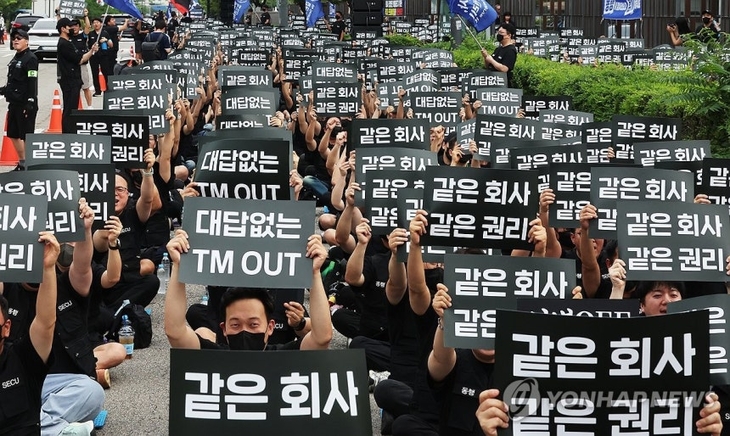
Samsung Electronics’s Device Experience division union has stopped knocking on doors in Seoul. Since September 5, a fifteen-second video has been looping on a digital billboard in Times Square, New York, featuring two messages: “Great products start with people” and “We are still here.” Before that, DX workers picketed outside chairman Lee Jae-yong’s private residence in Yongsan, starting September 18 with no announced end date. Before that, they gathered outside Samsung’s Seocho office tower.
The arc of escalation matters. This is no longer a grievance filed through domestic channels. It is a public campaign designed to reach an audience that includes foreign shareholders, institutional investors, and anyone who tracks Samsung stock from outside Korea.
The Pay Gap That Is Cracking Open
The dispute centers on what Samsung calls “efficiency optimization” as the company pivots toward AI-driven operations. The DX union, known by its Korean name Donghaeng, argues that headcount reductions and productivity mandates are hitting DX workers hardest while DS—the semiconductor division responsible for memory chips and foundry business—is shielded.
DX employees are requesting three concrete measures: 1,000 company shares per worker, a unified compensation fund tied to group-wide performance rather than divisional silos, and identical base salary increase rates applied across all business units. Their demands are structurally simple. Their political calculus is anything but.
Samsung’s internal pay architecture has long rewarded DS handsomely during semiconductor upcycles. DX’s profitability has softened on mobile and appliance demand. Management has treated the two divisions as separate P&Ls. The union is now insisting they cannot remain separate when compensation and job security are on the line.
Why This Matters Beyond Samsung
Samsung accounts for roughly 15 percent of Korea’s total stock market capitalization. It is the single most important equity holding in Korean pension funds and a heavy component in emerging-market index portfolios. When Samsung stumbles, index flows move. That is structural leverage, whether the union intends it or not.
What makes this episode distinctive is not the scale of the company but the direction of the pressure. Labor disputes at Korean conglomerates—known collectively as chaebols—have historically been domestic affairs. Protests at company gates, occasional encampments, mediated settlements behind closed doors. The escalation to an American advertising buy signals that the union believes domestic institutions have failed to provide a hearing.
It also signals that DX workers view global investors as a counterweight to management’s domestic influence. By placing ads in Times Square, the union is appealing directly to the people who own Samsung shares through New York and London and Tokyo. It is an attempt to shift the cost of the dispute.
The Governance Gap That Investors Ignore
Foreign holders of Samsung stock—roughly 30 to 35 percent depending on the measure—have long accepted a trade-off: operational excellence in exchange for thin governance safeguards. Korean chaebols concentrate control through cross-shareholding webs and family leadership. Dissenting stakeholders, including workers, have limited formal influence over strategic decisions.
This labor dispute exposes that imbalance publicly. The union’s move to lease advertising space in Manhattan suggests they consider the boardroom inaccessible and the labor courts too slow. The unresolved nature of the conflict—no termination date set, demands unmet—means the campaign can lengthen, stall, or intensify without external deadlines.
For global investors, the question is whether labor friction at Samsung should affect valuation. For years, the answer was essentially no. ESG scores captured broad categories but did not penalize specific labor conflicts at the single-company level. Index inclusion rules do not adjust for union disputes.
That is beginning to shift. Asset managers with active stewardship programs are asking portfolio companies about workforce planning during AI transitions. A few funds have publicly questioned Samsung’s compensation framework. None have built a scorecard around this yet. But the category exists, and it is growing.
What Happens Next
Samsung management has not issued a detailed public response to the Times Square ad buy as of this writing. The company typically responds to labor disputes through negotiations overseen by Korea’s Labor Relations Commission, a process that can drag for months. The union’s open-ended timeline means there is no near-term resolution horizon built into the campaign.
Three scenarios are plausible. The first is a mediated settlement in which DX receives a targeted share allocation and compensation adjustments without a structural rewrite of the divisional pay system. This is the outcome management prefers and the one most likely to contain the dispute.
The second is escalation. If the union perceives no meaningful engagement, it could expand the campaign—more international advertising, appeals to consumer-facing brand partners, or coordination with DS workers if semiconductor unit grievances surface.
The third is administrative resolution that satisfies neither side. A Labor Commission ruling could impose terms that freeze the status quo while giving management room to continue AI-driven restructuring behind a veneer of compliance.
The Real Takeaway
Samsung’s labor dispute is not a sidebar event. It is a signal that the oldest and largest Korean conglomerate is encountering the same AI-era friction that is reshaping workforces worldwide: automation replacing headcount, divisional profit models fracturing internal solidarity, and workers seeking leverage where institutional channels do not deliver.
The Times Square ad is costly and symbolic. It tells the world that Samsung’s supply chain, its brand, and its governance structure carry risks that are no longer confined to a factory gate in Suwon. Global investors who price Samsung today without accounting for labor volatility are missing a material variable. The union has already made that argument on a digital screen in Manhattan. The question is whether anyone with capital is listening.