Samsung, NVIDIA and the Quiet Times Square Alliance
Samsung's Times Square tribute to Jensen Huang was never just a congratulatory video. It signals a formalizing trilateral AI and chip industrial pact between Seoul, Silicon Valley, and the Korean diaspora—one aimed squarely at outpacing Chinese dominance.
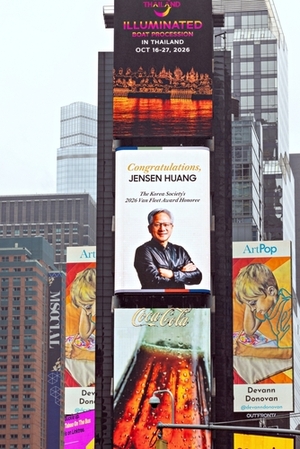
The Screen Was the Message
On October 27 and 28, a video looped on one of the most expensive advertising surfaces on Earth. It congratulated Jensen Huang, NVIDIA’s CEO, on receiving the 2026 Van Fleet Award. The sponsor was Samsung Electronics. Four keywords flashed across the Times Square screens—Pioneer, Architect, Builder, Friend. The language sounded like affection. The calculus behind it was something else entirely.
This was not a spontaneous corporate gesture. It was a signal transmission, aimed at multiple audiences in a single move. To Washington, it confirmed that Seoul’s most powerful industrial firm is structurally aligned with American AI leadership. To Beijing, it mapped a line the alliance will not let China cross. To the Korean public, it reaffirmed a decades-old pact between a chaebol and the United States—one that has now acquired an explicitly technological edge against a shared rival.
The Award No One Is Talking About
The Van Fleet Award is named after General James Van Fleet, commander of the US Eighth Army during the Korean War. It is administered by the Korea Society, a nonprofit based in New York, and annually honors individuals or institutions that advance US-Korea friendship and cooperation. Last time a Samsung figure stood on that stage was 2006, when the late Chairman Lee Kun-hee received the award for his contributions to economic ties between the two countries.
This year, the recipient was a Chinese-born American entrepreneur whose company designs the chips that power the world’s largest AI systems. The symbolism could not be more precise. Samsung and NVIDIA are now being publicly married on a stage dedicated to the institutional memory of the US-Korea alliance. Huang’s citation cited two things: his leadership in AI and accelerated computing, and his role in expanding US-Korea cooperation in AI and semiconductors. The award ceremony was merely the occasion. The real announcement was the Times Square slot itself.
The AI Factory Nobody Saw Coming
The details of what Samsung and NVIDIA are actually building deserve more scrutiny than they are getting. Samsung announced it is merging NVIDIA’s acceleration and digital twin technologies with its own semiconductor manufacturing capabilities to construct an “AI factory.” This is not a software integration project. It is a full-spectrum effort spanning research and development, chip design, and fabrication—essentially embedding AI into every stage of chip production using NVIDIA’s hardware and simulation tools.
The competitive logic is unmistakable. Taiwan Semiconductor Manufacturing Company, the world’s dominant advanced chip foundry, produces both Samsung’s custom AI accelerators and the majority of NVIDIA’s own GPU designs. TSMC is a Taiwanese company operating in a strategic gray zone. Samsung’s AI factory would give it a vertically integrated pathway to design, simulate, and fabricate next-generation chips with less exposure to geopolitical friction. It is, in practical terms, an insurance policy against Taiwan contingency.
For NVIDIA, the partnership locks in a trusted customer for its Hopper and Blackwell architectures at the fab level. For Samsung, it grants first-access engineering credibility that strengthens its bid to become the go-to foundry for AI accelerators outside of Taiwan.
Who Wins, Who Loses
Beijing loses first and most visibly. Chinese chip firms, already constrained by US export controls on advanced manufacturing equipment, now face a tighter coalition designed to exclude them from the frontiers of AI hardware. The US-Korea-NVIDIA axis is not merely a commercial arrangement. It is a containment architecture dressed as industrial cooperation. Huawei and SMIC will feel the pressure in every subsequent generation of AI accelerators that roll out of Samsung’s fabs.
TSMC is the less obvious loser. Samsung’s AI factory model, if it achieves production scale, offers an alternative supply chain for AI chips that currently runs almost exclusively through Taiwan. NVIDIA has already diversified some of its custom silicon orders to Samsung. The trend will accelerate.
Samsung’s domestic rivals, particularly SK Hynix, gain a nuanced advantage. SK Hynix supplies HBM memory to NVIDIA and benefits from the same alliance dynamics, but it does not share the Van Fleet Award spotlight. The public framing of this partnership will draw investment, talent, and policy attention toward Samsung’s broader ecosystem.
The Geopolitical Thread
The Van Fleet Award has always been a diplomatic instrument wrapped in civilian ceremony. General Van Fleet himself commanded American forces during one of the twentieth century’s most consequential proxy conflicts. The award’s founding logic was to cement a wartime alliance into peacetime institutional architecture. Samsung’s decision to broadcast a tribute to NVIDIA’s CEO on Times Square screens places a chip company inside that lineage.
What is remarkable is the speed at which this tripartite alignment has hardened. Samsung and NVIDIA have maintained a commercial relationship for years—memory supply agreements, co-development discussions, joint R&D channels. But the formalization of an AI factory project and the public staging of this award together suggest a shift from opportunistic partnership to structured industrial bloc. The language used in Samsung’s video—Pioneer, Architect, Builder, Friend—maps exactly onto the phases of that consolidation: invention, design, construction, then entrenchment.
The Timeline Ahead
Samsung has not released a production timeline for the AI factory. The Van Fleet Award was presented on October 27. If Samsung follows its historical pattern of committing publicly before securing engineering details, announcements about site selection, capacity targets, and first silicon could arrive within the next twelve to eighteen months.
US policy will almost certainly respond. The Biden-Harris export control framework already restricts certain AI chip sales to China. A visible Samsung-NVIDIA manufacturing partnership inside the United States or allied territories would invite further incentives—tax credits, federal subsidies, or export license fast-tracks—that deepen the alliance’s structural advantages.
Korean policymakers will watch closely. The Moon Jae-in and Yoon Suk Yeol administrations both treated semiconductor self-reliance as a national security priority. This partnership delivers on that ambition without requiring Seoul to rebuild a full foundry ecosystem from scratch. It trades strategic dependence on Taiwan for strategic dependence on NVIDIA architecture.
The Real Story
The English-language press covered the Times Square screen and the award. Few outlets noted what the display was actually performing: the public codification of an industrial alliance that has existed privately for years but now declares itself in the most visible commercial space on the planet. Samsung did not just congratulate Jensen Huang. It staged a monument to a new tripartite order in AI and semiconductors—one that treats the exclusion of Chinese advanced chip capability as a shared objective between Seoul, Washington, and Silicon Valley.
The award will be filed under corporate news. The alliance it marks should be read as something far heavier.