Vietnam is Samsung's Secret HBM Lifeline
Samsung is pouring nearly $3.6 billion into Vietnam for memory chip testing and advanced substrates — not just diversification, but a strategic hedge for its HBM ambitions. What Vietnam demands in return could reshape the deal.
Vietnam Just Became the Least Talked About Player in the Chip War
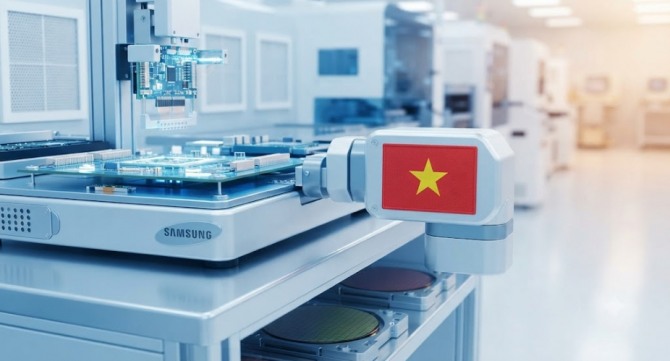
Samsung Electronics and Samsung Electro-Mechanics announced nearly 4.71 trillion won ($3.5 billion) in new investments in Vietnam this week — money aimed squarely at the AI server boom. On paper, this looks like another chapter in the familiar supply-chain diversification script: move operations out of China, build in Southeast Asia, hedge against geopolitics.
But the real story is not that Samsung is diversifying. It is that Samsung is quietly positioning Vietnam as the operational backbone of its high-bandwidth memory strategy — the one part of its AI chip business that faces the most intense competition and the steepest barriers to execution.
The numbers deserve attention. Samsung Electronics is committing roughly 2.2 trillion won to a memory semiconductor inspection facility. Samsung Electro-Mechanics is adding 2.51 trillion won for flip-chip ball grid array — known as FC-BGA — substrate production, the kind of interconnect boards essential for packing HBM stacks into AI accelerators. Together, these investments target the segment of the supply chain where Samsung has the most to lose: the final test and packaging stages that determine whether a chip works before it reaches a customer like Nvidia or AMD.
The HBM Problem Samsung Cannot Solve in Korea Alone
Samsung’s HBM race with SK Hynix is well documented. SK Hynix currently supplies the majority of HBM for Nvidia’s latest GPU generations. Samsung is trying to close the gap, but HBM is unforgiving — a single defect in a 3D-stacked memory chip can scrap an entire module worth thousands of dollars. Testing at scale is therefore not a back-office function. It is a competitive bottleneck.
Vietnam, not Korea, has emerged as the default location for this phase of the value chain. The country already hosts Samsung’s largest non-Korean semiconductor operations, with fabs and R&D centers in Bac Ninh and Thai Nguyen producing smartphone components for years. Adding memory inspection and FC-BGA substrate production extends that ecosystem into a territory where Samsung needs room to scale testing capacity without tying up domestic resources — and where it can keep a step ahead of SK Hynix’s parallel logistics.
This is not a side bet. It is the only way Samsung can run a high-volume, low-yield product category at competitive cost while retaining the option to shift volume quickly between sites.
The Broader Move: Who Else Is Building There
Samsung is not alone, and that matters. Intel is considering an additional $2.6 billion in Vietnamese semiconductor investment. Japanese substrate maker MinebeaMitsui has broken ground on a $500 million FC-BGA plant. The pattern is clear: multinationals are converging on Vietnam for the very same reason Samsung is — proximity to Asian assembly clusters, lower labor costs, and a government eager to convert trade surplus into industrial depth.
Vietnam’s foreign direct investment surged 55.4 percent year on year through August, reaching $40.6 billion. Korean firms now account for 45.3 percent of semiconductor FDI in the country, according to Da Nang-based researcher Go Young-kyung at Yonsei University. The data suggests Vietnam has moved beyond being a low-cost assembly destination into a legitimate node in the advanced packaging and substrate supply chain — exactly the layer where Samsung’s HBM competitiveness will be decided over the next two to three years.
What Vietnam Demands in Return
Here is where the deal gets interesting — and where Samsung may face its hardest test.
Vietnam is no longer satisfied with merely hosting foreign capital. Government officials, including Deputy Director Do Tien Tin of the National Innovation Center and former Finance Ministry official Ngo Chi Long, have publicly urged the country to prioritize projects that bring technology transfer and local supply-chain participation, not just throughput. The message is unambiguous: capital alone does not earn preferential treatment anymore.
In practical terms, this means Samsung will likely face mounting pressure to develop local suppliers for equipment, materials, and sub-component manufacturing within six months to three years — the exact window in which its Vietnamese packaging and substrate lines are coming online. If the company cannot meet rising localization expectations, it risks policy friction that could delay or degrade the economics of the entire Vietnam operation.
The Risk Scenario
The counter-risk is real. If global demand for AI servers softens — as it did briefly in 2024 during a period of inventory correction — Samsung’s Vietnam investments could sit underutilized, and the company would face hard choices about scaling back or accelerating capacity deployment. Infrastructure delays at home could also slow the rollout of the new inspection and substrate lines, creating a mismatch between planned output and actual capability.
Vietnam’s shift from quantity-based to quality-based FDI evaluation means future policy decisions will hinge on how much local supply-chain participation Samsung can demonstrate — not how much money it has committed on paper. That pivot will become the single most important metric for the success of this investment over the next 18 months.
Who Wins, Who Loses
Samsung wins if it can turn Vietnam into a reliable, scalable base for HBM testing and substrate production while simultaneously meeting Vietnam’s technology-transfer demands without sacrificing yield rates or intellectual property controls. The payoff is a supply chain that is harder to disrupt and cheaper to run than a Korea-only model would allow.
SK Hynix loses market share if Samsung’s Vietnamese operations close the HBM yield and capacity gap faster than expected — which is precisely what Samsung is betting on.
Vietnam wins if it converts this investment wave into a durable local semiconductor ecosystem rather than a temporary processing hub. The government has signaled it intends to push for that outcome. Whether it can enforce the terms without driving investors away remains an open question.
The global semiconductor order is fragmenting. Vietnam, not Korea or Taiwan, may end up holding the piece that matters most for the AI era: the ability to test, package, and deliver high-performance memory at scale.