Samsung Workers Demand 1,000 Shares Each as Semiconductor Divide Widens
Samsung's device-division union is splitting from its semiconductor colleagues over compensation, demanding 1,000 shares per employee and a company-wide reward pool — a challenge that could fracture the conglomerate's famously unified labor model.
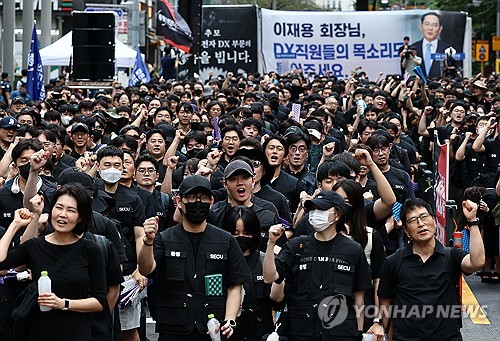
Samsung’s internal cold war is no longer theoretical.
On August 21, about 2,000 to 4,500 workers — estimates varied by source — marched past Samsung’s Seocho office in Seoul, chanting slogans that drew an unmistakable line inside the company: not all hands at Samsung are in the same boat.
The protesters belonged to the DX union, representing employees in home appliances, TVs, smartphones, and related consumer-business divisions. Their demand was concrete and explosive: 1,000 shares of Samsung stock per worker, a company-wide pooling of profits to distribute equally across divisions, and identical base-salary increases regardless of which business unit you worked in.
If fulfilled, the share payout alone would cost Samsung roughly 12 trillion won — roughly $8.5 billion at prevailing rates. That is not a negotiation tactic. That is a restructuring demand wrapped in a rallying cry.
The semiconductor premium is real.
Samsung’s trouble is structural, not accidental. The DS (Device Solutions) division — which makes memory chips, foundry products, and the components underpinning the global AI boom — has enjoyed years of outsized profitability. Memory prices surged through 2023 and 2024. Foundry contracts multiplied. Bonuses and year-end awards in DS scaled with those margins.
DX, meanwhile, has been in a profitability trough. Consumer electronics demand softened. Smartphone competition intensified. Home-appliance margins compressed. The division’s workers watched their colleagues in chip-making receive materially larger payouts while their own compensation stagnated — all while belonging to the same company.
The union’s central argument is straightforward and hard to dismiss: when a single corporate group pockets record profits in one division, the losses in another should not be borne solely by the losers. Instead, the company should create a common fund drawn from a set percentage of total results and redistribute it.
That is a challenge to one of Samsung’s oldest operating conventions: business-unit autonomy over compensation, rewarded performance locally and kept local.
The timing is contested — but the grievance is not new.
Skeptics call this a late move. A collective-bargaining agreement was reached in May, and the union waited months before escalating to public protest. Critics argue that demanding 1,000 shares per employee during a period of DX weakness is financially unrealistic.
Those criticisms miss the point. The grievance predates the May agreement. It accumulated over years of divergence between two halves of the same corporation. The protest is not about renegotiating last spring’s deal; it is about correcting a structural imbalance that the deal did not address.
The union explained the 1,000-share figure by pointing to prior DX windfalls that were redirected into semiconductor investment rather than distributed to workers. In their framing, those reinvested gains built the very chip business that now outperforms DX — and DX employees should share in the payoff.
Whether that framing is economically precise is debatable. Whether it is politically potent is not.
What this means for Samsung’s corporate model.
Samsung’s labor peace has been one of the quiet assumptions behind its reputation as a disciplined, high-performance conglomerate. Unlike many global firms where each business unit runs its own HR and compensation policy, Samsung has historically managed labor through a unified framework — and that framework has kept internal fractures contained.
This protest threatens to change that. If the DX union wins even a partial concession — a common profit pool, harmonized base-salary formulas, or a symbolic share grant — it will establish a precedent that other Samsung affiliates will expect. LG, SK, and Hanwha could face similar demands. The chaebol model of diversified, unit-autonomous operation meets its labor-counterman.
There is also a supply-chain implication. Samsung’s chip business benefits from a reputation for operational stability. Internal disputes that spill into public view can spook customers and investors alike. The more visible the split, the more questions arise about whether Samsung can sustain the coordination that makes its vertically integrated model competitive against TSMC and Intel.
Who wins, who loses, and what happens next.
Management loses first. Any concession sets a cost baseline that will recur. A common fund means DS profits will effectively subsidize DX wages indefinitely, reducing the financial rationale for keeping the two divisions separate. Rejecting the demand risks prolonged industrial action inside a company that cannot afford distractions during a cyclical upswing in semiconductors.
DX workers gain leverage. They have shown they can mobilize thousands, frame a coherent economic argument, and force the question publicly. Even if they fall short of 1,000 shares, a smaller grant or a formal commitment to review inter-division pay would be a meaningful victory.
Semiconductor workers are the silent third party. Their bonuses are tied to chip profits. If those profits are pooled and redistributed, individual payouts shrink — unless the common fund grows faster than the pool itself. That tension will define the next round of bargaining.
The most likely outcome is a partial settlement: a symbolic share distribution, a commitment to review compensation structures, and a delay on the common-fund proposal. But the precedent matters more than the numbers. Samsung’s era of managing internal inequality through silence is over.
The broader signal.
This dispute is not unique to Samsung. It reflects a global pattern: when technology cycles produce asymmetric winners and losers inside the same firm, labor movements will expose the gap. The AI-driven chip boom has amplified that gap at Samsung more than at most competitors because Samsung’s structure makes the contrast so visible — two divisions, one logo.
How Samsung responds will shape Korea’s labor landscape for years. If the company treats this as a one-time adjustment, it will recur. If it builds a new compensation architecture that accounts for intra-group profit divergence, it may set a model that other Korean conglomerates adopt — or fight against.
The march on August 21 was not the end of a cycle. It was the opening move.