Samsung's Most Powerful Union Is Besieging the Chairman's Home
Samsung DX union launching a long-term protest at Chairman Lee Jae-yong's residence over a pay gap with the semiconductor division. The move signals labor's growing leverage inside Korea's largest conglomerate — and a rare direct challenge to the Lee family.
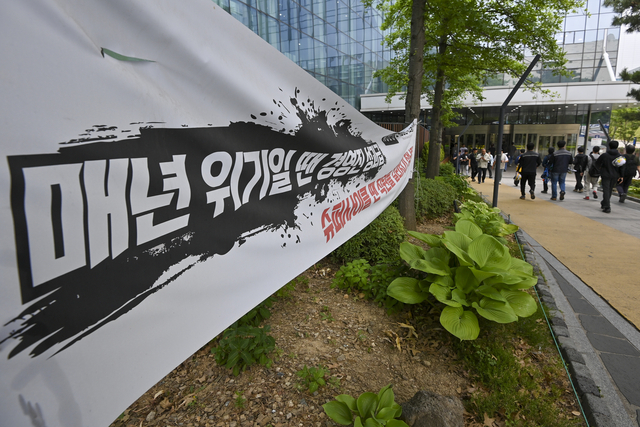
The protest is not at a factory gate. It is at the chairman’s doorstep.
Samsung’s Device Experience union, known in Korean as Donghaeng, announced on June 5 that it will begin a long-term demonstration outside Chairman Lee Jae-yong’s residence in Yongsan District, Seoul. The launch ceremony is set for the 18th. There is no end date. When weather or permits block a group rally, the union will shift to one-person pickets.
This is unusual even for Korea, where labor protests at company buildings are common and often tolerated as a routine part of corporate life. A protest aimed directly at the personal home of the controlling owner — not the executive offices, not the HR division, not a press room — is something else entirely. It is a signal that the DX union believes the problem sits at the top, and that only a confrontation with the Lee family will move it.
The grievance is a numbers game the union says is broken
At the heart of the dispute is a compensation gap between two of Samsung’s biggest divisions. Samsung’s semiconductor business — the Device Solution, or DS, division — and the consumer electronics arm — the Device Experience, or DX, division — negotiated wages separately this spring. The May settlement between Samsung management and the broader union left DX workers feeling sidelined. According to the union, the DS division secured terms that DX did not, despite both being pillars of the same conglomerate.
The union’s demands are specific:
- 1,000 Samsung shares per DX employee
- A company-wide profit-sharing pool funded by a percentage of overall earnings
- A uniform base-pay increase rate applied across all divisions
The first demand is the one drawing the sharpest criticism. Samsung’s DX division has faced margin pressure and revenue volatility in recent years. Industry observers told Yonhap News that granting 1,000 shares per worker in a division under stress is unrealistic — and that the timing, coming after a government-brokered wage agreement was already reached, weakens the union’s moral position.
The union disagrees. On May 21, it held a prior protest near Samsung’s Seocho office building, arguing that DX’s profitability problems are the result of management failure, not worker underperformance. The demand for shares, in this framing, is not a handout — it is a claim of ownership in a company whose fortunes the workers helped build.
Why this matters beyond the pay line
The Donghaeng union is widely regarded as the most influential labor organization within Samsung Electronics. Its membership covers the largest segment of Samsung’s workforce, and its strikes carry outsized economic weight. When Donghaeng moves, Samsung moves. That is why this protest is being watched closely by investors, corporate governance experts, and labor analysts — not just in Korea but internationally.
Three things stand out.
First, the targeting of Lee Jae-yong personally. Samsung’s corporate structure concentrates decisive authority in the chairman’s office. Wage settlements, share allocations, and strategic direction flow through it. By anchoring the protest at Lee’s home rather than a corporate facility, the union is making a calculated statement: the grievance cannot be delegated to an HR director or a labor relations team. It requires the chair’s attention.
Second, the share demand reframes the dispute. A base-pay increase is a cost. A share grant is an ownership argument. If Samsung were to concede even a fraction of the 1,000-share demand, it would establish a precedent that DX workers are entitled to equity participation comparable to their semiconductor colleagues — a shift that could ripple across the wider Samsung ecosystem and other Korean conglomerates where division-level pay disparities fuel similar resentment.
Third, the protest tests Samsung’s post-scandal governance. Lee Jae-yong returned to the company amid one of the most scrutinized leadership transitions in Korean business history. The narrative since has been one of restructuring, merit-based management, and distance from the patronage politics of previous generations. A sustained protest at his residence punctures that narrative. It suggests that behind the rebranding, the power structures that employees experienced before remain intact — and that some workers believe the only way to be heard is to make the chairman’s日常生活 inconvenient.
Who wins, who loses
If Samsung ignores the protest, it risks prolonged disruption and further erosion of morale in a division already facing competitive pressure from Chinese and Taiwanese rivals in smartphones and displays. If it negotiates in good faith, it sets a template for resolving intra-company pay gaps that could stabilize labor relations — at least for now. If it crushes the protest, it risks alienating its largest union and inviting escalation.
The union, for its part, faces its own constraints. A long-term protest at a private residence is legally delicate. The union admitted it has not filed formal rally permits for all planned dates and will fall back to one-person demonstrations where necessary. That flexibility is smart, but it also means the protest lacks the institutional cover of an officially sanctioned assembly. Sustaining momentum over weeks or months is harder than launching one.
What happens next
The immediate question is whether Samsung’s management will engage directly or issue statements through intermediaries. The symbolic choice matters. A meeting between union leaders and the chairman’s office would signal that the protest has shifted the center of gravity. Silence would risk prolonging the confrontation and deepening the divide.
On a broader scale, the Donghaeng protest is a barometer. Korean labor relations have tightened over the past decade, and chaebol unions have rarely staged actions of this visibility against the owner’s family. If this protest gains traction — if it draws support from other Samsung divisions or attracts public sympathy — it could embolden labor movements at Hyundai, LG, and SK Group. If it fizzles, it may reinforce the conventional wisdom that Samsung’s management retains the upper hand.
The shares demand is the dramatic headline. The real story is what the protest represents: a union that no longer accepts division-level pay gaps as inevitable, and a chairman whose home is no longer considered off-limits.
Whether this ends in negotiation or stalemate, the boundary between Samsung’s corporate operations and its owner’s private sphere just shifted.