Semaglutide Slows Aging in Mice — What It Means for Biotech and Policy
A Nature study shows semaglutide extends median lifespan by 12 percent in old female mice and reverses multiple hallmarks of aging. The findings could reshape how investors and regulators value the GLP-1 class beyond obesity.
The question a diabetes drug was not supposed to answer
A paper published in Nature this week asks something most researchers studying semaglutide would consider beside the point. Does the drug slow aging itself, or does it merely extend life by making old mice eat less and carry less fat?
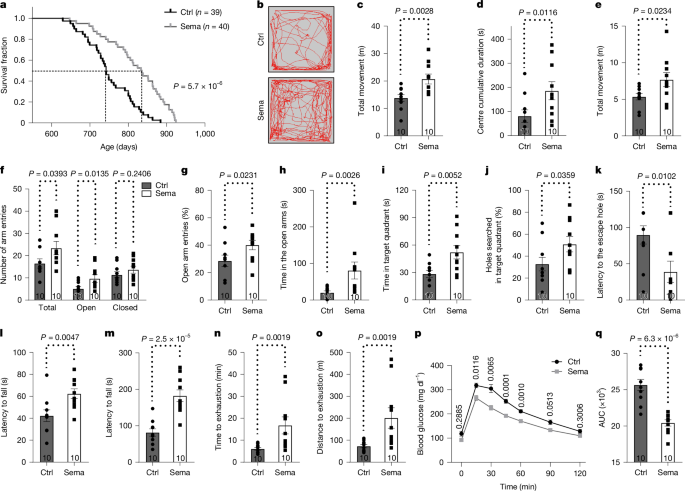
The researchers, led by teams with access to large longitudinal mouse cohorts, gave 20-month-old female C57BL/6 mice daily subcutaneous semaglutide — roughly the equivalent of starting treatment in a human in their late seventies. They tracked the animals for the rest of their lives and ran a parallel three-month cohort for molecular and physiological readouts.
The median lifespan of treated mice was 834 days. The control group died at 742 days. That is a 12 percent extension, well within the variability expected for this strain but statistically robust. Food intake dropped by 24 percent. Body weight fell, mostly as fat mass. Locomotor activity, oxygen consumption, respiratory exchange ratio, and energy expenditure — all adjusted for body weight via ANCOVA — did not differ between groups. In other words, the longevity signal was not simply explained away by lower caloric intake or reduced movement.
The hallmarks that flipped
The study examined every major hallmark of aging defined in the field: stem cell attrition, inflammation, cellular senescence, mitochondrial dysfunction, loss of proteostasis, and genomic instability. Semaglutide moved the needle on each one.
In the bone marrow, phenotypically defined hematopoietic stem cells decreased in number, which sounds paradoxical until you look at function. The remaining cells showed higher per-cell regenerative capacity, larger colony size in CFU assays, and a reduced bias toward myeloid lineage differentiation — a hallmark shift that accompanies immunosenescence. In the dentate gyrus, counts of BrdU-labeled proliferating cells and DCX-positive newly differentiated neurons both rose, indicating renewed neurogenesis in an aged brain region tied to learning and memory.
Inflammation fell across tissues. The percentage of CD68-positive macrophages expressing IL-6 dropped. Ly6Chigh monocytes, precursors to pro-inflammatory macrophages, were reduced. Senescence markers p16 and p21 declined, as did SA-β-gal staining. Gamma-H2AX foci — a readout of DNA double-strand breaks — decreased. Mitochondrial gene expression rose, ATP content increased, and reactive oxygen species fell.
Proteostasis, long considered one of the hardest aging levers to pull, showed measurable improvement. Mitochondrial unfolded protein response chaperones and proteases were upregulated in HSCs and NSCs. Endoplasmic reticulum stress markers, including phosphorylated eIF2α, decreased in the liver.
RNA sequencing of liver tissue mapped the transcriptional shift onto known calorie restriction pathways. Genes suppressed by semaglutide overlapped with those suppressed by dietary restriction — inflammatory response, lipid metabolism. Genes induced by semaglutide mirrored those induced by calorie restriction — adaptive immunity, insulin response, proteostasis. Transcription factor prediction pointed to SIRT1, FOXO1, FOXO3, and SIRT1 downstream targets as central nodes. NAD+ levels rose. IGF-1 fell. The sirtuin family of NAD+-dependent deacetylases was induced. Oser1, a conserved FOXO-regulated longevity gene, was upregulated.
The pattern is unmistakable: semaglutide activates the same genetic circuitry that calorie restriction activates, without requiring the animal to restrict calories voluntarily.
Who wins, who loses, what changes
The immediate winner is the framing of GLP-1 receptor agonists themselves. For years, the clinical narrative has been clean and commercially useful: these drugs treat obesity and type 2 diabetes, with cardiovascular and renal benefits tacked on as secondary endpoints. A longevity indication is messier. It expands the addressable population enormously — essentially every older adult — while introducing regulatory questions that have no precedent.
Novo Nordisk, which markets semaglutide under the brand names Ozempic, Wegovy, and Rybelsus, reported revenue from its glucose metabolism and obesity segment exceeding $25 billion in 2024 and projects it will cross $40 billion annually in the near term. Eli Lilly, with tirzepatide and its own GLP-1/GIP dual agonist pipeline, is running a parallel trajectory. A formally recognized anti-aging indication would not replace the obesity thesis; it would layer a second one on top, potentially justifying higher pricing tiers or separate reimbursement pathways in markets with established health technology assessment frameworks.
The loser, in a commercial sense, is the calorie restriction mimetic industry that has spent two decades chasing compounds that replicate fasting biology without the appetite suppression. If a GLP-1 agonist already does that work, the value proposition of smaller bioteths building stand-alone CRMs — whether they target NAD+ precursors, senolytics, or mTOR inhibitors — narrows considerably. Those assets are not dead, but their differentiation story just got harder.
The regulatory gap
No regulator has approved an anti-aging indication. The FDA treats aging as a natural process, not a disease. The EMA is similarly constrained. Yet the study raises a question that policymakers cannot ignore: if a drug approved for obesity and diabetes demonstrably extends lifespan and delays multiple age-related pathologies, what happens when clinicians prescribe it off-label for longevity? Patients are already doing this. TheNature paper gives them data to cite.
Trials designed to test whether GLP-1 agonists delay age-related disease — not just weight loss — would need new endpoint frameworks. Compression of morbidity, healthspan metrics, and composite age-indicator panels are under active discussion in gerontology circles but lack regulatory standing. Until they gain it, the most likely pathway is indirect: cardiovascular outcome trials and kidney disease trials that happen to enroll older populations and show broader physiological benefit. That is slower than the science suggests it should be.
What the study does not yet answer
The study tested only female mice. Male C57BL/6 mice were not included. Sex differences in GLP-1 signaling and in aging biology are well documented; assuming the results translate directly to males would be premature. The dose and formulation used in mice do not map one-to-one to human regimens. The 20-month-old starting point corresponds roughly to late middle age in humans, but the translation to earlier intervention remains unknown. Whether the effect depends on weight loss alone or on direct GLP-1R signaling in peripheral tissues — the study argues for the latter through its weight-adjusted analyses, but direct mechanistic proof in specific organs was not the focus here.
RNA-seq was performed on liver only. Other tissues, particularly brain and muscle, would likely show complementary signatures but were not profiled at the transcriptome level.
The recalibration
The Nature paper does not change what semaglutide is. It changes what semaglutide could be considered. The drug class has already been repositioned from a niche diabetes therapy to a mainstream obesity treatment. This study pushes the boundary one step further: GLP-1 agonists may also be the first pharmacological intervention with demonstrated lifespan extension in a mammalian model that operates through conserved aging pathways rather than through caloric restriction alone.
Investors who priced the GLP-1 space strictly on obesity prevalence and prescribing volume are now facing a wider ceiling. Policymakers who assumed the regulatory path for anti-aging drugs would run through novel indications are watching a approved drug cross that threshold by implication. Clinicians who framed these compounds solely as metabolic therapies are seeing their patients ask questions they were not trained to answer.
The mice lived longer. Their stems cells worked better. Their brains made new neurons. Their livers silenced inflammatory genes. The data is clean. What comes next — trials, indications, reimbursement decisions, competitive responses — has not been written yet.