Seoul's $10,000 AI Cheating Ring Exposes Credential Crisis
A membership-only Telegram group in Seoul's coaching district is selling AI-powered exam fraud for $10,000 a seat — a market signal that cheating has moved from hardware to subscription model.
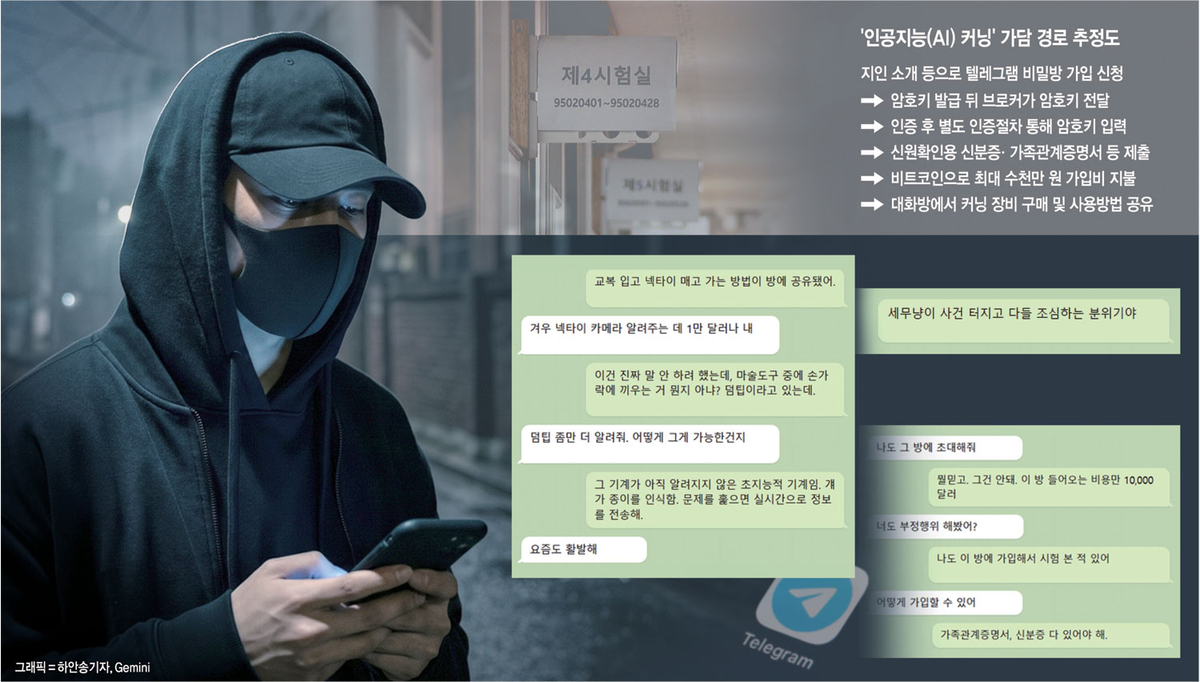
The Membership Fee Was the Warning
In Daechi-dong, the narrow streets of Seoul’s most concentrated tutoring district hide something far more expensive than cram school fees. A Telegram group, invite-only since at least last year, charges roughly 13.4 million won—about 10,000 dollars—just to listen.
That price tag alone tells you what kind of market this is. This is not a desperate kid posting a Craigslist ad for a hidden camera. This is a SaaS subscription model applied to academic fraud: pay for access, receive tools, share methods in private channels, move on.
According to a Munhwa Ilbo investigation, new sign-ups have been restricted since late last year, when AI眼镜 (smart glasses capable of projecting answers) became public knowledge. Prospective members must now produce a separately issued join key and submit a family relationship certificate—not for identity theft, but as a trust mechanism within a community where exposure means ruin.
The requirement makes cold strategic sense. In an underground economy built on silence, verifiable identity is the only collateral.
What They Claim Inside the Group
Members describe a toolkit that goes well beyond pocket cameras. There are tie-shaped video recorders, miniature cameras sewn into clothing, and so-called “dumpup”—silicone finger props used in stage magic. The latter, allegedly, allows someone to scan a test booklet by running a fake fingertip over the page while secretly transmitting images outward in real time.
An AI safety researcher told the paper that such a device would likely rely on textured surface detection or optical character recognition via specialized lighting—technologies that exist in prototype form but whose practical deployment for live exams remains unverified.
Whether every tool described inside the group actually works is less important than what their presence signals: the barrier between sci-fi concept and classroom reality keeps falling.
It Always Works This Way
The pattern stretches back further than anyone wants to admit. In October 2013, five people were fined between 100,000 and 500,000 won for running a TOEIC answering ring that used concealed cameras and Bluetooth earpieces to leak questions to test-takers. In 2023, a Chinese-language instructor who targeted regional TOPIK exam centers with hidden cameras received a 1 year 6 month prison sentence.
Each cycle, authorities respond with tighter surveillance, stronger penalties, more proctor training. Each cycle, the technology moves one step ahead of the enforcement infrastructure.
What makes the current iteration distinct is the pricing model and the sophistication of the value proposition. Previously, cheating rings operated as transactional services—you paid per exam, you got answers. The Telegram group reframes the entire enterprise as ongoing membership: tools, techniques, and insider knowledge distributed continuously. That structural shift mirrors how other shadow economies professionalize over time. When fraud becomes a recurring revenue stream rather than a one-off deal, it invests in R&D.
The Gangnam Detail That Matters
One participant cited an introduction from an acquaintance living in Daechi-dong. That neighborhood detail is not incidental. Daechi-dong houses some of South Korea’s most exclusive and profitable hagwons—private academies where wealth and academic pressure intersect at the highest altitude. Students there do not simply want to pass exams. They want to outperform peers whose families also pay premium rates for premium coaching.
The same ecosystem that produces top university admission rates also sustains markets for advantage-at-any-cost. The cheating ring did not emerge in a vacuum; it grew alongside institutions that treat educational outcomes as commodities and students as consumers competing for finite status goods.
Why This Is Harder to Catch Now
Police officers quoted in the report acknowledged a structural problem: participants in these schemes are themselves lawbreakers. Victims of fraud who paid for fake gadgets or leaked questions face a dilemma. Reporting the crime admits their own involvement. So they stay silent.
Criminals, the officers noted, prefer precisely this kind of soft target. When potential clients cannot safely come forward, scam operators face zero accountability. Fake equipment gets sold with no recourse. Money disappears without a complaint trail. The result is what Korean law enforcement calls a “crime with no victims”—a category that exists because the victim class is legally compromised by design.
This dynamic compounds the secrecy. A membership group requiring household certificates is hard to infiltrate. A community whose members cannot report scams to police is impossible to audit from the outside.
What Comes Next
The immediate implication is reputational damage to South Korea’s high-stakes examination system. But the longer arc matters more globally. Whenever a country treats university admissions as a near-zero-sum competition—where marginal advantages determine life trajectories—it creates fertile ground for AI-augmented circumvention.
Other high-pressure education systems will see similar groups form. China’s gaokao, India’s IIT entrance exams, parts of the U.S. AP and SAT ecosystem already show early signals. The infrastructure is open-source: any student with a smartphone and a Telegram account can become both consumer and distributor.
Institutions can respond with better proctoring, biometric verification, randomized seating, or even AI-driven anomaly detection in testing rooms. All of those measures raise the cost of cheating without eliminating the incentive. Until the incentive—the extreme economic return attached to a single exam score—shifts, the market will keep finding new ways to monetize it.
The 10,000-dollar entrance fee is not just a price. It is a signal that the industry has graduated from opportunistic side-hustles to institutionalized service models. The question now is whether education systems can catch up before the next generation of tools appears inside a private channel no investigator can enter.