Seoul Buys 200 Robots and Sets a New Global Template
South Korea's government is buying 200 humanoid robots for factory floors and nearly doubling its AI budget for 2027. The move is turning Korean robotics stocks up to 30% overnight — and sending a signal to Washington and Beijing.
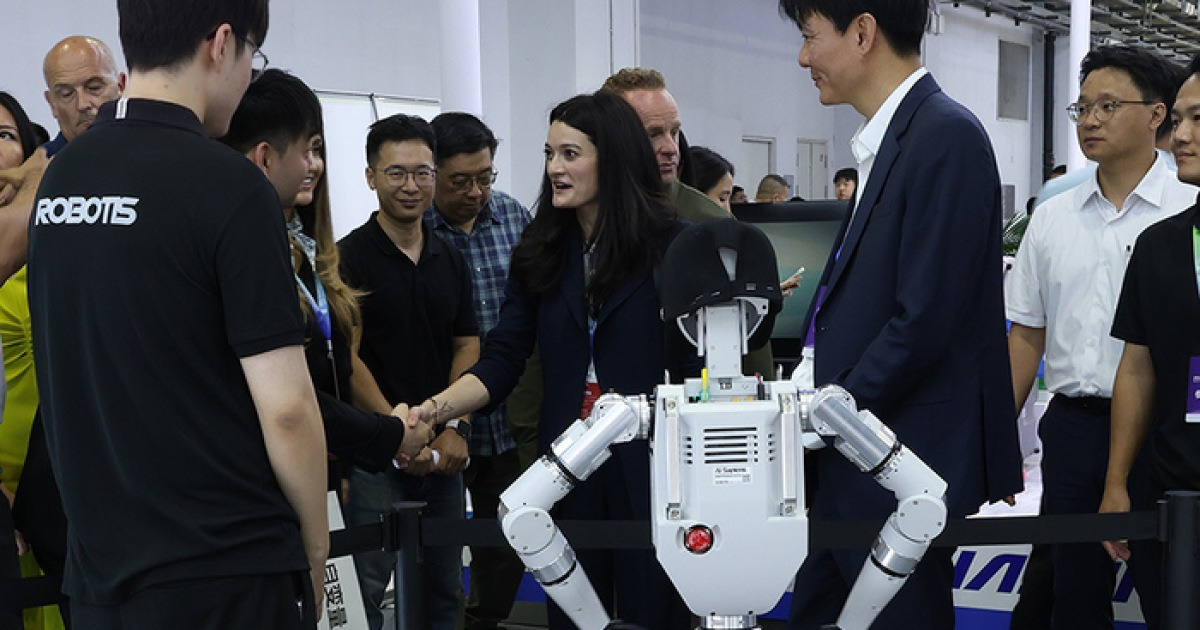
The buyer has arrived.
South Korea is no longer just funding robot research. It is now one of the world’s first governments to place a direct, large-scale order for humanoid machines destined for factory floors. This week the government confirmed it will purchase 200 domestically developed humanoid robots and spend 30 billion won — roughly $20 million — on a public demonstration program to test and validate them in real manufacturing settings.
The market reacted immediately. Wonik Holdings, parent company of Wonik Robotics, surged 29.9% to close at 22,500 won. Robovis jumped 22.5%, HiJin R&M rose 14.4%, and several other robotics names followed. ETFs focused on Korean humanoid robots tracked gains of nearly 9% in a single session.
The significance is not the size of the order. It is what the order represents: a shift from subsidy to demand creation.
From R&D grants to guaranteed buyers
For years, Korea’s robot policy — like much of the world’s — concentrated on research and development funding. The government wrote checks for prototypes, lab testing, and basic research. No one was required to buy the results. That left a classic valley of death between working prototypes and commercial products that could survive in a factory.
The 2027 budget proposal marks a deliberate pivot. Total spending on AI and “three mega projects” will nearly double, rising 97.2% to 21.3 trillion won from 10.8 trillion won this year. Growth-oriented budget lines expand by 22.7%. The money is no longer scattered across general grants. It is aimed at specific infrastructure — semiconductor fabrication bases, physical AI, and energy transition — where demand must be created artificially before a market can form.
The Ministry of Trade, Industry and Energy is allocating 807 billion won for intelligent robot diffusion, up 42.3% from last year. New or expanded programs include 11.9 billion won for autonomous manufacturing in factories, 11.6 billion won for a national manufacturing data library, and 3.7 billion won for ecosystem advancement. The 200-robot public demonstration sits alongside these as the anchor demand driver.
The Ministry of Science and ICT is adding 4 billion won for a physical AI training center and 5.5 billion won for core technology development.
Together, these numbers describe a state that has decided to become the first customer. Not a grant writer. A buyer.
Why the timing matters
The global humanoid-robot market is still in its early commercial phase. Startups and spin-outs from major manufacturers are racing to prove their machines can work outside controlled lab environments. Most are waiting for enterprises to place orders. Enterprises are waiting for evidence. The result is stagnation — a classic coordination problem.
Government procurement breaks that loop. By placing 200 orders and building a demonstration program, Korea is creating the very evidence private buyers need. A robot that has passed government validation and accumulated real-world operational data carries a credibility advantage over a competitor whose machine has only been shown in a trade-show booth.
Yun Sang-yoon, a researcher at Yuhan Investment & Securities, noted that Korean firms will acquire three things simultaneously: initial revenue, reference installations, and the training data needed to improve their systems. Products cleared through government demonstration will also find it easier to enter civilian and overseas markets, he said.
That third point is the geopolitical lever.
The China-America angle
Most analysis of humanoid robots frames the competition as US versus China. Boston Dynamics, Figure AI, Tesla, and Skydio from America; Unitree, Fourier Intelligence, and Xiaomi from China. Korea rarely appears in those conversations.
The procurement shift changes that framing. If the United States continues to restrict Chinese robotics from entering its market, as export controls and investment screening tighten around physical AI and advanced automation, the US will need alternative suppliers. Korea — with a large manufacturing base, deep semiconductor capabilities, and now a government actively subsidizing robot adoption — is positioned to fill part of that gap.
Goldman Sachs recently raised its target price for Robovis to 63,000 won, citing surging demand for the company’s Dynamixel servos — the joint actuators that make humanoid movement possible. Rainbow Robotics, a key partner of Samsung Electronics in humanoid robot development, was also highlighted by analysts as a stock with genuine moat advantages, particularly its ability to develop core components in-house.
Neither company is yet a household name outside Korea. Both may become if the government procurement program produces reliable, validated machines at scale.
Who wins and who loses
The immediate winners are clear: Korean robotics companies, their suppliers, and the domestic component industry that feeds them. Wonik Holdings’ near-30% single-day move illustrates how quickly sentiment can shift when a government signals it will pay for the category it wants to build.
The secondary winners are Korean equipment and materials suppliers tied to semiconductor fabs. Yun noted that the broader fiscal expansion supports early commissioning of Yongin and Pyeongtaek fab sites, which in turn drives infrastructure spending that benefits related companies.
The losers are more abstract. Foreign robot manufacturers that rely on Korea as a growth market will face a government procurement system designed to favor domestic suppliers. The 200-robot demonstration is a closed loop initially — domestic machines tested on Korean floors. That creates a protective ring around the nascent industry while it matures.
American and Chinese firms will watch closely. Both have larger markets and deeper pockets. But Korea is demonstrating something more valuable than subsidies: a template. A government can catalyze an entire industry by becoming the anchor customer. The question is whether Washington and Beijing will respond in kind.
What happens next
The 2027 budget still needs formal legislative approval. Some line items may shrink during the process. But the direction is unmistakable — Korea is moving from supporting robot development to supporting robot deployment.
If the 200-robot demonstration proceeds as planned, the first operational data should begin flowing within 12 to 18 months. Companies that clear that threshold will carry a significant certification advantage into the private sector and into export markets. The Korean government will be able to say, with data, which domestic robots work and which do not.
That kind of proof is worth more than any subsidy. It is the difference between a category that exists on paper and one that generates revenue.