Seoul's Hormuz Tightrope: Why Korea's Waiting Game Matters Globally
South Korea is sending reconnaissance teams to the Strait of Hormuz while carefully avoiding commitments that could trigger Iranian anger or strain its relationship with Washington. The diplomatic precision reveals how much global energy markets now depend on Seoul's calculations.
The Strait That Won’t Let South Korea Look Away
South Korea is doing something unusual for a country located 7,000 kilometers from the Persian Gulf: it is carefully watching the Strait of Hormuz. Not with boots on the ground — yet — but with reconnaissance teams, diplomatic cables, and a level of strategic attention that signals just how central this chokepoint has become to Seoul’s survival calculus.
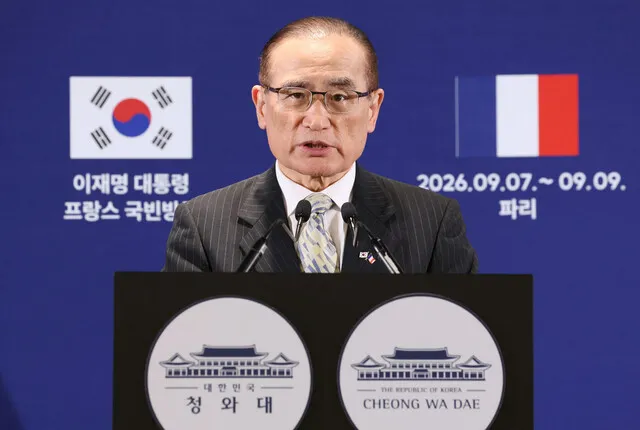
President Lee Jae-myung discussed the Hormuz situation with French President Emmanuel Macron during a state visit to Paris on September 8, according to reports from the Korean media. The conversation covered what both leaders called “international solidarity” on navigation safety in the strait. That phrasing matters enormously. It is the diplomatic equivalent of someone standing at the edge of a pool, testing the water with one toe.
What Actually Happened in Paris
The Blue House was explicit about what did and did not happen. Senior National Security Office Chief Song Wi-saeng held a press briefing after the Lee-Macron meeting and described the outcome as broadening consensus on major issues and discussing strategic cooperation frameworks — language that signals alignment without specifics.
When pressed about whether troop deployment was discussed, a presidential source drew a sharp line: calling the conversation about deployment would be inaccurate. What France and Britain proposed, according to the source, was how to contribute to international solidarity on security and navigation issues in the Hormuz Strait. That is a fundamentally different ask than sending warships or soldiers.
The distinction is not merely semantic. A contribution to “solidarity” could mean logistics support, port access, medical assistance, or intelligence sharing. A troop commitment implies kinetic risk — the possibility of South Korean servicemembers finding themselves under fire in waters where no US ally has operated a combat deployment in decades. Getting the framing right gives Seoul room to maneuver; getting it wrong could lock the country into a course it never intended to follow.
The Reconnaissance Team Is the Story
Here is where it gets interesting. South Korea’s Defense Ministry confirmed it has dispatched a local investigation team to the Hormuz region. The ministry stressed this was for situational awareness — understanding the security environment, assessing risks, gathering intelligence. It is not, the ministry said, a precursor to deployment.
But calling it reconnaissance does not make it neutral. Fact-finding missions in contested waterways are never purely observational. They are political acts. Sending a team to Hormuz signals to Washington that Seoul is paying attention and taking the issue seriously. It signals to Tehran that Korea is monitoring the situation closely — which is exactly what Iran wants it to know, and exactly what gives Iran reason to push back.
The Defense Ministry also denied reports that the United States had set a November deadline for South Korea to commit troops. Calling the reports “not true,” the ministry did not deny that the US had asked — it denied the timeline and the framing. That omission is itself a statement. The fact that the ministry felt the need to address the deadline rumor at all suggests Washington’s pressure is real even if the specific date is not.
Iran Already Noticed
According to the Blue House, Iranian officials reached out after reading media reports about South Korea’s involvement. There was no meaningful response beyond that inquiry, the source said, because Korea’s moves remain at the review stage. But the fact that Iran felt compelled to ask questions at all reveals the pressure Seoul is under from both sides.
Tehran has made its position clear through other channels: any foreign military presence near Iranian waters, especially by a country maintaining significant trade ties with Iran, will be viewed as hostile. South Korea imports roughly 15 percent of its oil through Hormuz. The math is not lost in Tehran.
There is a second-order effect here that Seoul should be weighing. If Iran perceives Korea as drifting toward a US-led coalition structure in the Gulf, it could recalibrate its own commercial calculus — slowing payments, imposing new inspection requirements on Korean vessels, or leaning harder into relationships with China as an alternative energy partner. Korea’s energy import diversification strategy, already a work in progress, would face a new accelerant. Every day the crisis drags on, the risk of Iranian economic retaliation against Korean interests grows.
Why France Is in This Now
Macron’s involvement is not incidental. France has positioned itself as a strategic autonomous power in the Middle East, maintaining relationships with Iran that the US and its Gulf allies cannot easily replicate. A France-Korea dialogue on Hormuz opens a channel that neither Washington nor Seoul controls alone. It also gives Seoul diplomatic cover — if the conversation is framed as European solidarity on navigation safety rather than American coalition-building, it reduces the risk of Iranian escalation while keeping options open with Washington.
This is the kind of multilateral flexibility that small and middle powers need when great power competition squeezes their options. But it is also fragile. France’s own interests in the Gulf are anchored to its nuclear program negotiations with Iran and its commercial relationships with Gulf states. If Washington and Tehran escalate, Paris’s mediating role could fracture, leaving Seoul without its secondary diplomatic backstop just when it needs one most.
Who Wins and Who Loses
If South Korea commits troops to Hormuz, it strengthens the US-led security architecture in the Persian Gulf and deepens its alignment with Washington — but risks Iranian retaliation against Korean commercial interests in the region and potentially domestic political backlash. Korean voters have not forgotten the economic costs of distant deployments, and a Hormuz mission would invite comparisons to Iraq and Afghanistan that Seoul’s leadership would prefer to avoid.
If it refuses entirely, it damages credibility with its most important alliance partner and risks being sidelined in conversations about regional security architecture that will shape the post-Hormuz era. The United States has made clear that burden-sharing is non-negotiable for allies that benefit from American security guarantees. Choosing silence now could mean choosing isolation later.
The reconnaissance team, the careful language, the Macron channel — these are all tools of delay. Delay is a strategy when you do not yet have a strategy. But delay has limits. The US deadline, whatever the exact date, is approaching. And every day Seoul spends deciding is a day the strait grows more dangerous.
The Bigger Picture
The Strait of Hormuz carries roughly 21 million barrels of oil per day — around 20 percent of global consumption. A single incident — a mined channel, a seized tanker, a exchanged salvo — could send energy prices surging and supply chains shuddering. Seoul, as the world’s fourth-largest energy importer, is uniquely exposed. The country’s refineries cannot run without Gulf crude. Its export economy cannot sustain a prolonged disruption.
But exposure is not destiny. South Korea has spent decades building economic resilience through diversification — sources, routes, partnerships. The Hormuz question forces Seoul to ask whether that resilience extends to the security domain. Energy independence without security guarantees is vulnerability in disguise. That is the paradox Korea must resolve, and the reason the world is watching closely.
What Happens Next
The investigation team’s findings will arrive before any decision point. They will shape what Seoul tells Washington and what it tells Tehran. The outcome will signal whether South Korea sees itself primarily as a US alliance partner with global responsibilities or as an energy-dependent middle power that must hedge carefully.
The strait carries roughly 21 million barrels of oil per day — around 20 percent of global consumption. Seoul cannot afford to be unprepared for whatever happens there. But it also cannot afford to be presumptuous. The tightrope is narrow, and the wind is picking up. Whatever Seoul decides, the decision will reverberate far beyond the Korean Peninsula — through energy markets, alliance structures, and the increasingly frayed architecture of Middle East security.