Seoul's Quiet Hormuz Pivot Is the Middle Power Move of the Decade
South Korea is quietly exploring a role in Gulf security without calling it troop deployment — a strategic hedging play as US-Iran tensions escalate and Washington's reliability wavers.
The Word That Matters Most
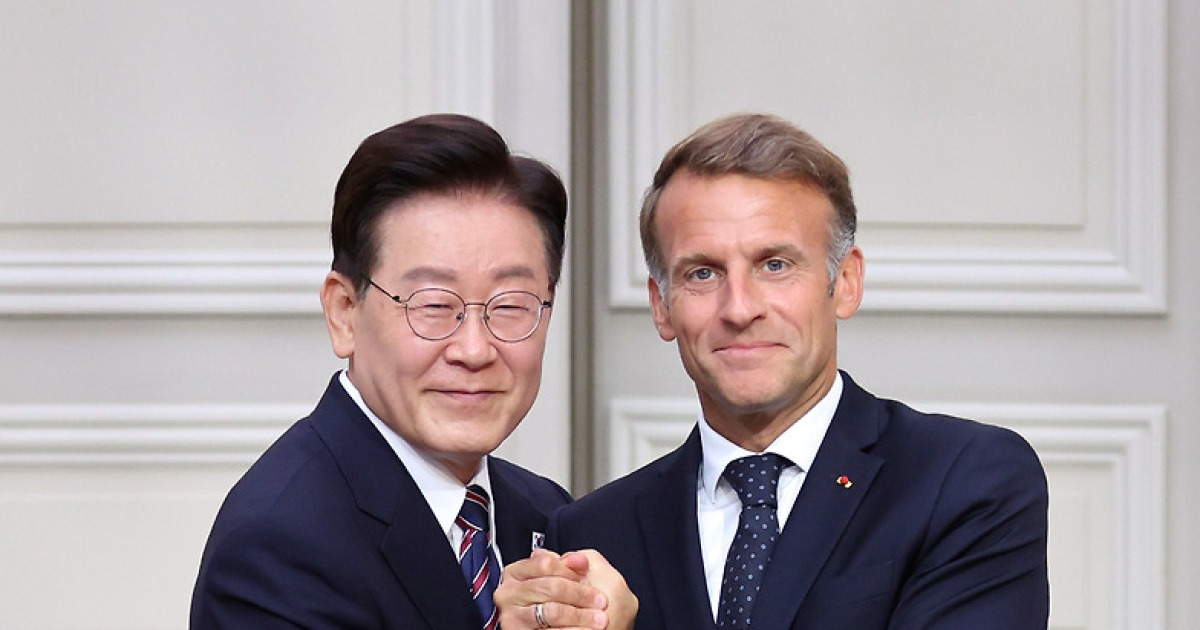
South Korea is walking into a new security role in the Middle East, and it is doing so by refusing to name what it is doing. President Lee Jae-myung discussed the Strait of Hormuz with French President Emmanuel Macron at the Élysée Palace on September 8, but the Blue House immediately and explicitly told reporters not to call it a troop deployment discussion.
That careful deflection is itself the story.
A senior Blue House official told reporters in Paris: “Do not define today’s topic between the two leaders as troop deployment. This is still limited to discussions about how we can participate regarding stable navigation in the Strait of Hormuz, which France and the UK proposed. Viewing it as a discussion about troop deployment would be premature.”
The distinction sounds like legalistic horse-trading. It is not. It is a country trying on a heavier security posture without yet committing to wear it publicly. Seoul is testing whether it can be a Gulf security player while keeping every option open and keeping domestic opponents quiet.
Why Hormuz Now
The Strait of Hormuz is the world’s most critical energy chokepoint. Roughly 21 million barrels of oil pass through it every day — about one-fifth of global petroleum consumption. When tensions between Iran and the United States spike, as they have repeatedly this year, the strait becomes a potential tripwire for a broader regional war.
South Korea imports about 60 percent of its crude from the Persian Gulf. More than half of that flows through Hormuz. The math is not complicated: if Iran blocks or threatens the strait, the South Korean economy faces an immediate shock that no amount of domestic production could absorb.
This is not a new strategic insight for Seoul. But it has always been possible to treat Hormuz as a distant economic risk rather than a security responsibility. The Trump-era tensions with Iran, followed by continued American unpredictability, have made that luxury disappear. Middle powers that once trusted the United States to guarantee sea lanes now face the reality that Washington may prioritize other theaters, or withdraw entirely, at a moment’s notice.
France Leads the Ask
Macron has been pushing the idea of a multinational mission to secure Hormuz for months. He met with the British prime minister to coordinate a joint Franco-British proposal, and is now inviting other resource-dependent states to join. South Korea, Japan, India, and several European nations are all being approached.
Macron’s framing has been deliberate and carefully calibrated. He told reporters after the Lee meeting that “the multinational mission will be peaceful” and that France would cooperate with partners “as relevant consents are obtained.”
The word “peaceful” is doing heavy lifting here. It signals to Pyongyang, Tehran, and domestic audiences in all participating countries that this is not a return to the kind of unilateral naval missions that defined the early 2000s. It also gives Seoul political cover.
Lee himself was blunt about the logic of participation. “The Republic of Korea and France will continue close coordination so that freedom of navigation in the Strait of Hormuz and the stability of global supply chains can be restored as soon as possible,” he said.
Supply chains. Navigation. Coordination. None of those words means warfighting. That is the whole point.
The Domestic Minefield
South Korea’s hesitation is not about strategic clarity. It is about domestic politics.
Any formal troop deployment to the Middle East requires National Assembly approval under South Korean law. That gives opposition parties, especially the conservative right, a powerful veto. But it also gives the ruling party’s own base a reason to rebel.
Progressive and civil society groups in South Korea have already warned that deployment without a clear legal and moral basis would repeat the mistakes of past foreign interventions. There is also a practical fear: Iran has already issued direct threats. On September 7, Iranian officials warned that if South Korea deploys troops to Hormuz, it would “lead to serious consequences.”
That warning is not abstract. Iran conducted a major missile drill earlier this year that explicitly targeted South Korean infrastructure. Tehran has long maintained a shadow network of proxies across the Middle East and could plausibly retaliate against South Korean interests there — ships, citizens, energy facilities — without crossing the threshold that would trigger a formal act of war.
The ruling People Power Party is not united on this either. Several members have argued against deployment on the grounds that South Korea has no direct security stake in the Gulf, that entanglement would draw it into conflicts it cannot win, and that the diplomatic cost at home would be severe. The president’s office is clearly listening.
The Reconnaissance Mission Complication
The complication deepened on the same day as the Lee-Macron meeting. South Korea’s Ministry of National Defense announced it was sending a fact-finding delegation to the United Arab Emirates to assess the regional security situation.
The government immediately tried to contain the interpretation. “This is not a prerequisite for troop deployment,” a defense ministry official said. “It is part of the deliberation process.”
But fact-finding missions to the Gulf are not routine. They are the first visible step in a deployment pipeline. The fact that Seoul is taking this step — even while denying the destination — suggests the leadership is moving forward incrementally, building a factual and political case before any formal decision.
Iran apparently noticed. The Blue House confirmed that Iranian officials had reached out through media reports, asking Seoul directly about its intentions. Korean diplomats responded, as expected, with ambiguity: “We are considering it. Nothing has been decided.”
That is the standard language of a government that has decided to decide later.
The Bigger Picture: Middle Power Hedging
What is happening in Seoul is not unique. Japan is pursuing a similar recalibration, increasing its naval presence in the Indian Ocean and Red Sea while carefully avoiding the language of military alliance. India is expanding its maritime footprint in the Gulf. Germany has sent frigates to the region under the banner of “freedom of navigation.”
All of these countries share the same structural problem: their economies depend on Gulf energy, but their security architecture does not. The United States remains the anchor of regional stability, but its commitment is increasingly conditional and unpredictable. European powers are willing to talk about shared burdens but lack the strategic depth to act alone. And the Gulf states — particularly Saudi Arabia and the UAE — are happy to host foreign ships but reluctant to provoke Iran into open conflict.
South Korea’s approach illustrates the narrow window middle powers now occupy. They can engage enough to signal relevance without crossing the line that triggers escalation. They can build partnerships with France and Britain without anchoring themselves to American strategy. They can explore military options without committing to them.
The Strait of Hormuz is where that balancing act becomes existential. The strait is narrow — at its tightest point, only about 21 nautical miles wide. A single successful blockade could choke off the energy supply to the three most export-dependent economies in East Asia. Seoul cannot afford to wait until the crisis is upon it to decide what to do.
Who Wins, Who Loses
If South Korea joins a multinational Hormuz mission, it gains leverage with Washington and Brussels, strengthens ties with Gulf states, and establishes itself as a responsible security actor. It also acquires a target. Iranian retaliation against Korean shipping or citizens in the region would be predictable and costly.
If Seoul stays out, it preserves domestic unity and avoids provoking Tehran — but it also cedes influence over the very waterway its economy depends on. It signals to allies that economic interdependence does not translate into security commitment. And it leaves a vacuum that China, which already maintains a naval base in Djibouti and has energy ties with Iran, is eager to fill.
The Chinese angle matters more than Seoul admits. Beijing has been courting Saudi Arabia and Iran simultaneously, positioning itself as the neutral broker of Middle Eastern energy. Every month South Korea hesitates is a month China deepens its diplomatic and commercial leverage in the Gulf. The strait is not just an energy route. It is a arena of great power competition, and middle powers that refuse to choose sides still get chosen.
What Happens Next
Nothing is decided. The Blue House made that explicit. But the direction of travel is clear: South Korea is moving from observer to participant in Gulf security, doing so in small, deniable increments that avoid triggering political or military consequences until the coalition is already forming around it.
The National Assembly will eventually have to vote. Civil society will mobilize. Iran will issue more warnings. The United States will demand more from its allies and give less in return. France and Britain will keep inviting countries to what they call a “peaceful” mission.
The question is not whether South Korea ends up involved in some form. The question is whether it enters the Gulf on its own terms or on someone else’s. The current hesitation suggests the government is trying to preserve that option as long as possible. But hesitation itself is a decision, and the Strait of Hormuz does not wait.