Seoul's Quiet Pivot: Why Korea's Maritime Redraw Matters Beyond the Middle East
President Lee Jae-myung drew a sharp line against war deployment to the Middle East—while quietly opening the door to expanding a naval task force already operating in contested waters. The distinction is everything.
The Line Between Not Fighting and Fighting
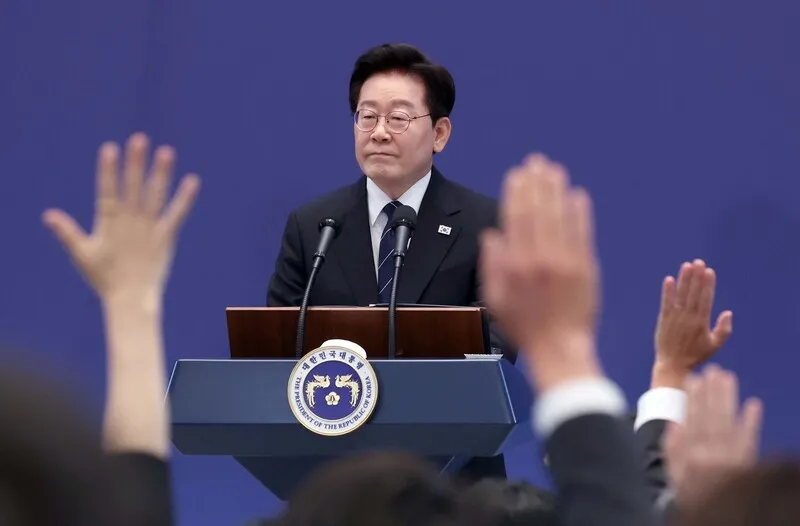
President Lee Jae-myung made one sentence deliberately clear during his September 18 press conference: South Korea will not deploy troops for war involvement or intervention in the Middle East. He repeated the phrase, almost insisting on it. But the sentence that followed was where the real story lived.
“We are reviewing and deliberating whether to strengthen” the Cheonghae Unit, a naval task force already deployed to the Gulf of Aden for anti-piracy and shipping-lane protection duties.
The gap between those two positions is narrower than it appears on paper. The Cheonghae Unit operates in waters that overlap with active military zones. The Red Sea and Gulf of Aden are where Houthi forces have been striking commercial vessels. Strengthening a naval presence there—adding ships, weapons, personnel—is not the same as joining a war. But in practice, it moves closer to the line every day.
Why the Redrawing Matters
South Korea imports over 90 percent of its crude oil through the Strait of Hormuz and the Red Sea. A single disruption in those chokepoints would send shockwaves through an economy that runs on imported energy. That dependency is the structural reality behind Lee’s calculus. When he said, “giving up oil transport over low-level risk would deal too heavy a blow to the Korean economy,” he was stating a dry economic fact that simultaneously justifies an escalatory military posture.
But the consequences of disruption go deeper than oil. Korean ports process enormous volumes of containerized cargo bound for and from the Middle East. Port operations in Busan and Incheon employ tens of thousands directly and indirectly. Insurance premiums for vessels transiting the Bab el-Mandeb strait have already climbed sharply since Houthi attacks accelerated in 2024. Those costs are passed down supply chains—into the price of electronics, automotive parts, and industrial materials that flow through Korean manufacturing hubs. An expanded naval presence is as much about protecting industrial logistics as it is about keeping fuel tanks full.
The president also ordered reviews of Red Sea access—without committing to a decision. That deliberate ambiguity is itself a signal. It means the government is preparing contingencies while buying political time. Neither option—deploy or don’t deploy—has been closed.
What changed is the framing. For years, Seoul’s official position was crisp: no participation in Middle East conflicts. The Cheonghae Unit’s original mandate, launched in 2009, was strictly anti-piracy. Now, the government is openly debating whether that mandate should broaden into what amounts to a wartime-era maritime protection role. The policy isn’t shifting overnight. But the direction is visible if you’re paying attention.
Who Is Being Reassured—and Who Isn’t
The press conference was structured as damage control. Domestically, Korean public opinion is deeply skeptical of overseas military deployments. Lee explicitly acknowledged the concern: “I think our citizens are worried because the boundary might become unclear.” The president’s language was crafted to separate the current operation from any perception of escalation. But the audience matters. International readers—particularly Washington and Tokyo—will hear the same words and register a different signal.
Washington has been pressing allied nations to contribute to Red Sea and Gulf security arrangements. Tokyo has quietly expanded its own maritime posture in recent years. Seoul’s clarification lands somewhere between refusal and accommodation. It tells allies that Korea will not join a combat coalition, but it also tells them that Korea is taking the threat seriously enough to expand its naval footprint. That distinction is intentional. It preserves diplomatic flexibility while avoiding the appearance of free-riding on allied security efforts.
The second-order effect is harder to quantify but potentially more consequential. If Seoul normalizes an expanded naval role in the Middle East without a formal combat mandate, it sets a template other middle-power states could follow. Japan, Australia, and India all navigate similar tensions between economic dependence on Middle Eastern energy and reluctance to be drawn into regional conflicts. A Korean model of calibrated ambiguity—enough presence to signal commitment, enough deniability to dodge escalation—could become a quiet standard for non-great-power maritime security participation. That shifts the architecture of alliance politics in ways that extend well beyond the Red Sea.
The Blurry Line Ahead
Here is what English-language coverage has mostly missed: the Cheonghae Unit’s mandate is already being tested. Yemeni rebel activity has intensified shipping difficulties, and Lee himself noted “many elements requiring moment-by-moment judgment and decisions.” Every intercepted vessel, every close encounter, every decision to escort or not escort becomes a de facto policy determination. The government is preparing for exactly that scenario—gray-zone operations where the line between defensive posture and combat involvement dissolves in real time.
The risk is that Seoul finds itself in waters—literally and figuratively—without a clear exit strategy. An expanded Cheonghae deployment could draw the unit into incidents that force a binary choice: escalate or withdraw. Either outcome carries domestic political costs. Withdrawal looks like capitulation to hawks. Escalation looks like recklessness to skeptics. The government’s current ambiguity shields it from both critiques—but only as long as nothing forces a decision.
There is also a domestic political dimension that deserves attention. Lee’s standing within his own party and among the broader progressive base depends on maintaining the no-war posture. But if a Korean-flagged vessel is struck or a Cheonghae ship comes under fire, the political math changes instantly. Public sympathy tends to favor a military response after attacks on national assets, regardless of how the deployment was originally justified. The president has effectively boxed himself into a corner where any incident could unwind the careful language he deployed on September 18.
What Comes Next
Watch for three indicators over the coming months. First, whether the cabinet formally approves additional ships or personnel for the Cheonghae mission—a procedural step that would signal the expansion has moved past deliberation. Second, whether Seoul coordinates with U.S. or Japanese naval operations in the region, which would reveal whether the expansion carries an allied dimension or remains unilaterally Korean. Third, whether any commercial shipping incident involving Korean assets triggers an emergency session, which would expose how far the current ambiguity can stretch before it fractures under pressure.
The president’s declaration that there will be no war deployment is not a permanent commitment. It is a current posture. The fact that it needed to be restated so emphatically suggests that the pressure to do more is already building—and that the government is struggling to hold the line. Seoul is walking a narrow channel, and the water is getting rougher by the week. How long the distinction between defense and involvement holds depends less on policy documents than on events that no one in the Blue House can control.