Seoul's Stealth Export Play: KF-21 and the Fight for the Global Fighter Market
South Korea is pairing its KF-21 fighter with an indigenous long-range missile — a move that transforms the aircraft from a domestic project into a competitive export platform. Hanwha Aerospace and KAI's latest MOU signals Seoul's ambition to break into a market dominated by Washington, Paris, and Israel.
The deal nobody is shouting about
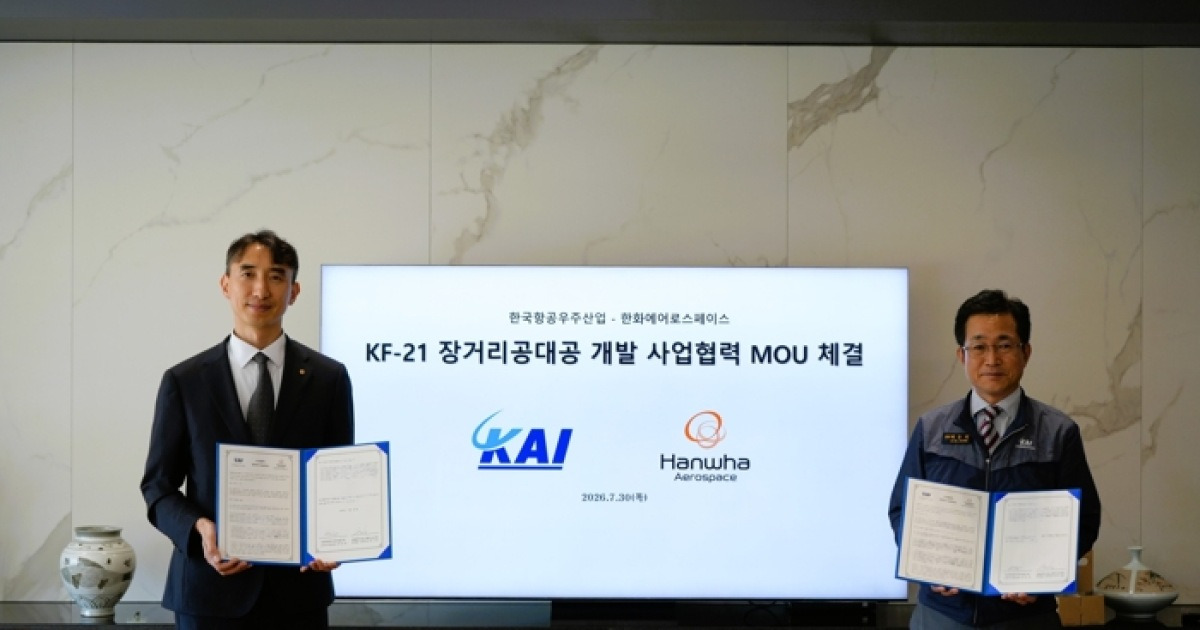
On September 23, Hanwha Aerospace and Korea Aerospace Industries (KAI) signed a memorandum of understanding in Sangju to deepen cooperation on integrating a domestically developed long-range air-to-air missile onto the KF-21 Boramae fighter. The ceremony was quiet. There were no prime ministers in attendance, no foreign delegations, no fanfare at a major arms show.
But the agreement quietly represents the most important step yet in South Korea’s attempt to become a global fighter jet exporter — a club that currently admits only the United States, France, and, to some degree, Israel.
For years, Seoul’s defense narrative was simple: buy American, assemble locally, sell regionally. The KF-21 program changed that script. Co-developed with Indonesia, the fighter was always intended to eventually stand on its own. What took shape on September 23 is the moment that intention became industrial policy.
Why the missile matters more than the airframe
A fighter jet without indigenous weapons is a platform in search of a soul. It can fly, it can fight — but every trigger pull depends on someone else’s supply chain. The KF-21 has been flying on borrowed ordinance since its initial operational capability, relying primarily on the European-made MBDA Meteor beyond-visual-range missile and American joint direct attack munitions.
That arrangement works for basic deterrence. It does not work for export. Buyers in regions where delivery timelines are uncertain and political conditionalities attach to every purchase order do not want to bet their air defense on foreign decisions they cannot influence.
South Korea is now building the one thing that turns the KF-21 from an assembled aircraft into a sovereign weapons system. The long-range AAM program, overseen by the Agency for Defense Development (ADD), carries a price tag of 753.5 billion won ($530 million) from 2026 through 2033. ADD is currently in the process of selecting prototype contractors — negotiations are set for October 12, with a contract expected before year-end.
The missile itself is still in early development. But the architecture of the program reveals something deliberate: Hanwha is not waiting for the missile to be ready before integrating it. The September MOU explicitly links the missile’s development timeline to the KF-21’s systems integration, meaning the two programs advance in parallel rather than in sequence. That is how you compress a fifteen-year development cycle into something closer to ten.
Who Hanwha and KAI actually are
The partnership behind this effort is not a coalition of newcomers. Hanwha Aerospace has been responsible for aero-engine integration, landing gear, and flight control systems on the KF-21 since the program’s earliest phases. Hanwha Systems — the group’s defense electronics arm — developed the KF-21’s AESA radar, target acquisition systems, and mission computers. KAI is the airframe integrator and the company that will ultimately deliver the completed fighter to operators.
What makes this combination distinct from, say, Japan’s indigenous fighter efforts, is that both the airframe and the major subsystems already exist. South Korea is not starting from scratch — it is filling the final gap in a complete indigenous loop. That is a vastly different challenge than designing a new platform.
The February MOU between the two companies and a subsequent cooperation agreement signed at the World Defense Showcase in Riyadh demonstrate that Seoul is treating this as a single export strategy, not two parallel defense projects. Riyadh is not coincidental — it is where South Korea has been courting Middle Eastern buyers who are watching the region’s air balance shift with growing anxiety.
The export calculus
Here is what English-language coverage of the KF-21 usually misses: the aircraft was designed with export from day one. Its specifications — range, payload, multirole flexibility — were shaped not only by the Republic of Korea Air Force’s requirements but by the anticipated needs of smaller air forces that cannot afford F-35s or Rafales but need genuine fourth-generation-plus capability.
Poland has already signaled interest. The Philippines is evaluating alternatives to its aging fleet. Finland, though a NATO member, has quietly explored options beyond the Eurofighter. None of these countries are looking at the KF-21 as a curiosity. They are looking at it as a realistic option — and the indigenous missile changes that equation significantly.
A Korean buyer gets a fighter and a missile that Seoul controls. No congressional export reviews. No French parliamentary delays. No Israeli operational constraints tied to regional alliances. For countries that have felt the friction of Allied munitions politics — Japan included, despite its own indigenous ambitions — that independence is not secondary. It is the primary selling point.
What this means for regional competitors
Japan’s F-3 integration with indigenous missiles is a parallel effort, but it remains anchored to American platform cooperation. China’s J-20 is fully indigenous but not for sale. Russia’s Su-57 is neither fully indigenous nor available to anyone who wants to avoid secondary sanctions. South Korea occupies a space that is, frankly, empty: a middle-power fighter program with both a mature airframe and a domestic weapons track that is approaching operational readiness.
The 753.5 billion won investment is modest by American or European standards. But it is substantial for a program that needs to prove itself to buyers who have never purchased a fighter jet from an Asian manufacturer before. The first export contract changes everything. The first ten change the market.
What happens next
TheADD’s contractor selection in October is the next visible milestone. By late 2026, the long-range AAM should be moving from paper to prototype. Integration testing with the KF-21 is expected to begin in the early 1930s, roughly aligning with the Korean military’s planned transition to full indigenous armament on the type.
Export demonstrations — likely including stops at major defense expos in Dubai, Paris, and Seoul — should follow soon after. The question is not whether the KF-21 can fly with a Korean missile. The question is whether buyers will commit before the program’s first delivery to the ROKAF is complete, locking in production runs that make the whole enterprise commercially viable.
Seoul has built the airplane. Now it is building the ammunition. The final piece is convincing the world that a country which only recently became a major defense importer can now be taken seriously as an exporter. The September MOU was a small signing. But it points in a direction that the global fighter market has not seen in decades.