Seoul's Three-Front Recalibration With Washington Is About More Than Hormuz
South Korea's foreign ministers met after a seven-month gap to untangle Hormuz deployment, a $350 billion investment package, and stalled North-South talks — three threads pulling Seoul in different directions.
The Gap Tells the Story
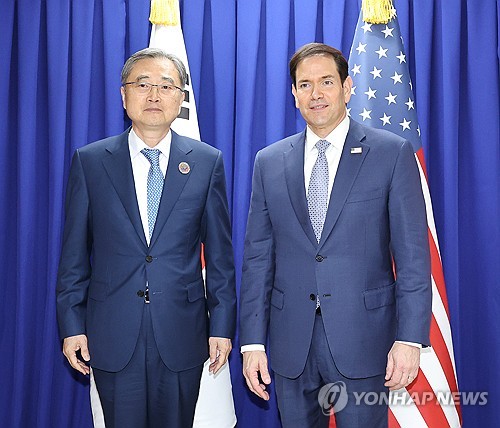
Seven months. That is how long it took for the foreign ministers of two nominally closest allies to sit down again in a bilateral meeting. Choi Soo-kyung of the South Korean Foreign Ministry and Marco Rubio of the US State Department met in Washington on September 18, breaking a silence that had stretched since February. The gap itself is the first data point: a standard US-ROK diplomacy cadence would produce such a meeting every two to three months, not every quarter plus three months.
What fills those seven months of quiet is a useful backdrop for reading what actually happened in that State Department room. In between, Seoul’s President Lee Jae-myung took office and reset the tone of the alliance, Trump’s administration began pressing hard on trade and defense cost-sharing, and the broader Middle East picture — particularly around the Strait of Hormuz and Iranian nuclear posture — shifted enough to make Korea’s traditional ‘stay home’ security doctrine look awkwardly out of step.
The Hormuz Question Is Not What It Looks
The domestic political controversy in Seoul over deploying forces to the Strait of Hormuz is getting flattened into a simple yes-or-no in most English-language coverage. The actual position is more layered.
Lee Jae-myung drew a hard line in a press briefing: no troop deployment for war participation or intervention. That sentence is doing heavy lifting. It forecloses a combat escort role in a potential US-Iran confrontation. But in the next breath, he acknowledged that South Korea’s Cheonghae Force — roughly 300 sailors operating out of a base near Aden, Yemen — is already conducting anti-piracy and ’national safety threat’ missions in the wider Gulf region. Strengthening that deployment, he said, is under active review.
The distinction matters because it gives Seoul a legal and political shield while leaving a valve open. If tensions around Hormuz escalate, the government can point to the Cheonghae Force mandate and argue it is expanding a counter-piracy mission rather than launching a war-fighting task force. For Washington, which has been asking regional partners to share the burden of keeping the strait open, that valve is enough to keep the conversation going without triggering the domestic backlash that would accompany the word ‘war.’
For the Gulf states watching this, the implication is subtler but significant. Korea is not a Gulf state, not a NATO member, not a traditional security guarantor of the region. Yet if a South Korean naval contingent ends up running escort lanes in Hormuz, it adds another East Asian flag to the waters where Japan’s JSDF patrol boats already operate. The quiet signal to Riyadh, Abu Dhabi, and Muscat is that the security architecture protecting their export corridors is broadening beyond the US-Europe axis. That is a geoeconomic shift, not a military one, and English-language reporting on the meeting tends to miss it entirely.
The $350 Billion Number and the Delay That Reveals Friction
The investment track is where the meeting’s optics become a little more complicated. Reports heading into the bilateral session suggested the two sides were close to converging on a Korean investment package to the United States in the range of $350 billion. That is a figure large enough to move markets: it exceeds South Korea’s annual trade surplus with the US by a wide margin and would reshape where Korean capital in semiconductors, battery manufacturing, and petrochemicals ultimately lands.
The catch is procedural. The initial public announcement of the first tranche was scheduled for September 18, Korean time — the same day as the ministerial meeting — but got pushed to the following week because of a delay in reporting to the National Assembly. That is not a trivial footnote. In the Korean system, major foreign economic commitments that exceed certain thresholds require legislative notification. A delay means the opposition benches are already circling, framing the package as a concession to Trump in exchange for tariff relief. The fact that the delay landed on the very day of the highest-profile diplomatic event in seven months gives Seoul’s domestic critics a ready-made narrative: the government is performing diplomacy abroad while dragging its feet at home.
For Washington, the timing slippage creates a small but real window in which trade policy can backslide. Rubio and Choi presumably walked out of that meeting with a verbal framework, but a framework that has not cleared the National Assembly is a framework that can still be amended, diluted, or reversed by a changed political mood in Seoul. The seven-month gap in ministerial meetings will not be repeated while this package is unratified; both sides need a short, intense negotiation sprint before the next domestic election cycle in Korea tightens the noose.
North-South Momentum as a Bargaining Chip
The third thread running through the meeting is the one that does not make front pages outside East Asia: North-South dialogue. Trump has publicly floated a North Korean summit several times, and the White House wants a visible progress line it can point to before any broader diplomatic architecture with Pyongyang. For Lee Jae-myung’s government, which has campaigned on reducing inter-Korean tensions, the summit question is simultaneously an opportunity and a trap. Agreeing to shuttle diplomacy puts Seoul in the middle of a negotiation it cannot control; refusing risks being branded obstructionist at exactly the moment it is courting Western investment.
Rubio and Choi reportedly discussed ‘regional and global issues’ in broad terms, which in diplomatic code means the North track was on the table but kept at arm’s length. The more important subtext is the sequencing: the $350 billion investment and the Hormuz posture are being negotiated in parallel with, not subordinate to, the North-South file. That tells Washington that Seoul will not trade its peninsula-policy autonomy for a signature on a trade deal. It also tells Pyongyang that a new South Korean administration is willing to talk, which is a development North Korea’s leadership has been watching since February.
What Happens Next
The next 48 to 72 hours matter more than the meeting itself. The National Assembly reporting on the investment package is the immediate gate. If it clears smoothly, the first tranche announcement likely lands by early next week and the trade narrative in both capitals resets. If opposition amendments stall it, the diplomatic floor under the whole trilateral package — Hormuz, investment, North talks — thins out fast.
On the security side, the Cheonghae Force ‘strengthening’ review is the number to watch. A modest expansion of anti-piracy patrols off the Omani coast would be routine. Any language shifting the mandate toward ’escort’ or ‘protection of commercial navigation’ in the Strait of Hormuz specifically would be a red-line crossing in Seoul’s domestic politics and a green light for Gulf states wanting diversified naval partners.
The seven-month silence is over. What replaces it — a sustained, high-frequency diplomatic rhythm or another long pause — will be a cleaner indicator of US-ROK alignment than any press release out of the State Department stairwell.