Reading Your Brain in Real Time Turns Out to Be Complicated
A Nature study shows that brain-computer interfaces must be trained on concurrent speech-and-gesture attempts to work reliably — isolated behavior data simply doesn't generalize. The finding is a milestone for assistive tech and a warning about how poorly we understand neural privacy.
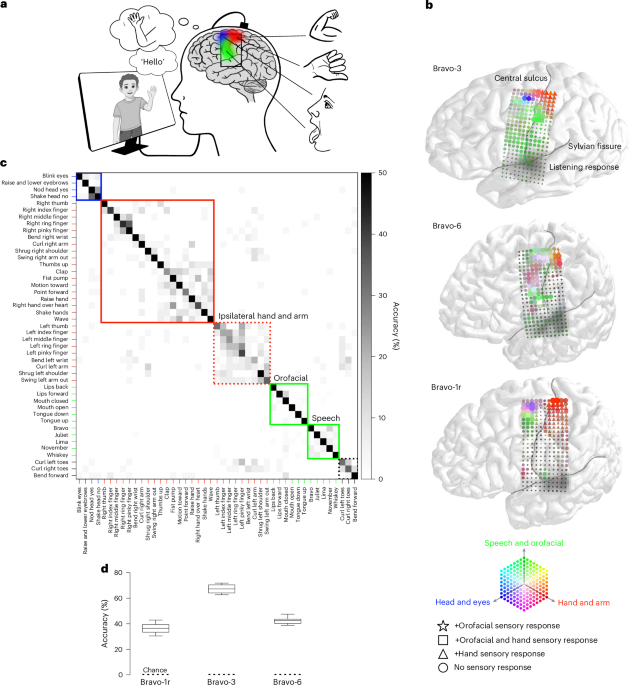
A single brain implant can now decode both speech and gesture — but only if you train it right
Three people with severe paralysis sat still while researchers recorded electrical activity from plates placed directly on their motor cortices. The participants silently attempted phrases, imagined hand waves, and — crucially — tried to do both at the same time. A computer mapped those neural patterns onto a digital avatar that spoke and gestured in real time.
The results, published in Nature Neuroscience, mark one of the most significant advances in brain-computer interface (BCI) research to date. A single electrocorticography (ECoG) array can reliably decode simultaneous speech and gesture, two motor systems that have historically been studied in isolation. That finding clears a major hurdle for assistive devices aimed at people who have lost the ability to speak or move.
But the paper’s most important result is also the least glamorous: models trained only on isolated speech or isolated gesture performance failed to generalize when those behaviors were attempted concurrently. The decoders had to see real examples of the two behaviors happening together before they could accurately interpret them. This isn’t a minor technical detail. It has direct consequences for how these devices will be calibrated in clinical settings — and who gets left behind in the process.
Why simultaneous decoding matters
Natural human communication is multimodal. When people talk, they almost always gesture. Cospeech gestures are not decorative; they carry semantic information, signal turn-taking, and help listeners integrate meaning. For someone with ALS or a brainstem stroke who has lost the ability to speak and move, losing that dual channel of expression is devastating. A BCI that can only restore speech or only restore gesture is a compromise. A BCI that restores both — simultaneously — is closer to restoring agency.
The study involved three participants, designated Bravo-1r, Bravo-3, and Bravo-6. Two had brainstem strokes and severe limb and vocal-tract paralysis. One had ALS with severe vocal-tract paralysis and moderate limb impairment. Despite their different conditions, all three showed that a single high-density ECoG array covering the sensorimotor cortex could capture neural representations for speech articulators, hand and arm movements, and head/eye movements — roughly arranged along the known somatotopic map of the cortex.
That somatotopy is not as clean as textbooks suggest. Electrodes in the precentral gyrus showed partial overlap, firing during both speech and gesture attempts. The neural population tuning is broad and heterogeneous, not neatly partitioned into speech zones and gesture zones. This anatomical reality is what makes concurrent decoding both necessary and difficult.
The generalization problem
The team tested three behavioral contexts: speech-only trials, gesture-only trials, and simultaneous speech-plus-gesture trials. They trained separate neural network models on isolated speech data and isolated gesture data, then tested those models on simultaneous trials. Performance was poor.
They then trained hybrid models using an equal mix of isolated and simultaneous data. These models generalized across contexts significantly better. The takeaway is blunt: if you want a decoder that works when someone attempts speech and gesture together, you must train it on data where speech and gesture are actually attempted together. Isolated training data is insufficient.
This finding mirrors earlier intracortical spiking studies that found nonlinear changes in neural tuning during concurrent movements. But those earlier studies used electrode arrays implanted into brain tissue. The current work uses ECoG, which records from the brain’s surface and captures the combined activity of thousands of neurons rather than individual spikes. Surface recording is less invasive and has a longer track record of clinical safety — but it also means broader, noisier signals that are harder to decompose when multiple motor systems are active at once.
What this means for the clinic
The most immediate implication is practical: BCI calibration sessions for paralyzed patients will need to be more elaborate than simply recording isolated movements. Clinicians will need to design training protocols that include concurrent speech-and-gesture attempts, which may be cognitively demanding for patients who have already lost substantial motor control. Some participants in this study used different strategies — one silently attempted speech and minimally attempted gestures, another overtly produced speech while imagining gestures. A single calibration protocol may not fit all patients.
The researchers drove a personalized full-body avatar in real time, demonstrating that the system can operate at a latency suitable for conversational use. That’s a proof of concept, not a product. Moving from a research lab with three participants to a clinical deployment for hundreds will require larger studies, longer-term stability data, and — inevitably — commercial partners.
Who wins, who loses
The primary winners are people with locked-in syndrome, advanced ALS, and severe brainstem stroke — populations that have been underserved by existing BCI approaches. Current commercial and experimental devices largely focus on cursor control or letter-by-letter spelling. A system that restores conversational speech and gesture in a single implant is a qualitative leap.
Secondary winners include the companies building out the BCI ecosystem. This research reinforces the case for multi-effector, multifunctional implants over single-purpose devices. Investors and device manufacturers will take note.
The losers are anyone who assumes that neural decoding is just a matter of collecting more data from a single behavioral mode. The field needs to stop treating speech and gesture as separate problems. It also needs to confront the fact that training requirements scale non-linearly — adding concurrent behavior to the training set is essential, but it also means longer, more complex calibration sessions that may exclude patients with lower cognitive stamina or limited attention spans.
The neural privacy question no one in the paper addresses
There is a deeper issue lurking here. This device reads intent — not just movement, but the neural correlates of planned speech and planned gesture. It reconstructs communicative acts from brain activity. That is fundamentally different from decoding a cursor position or a motor command. It edges close to reading thoughts.
As BCIs become capable of reconstructing speech and gesture simultaneously, the question of consent and data ownership becomes urgent. Who owns the neural data generated during a calibration session? Can it be used to train commercial models? What happens if a company that built your BCI goes out of business — do you lose access to the decoder weights that make your device functional? These are not hypotheticals. They are immediate policy questions that neuroscience journals rarely touch.
The study’s authors are careful to frame their work as a proof of concept. The science is sound. The clinical path ahead is real. But the social infrastructure needed to protect the people who will use these devices — patients whose most intimate cognitive processes may one day be recorded, stored, and potentially exploited — has not kept pace with the technology.