South Korea's 2040 Power Crisis Could Starve the World's Chips
South Korea projects its 2040 electricity demand will spike by 27 gigawatts — the output of 19 nuclear reactors — driven overwhelmingly by semiconductor fabs and AI data centers. If Seoul can't power its factories, the global memory-chip supply faces a reckoning.
The Grid Is the New Supply Chain
South Korea’s government recently revised its 2040 electricity demand forecast upward by 27 gigawatts in just four months. That is not a rounding error. It is the equivalent of 19 state-of-the-art nuclear reactors, or 2.7 times the entire power consumption of Seoul. The revision came after President Lee Jae-myung announced three megaprojects in June — semiconductors, AI data centers, and related infrastructure — and the numbers simply caught up with the ambition.
Semiconductors alone account for 20.6GW of that increase. Data centers add another 7.9GW. Demand-side management programs knocked a modest 2.7GW off the total. What remains is a raw picture of a country trying to power an AI and chip industrial policy against a grid that was never designed for it.
Who Is Drinking the Power
The math is blunt. The 12th Electricity Supply and Demand Basic Plan now projects 2040 annual consumption at 847 to 885 terawatt-hours, up from the 131.8 to 138.2GW peak demand estimate last April. An independent researcher at the Korea Energy Economics Institute, Park Woo-young, calculated that the three megaprojects will generate 38.4GW of additional demand through 2041 — 18.4GW from AI data centers and 20GW from semiconductors. Add the expected power needs of a new semiconductor cluster in Yongin, and the gap widens further.
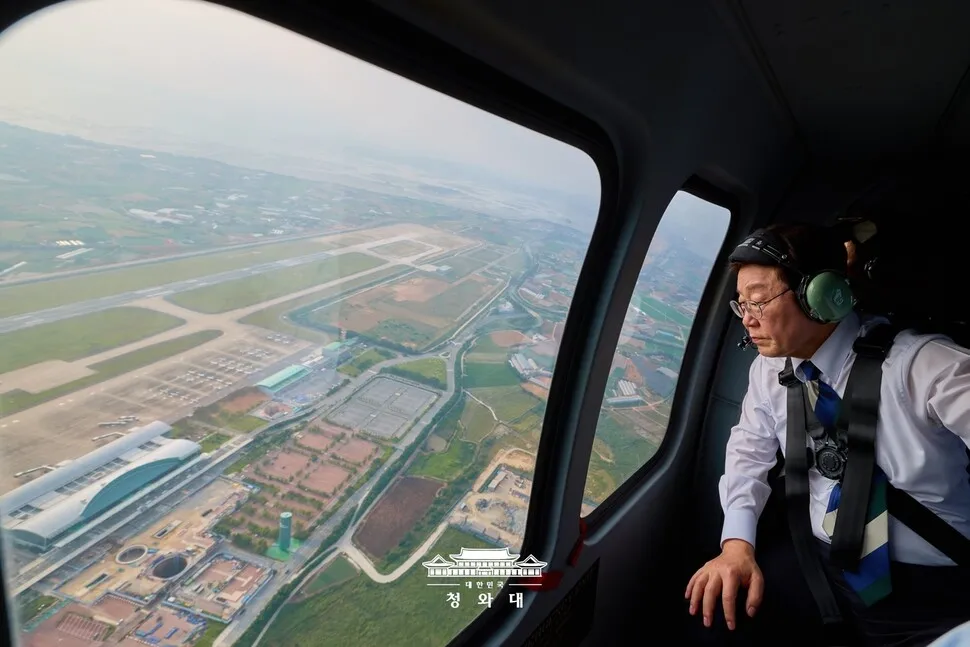
President Lee was photographed in June flying over a former military airbase in Gwangju slated to become a massive semiconductor industrial complex. Naver has already begun construction on what it calls its largest data center in Sejong. These are not speculative projects. They are breaking ground now, and they will be drawing hundreds of megawatts apiece within this decade.
The Reactor Question
The government’s answer to the shortfall is straightforward and controversial: extend the lifespan of every nuclear reactor scheduled to retire by 2030. Nine reactors currently face decommissioning. Extending their operation is being described inside the energy ministry as the cheapest and fastest source of carbon-free power available. Climate and Energy Minister Kim Sung-hwan publicly signaled support for life extensions if safety can be demonstrated. Some lawmakers are pushing to double the standard extension period from 10 years to 20.
Nuclear opponents call it surrender. Park Hang-joo of Green Korea United called the plan to run every aging reactor indefinitely “lazy and irresponsible,” arguing the government should instead curb data center construction and strengthen demand management. Kim Byeong-kwon of the Korea Institute for Energy Transition warned that the power hunger of the megaprojects could derail South Korea’s 2030 emissions target, which requires a 44.4 percent reduction in the power sector compared to 2018 levels.
The sixth public consultation on the plan opens on October 26. The government intends to finalize the plan by year end.
Why the World Should Care
South Korea is the world’s largest memory-chip producer. Samsung Electronics and SK Hynix together dominate the global markets for DRAM and NAND flash. These are not commodities produced in a dozen countries with interchangeable capacity. They are made in a handful of fab cities — Piang in Hwaseong, Yiweon in Gwangyang, and the proposed new cluster in Gwangju — all of them energy-intensive. A single advanced memory fab can draw 300 to 500 megawatts, comparable to a small city.
When Seoul says its 2040 demand will rise by 27GW, it is not talking about more air conditioners. It is talking about the physical infrastructure of artificial intelligence and the silicon that runs it. A power shortage in South Korea does not mean higher electricity bills. It means fewer chips. And because the memory-chip supply chain is so concentrated, a disruption in Korea echoes through every device, server, and autonomous system on the planet.
TSMC and Intel are not immune to the same dynamic. TSMC’s new Arizona fabs have been wrestling with water and power constraints since construction began. Intel’s ambitious foundry expansion in the United States faces the same bottleneck: you can build the fab, but you cannot plug it in. South Korea is simply further along the curve. Its crisis is a preview.
The Timeline Trap
The most uncomfortable detail is the lag. Nuclear reactors take a decade to permit and build. Wind and solar farms require land, grid connection, and community buy-in. Battery storage is scaling but remains expensive at grid scale. Life extensions on existing reactors are the only lever that can deliver power within the next five years. Everything else comes later.
If the government extends the nine reactors and adds two new ones, as the energy institute’s roadmap suggests, South Korea may squeeze through the 2030s. But the megaprojects are designed for 2040 and beyond. The 38.4GW of additional demand that Park Woo-young flagged assumes the AI and semiconductor buildout proceeds as planned. Any delay in power delivery delays the fabs. Any delay in the fabs delays the chips. The chain runs straight through to consumers.
What Comes Next
Three outcomes are plausible. In the first, the government extends the nine reactors, fast-tracks two new ones, and accepts higher nuclear dependence — a political shift away from the progressive opposition’s anti-nuclear platform. In the second, power curtailments force fab expansions to slow, giving TSMC and Intel a narrow window to capture share in memory and advanced logic. In the third, the government leans hard on demand-side management and renewable buildout, missing its targets and facing brownouts in industrial zones.
All three outcomes share one constraint: electricity is no longer a background utility. It is a strategic input, as critical as lithography equipment or refined sand. South Korea’s 27GW revision is a signal that the AI boom has outpaced the grid, and the world’s memory-chip supply sits inside that gap.
The next time your phone gets slower to update, the question may not be about silicon. It may be about whether the lights stay on in Gwangju.