Korea's Hypersonic Test Changes Asia's Deterrence Calculus
South Korea has unveiled its first domestic hypersonic glide vehicle, a test that moves Seoul from buyer to builder of next-generation strike weapons — and shifts deterrence across East Asia.
Seoul’s Hypersonic Gambit
The White House released photographs on October 9 that turned out to be more than a photo opportunity. They showed South Korea’s first successful test launch of an indigenous hypersonic glide vehicle — a system that flies at Mach 5 or faster, changes course in the atmosphere, and, by all appearances, hits where it aims.
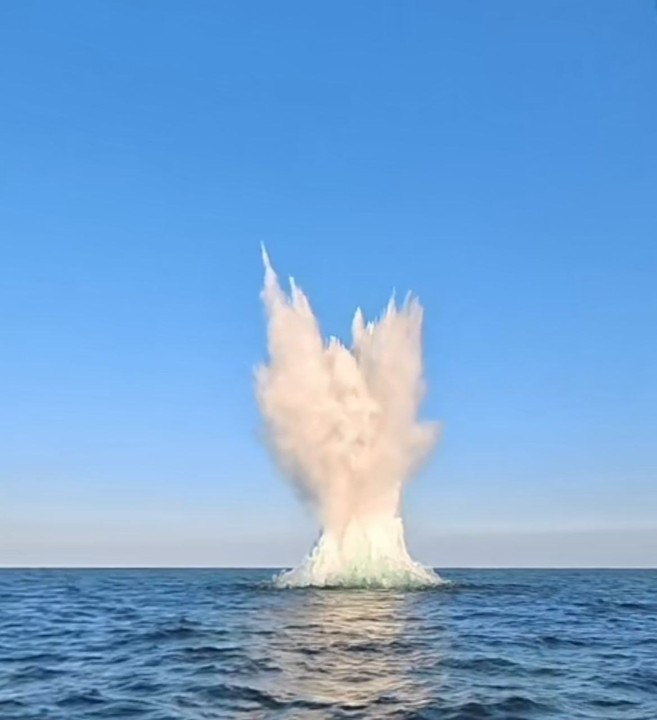
President Lee Jae-myung stood on the deck of a fixed offshore platform at the Defense Acquisition Program Administration’s Anheung test complex in South Chungcheong Province on October 8. What he witnessed was a rocket booster accelerating the glide vehicle to altitude, releasing it, and then watching the vehicle descend at extreme speed, maneuver vertically and horizontally, and strike a designated target in the West Sea with a towering plume of water.
The images were deliberately staged — smoke and flame from the booster, the glide body cutting down through the atmosphere, the impact itself. But the milestone they document is real. South Korea is now one of the few countries on Earth that can design, build, and flight-test a hypersonic glide vehicle of its own making.
What the Test Actually Demonstrated
An HGV works differently from a conventional ballistic missile. A traditional missile follows a predictable parabolic arc once it leaves the atmosphere — largely unchangeable and therefore trackable by early-warning radar. An HGV rides a rocket to high altitude, separates, and then glides — skimming through the upper atmosphere at hypersonic speed while steering. That steering capability is the hard part. It requires materials that can survive extreme heat, guidance systems that can handle the chaos of atmospheric re-entry at Mach 5 plus, and propulsion management that keeps the vehicle stable during what the presidential office called “irregular gliding.”
Seoul’s test, according to the Blue House, covered the full sequence: booster separation, unsteady glide, and precision impact. The vehicle reportedly flew several hundred kilometers over the West Sea before striking its target. That range is consistent with a theater-strike weapon designed to cover the Korean Peninsula and nearby maritime approaches — not an intercontinental system.
The trajectory profile matters more than the range. A weapon that can bank left and right at hypersonic speed makes existing missile defense architectures far less useful. Thailand’s terminal high-altitude area defense systems, Japan’s Aegis destroyers, and U.S. Pacific layered defenses were all designed around intercepting ballistic trajectories. None of them were built to engage a target that can alter its flight path mid-descent at five times the speed of sound.
Who This Changes
Pyongyang is the most immediate audience. North Korea has spent years developing its own ballistic missile program, including ICBMs capable of reaching the continental United States. But its missile defense evasion strategy has been largely brute-force — multiple warheads, decoys, and speed. A South Korean hypersonic weapon adds a qualitatively different threat: one that can strike with short warning time, cannot be intercepted by the systems Pyongyang has been preparing for, and can adjust its aim point en route.
Beijing faces a harder calculation. China has been aggressively building A2/AD networks across the Western Pacific — anti-ship ballistic missiles, land-attack cruise missiles, and layered air and missile defense. South Korea’s new capability undercuts some of that math. A hypersonic glide vehicle launched from the Korean Peninsula could threaten Chinese naval assets in the Yellow Sea and even reach targets further west, with Beijing’s current defenses struggling to track and engage a maneuvering target at that speed.
Tokyo has been watching closely. Japan has been pursuing its own hypersonic technology, including the X-5 experimental vehicle and what appears to be an indigenous hypersonic cruise missile program. South Korea’s successful flight test puts Japan slightly behind in operational deployment — a gap Tokyo will want to close fast, especially given the shared strategic challenge from both China and North Korea.
The Bigger Picture
South Korea has spent two decades moving from a consumer of American weapons to a developer of its own systems. The KSLV-II Nuri rocket, the Kill Chain early-strike network, the KCZX air defense system, and the Hyunmoo-series cruise missiles all trace a lineage of growing autonomy. The hypersonic glide vehicle is the most technically demanding project in that lineage so far.
The test took place under a Conservative Party president, Lee Jae-myung, which complicates the easy narrative about which political camp drives South Korea’s defense industrialization. The program predates his administration, but the political visibility of this test — the photographs, the presidential presence, the immediate press release — is a deliberate act of statecraft. Seoul is announcing to the world that it no longer needs to wait for allies to provide the tools it needs for its own deterrence.
That message lands differently depending on who is listening. Washington may see a partner gaining capability it can coordinate with. Beijing will see a new actor with a weapon system designed in part to penetrate Chinese defenses. Pyongyang will see a direct escalation it did not previously face.
What Comes Next
A test launch is not a deployment. The gap between flying a prototype hundreds of kilometers and fielding a reliable, repeatable weapon system in battalion-level units is substantial. Questions remain about production rates, warhead options, integration with existing command-and-control networks, and whether South Korea plans to mount these systems on land, sea, or both.
But the direction is clear. South Korea is no longer just buying hypersonic-capable systems from abroad — as it has discussed with the United States — it is building them. That distinction matters. Indigenous production means Seoul can decide when, where, and against whom to deploy these weapons without waiting for permission from Washington.
The photographs from the West Sea show a weapon that works. The next photographs will matter more: of the system in its operational configuration, under actual military command, ready for use.