South Korea Judges Martial Law Generals — A Signal for East Asia
South Korea's first criminal convictions for top military officials involved in the Dec. 3 martial law crisis mark a decisive break from the tradition of military impunity. The sentences carry implications far beyond the courtroom.
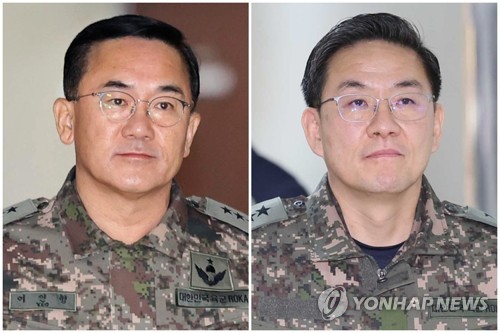
The Generals Got Their Day in Court
Seoul Central District Court handed down prison sentences Tuesday to five former high-ranking military officers who participated in the Dec. 3 emergency martial law declaration — the first time South Korea has criminally prosecuted top military leaders for a coup attempt against their own government.
Yeo In-hyung, the former commander of the Armed Forces Counterintelligence Command, received 18 years. Lee Jin-woo, former commander of the Capital Defense Command, was sentenced to 15 years. Mun Sang-ho, former intelligence commander, got 12 years. Army Chief of Staff Park Ahn-soo, who served as martial law commander at the time, received 10 years. And Kwak Jong-geun, former commander of the Special Warfare Command, was given 9 years.
Prosecutors had sought 30 years for the two senior figures. The gap between what was asked and what was delivered will be closely watched — but the mere fact that any real prison time was handed down is itself extraordinary in a country where military officers have historically retired with their reputations intact, regardless of political overreach.
What the Court Found
The judgments are specific and damning. Yeo In-hyung was found to have organized a “joint arrest squad for anti-state forces” within hours of the martial law proclamation, targeting more than a dozen politicians including then-opposition leader Lee Jae-myung. Documents and memoranda recovered from Yeo showed he had coordinated with former President Yoon Suk Yeol and former Defense Minister Kim Yong-hyun in advance, and that he understood the declaration’s purpose was unlawful.
Lee Jin-woo was convicted of deploying his Capital Defense Command troops to the National Assembly after receiving a direct order from Yoon to “drag out the lawmakers.” The order came just before the assembly voted on a motion to lift martial law — a timing that the court treated as deliberate interference with legislative function.
Park Ahn-soo, as the overall martial law commander, issued what the court ruled were unconstitutional and illegal proclamations and ordered the police commissioner to seal off the National Assembly. His defense — that he was following orders from above — was rejected. The court noted that as an army chief of staff with access to military intelligence, Park should have recognized the situation did not constitute an emergency and should have formally objected rather than complied silently.
Kwak Jong-geun, the only defendant who admitted guilt during proceedings, still was found guilty of deploying special forces to the National Assembly, the Democratic Party headquarters, and the Election Management Committee building in Gwacheon.
All five were convicted of participating in insurrection — a charge the court described as incomparably grave, one that strikes at the foundation of the state itself.
Why This Matters Beyond South Korea
South Korea’s democratic transition in 1987 was built on a compact: the military would stay out of politics, and in exchange it would retain institutional autonomy and legal protections. Decades of martial law under Park Chung-hee and Chun Doo-hwan left deep scars, and successive governments chose accountability selectively or not at all. Military officers who imposed martial law in 1979 and 1987 were later tried, but the political turbulence of those periods meant outcomes were uneven and often discounted by the public as political revenge.
This ruling is different. It is the product of a special prosecution team, a unified judiciary, and a political environment where the basic constitutional order was directly attacked and the public response has been overwhelmingly clear. The court’s language — that these officers “abandoned the political neutrality of the military and deployed it for the benefit of a specific faction” — carries weight precisely because it comes after years of uncertainty about whether South Korea’s democracy was secure.
For the region, the implications are sharper than they might appear. Japan and Taiwan watch closely how Seoul handles civil-military disputes. A credible precedent that military intervention in politics carries personal criminal liability strengthens the normative barrier against exactly the kind of escalation Beijing tests regularly in the Strait. It also signals that Washington’s alliance architecture in East Asia now rests on partners where the rule of law, however strained, can self-correct even under direct threat.
Who Wins, Who Loses
The winners are the institutions the martial law declaration targeted: the National Assembly, the Election Management Committee, the courts, and ultimately the Constitution itself. The ruling reaffirms that in South Korea, the chain of command bends to civilian authority — and breaking that norm is a crime, not a career move.
The losers are the remaining factions within the military and political establishment who believed that loyalty to a president could shield them from consequences. Park Ahn-soo’s rejected defense is the clearest example. Future military leaders will read this sentence and understand that “following orders” is not a defense when those orders violate constitutional order.
Former President Yoon Suk Yeol, who is not a defendant in this trial, faces separate proceedings. But the judgments effectively fill in the factual record of his role — coordinating with military commanders, directing troop movements, attempting to arrest opposition figures. That record will shape whatever comes next.
What Comes Next
Sentences of 9 to 18 years for coup participation are not unprecedented globally, but they are heavier than anything South Koreans have seen for political offenses involving military personnel since the 1990s. The lightest sentence — 9 years for Kwak — still represents a significant deprivation of liberty for a man who spent decades rising through the ranks as a model officer.
Legal appeals are expected. The Supreme Court will ultimately decide whether these rulings hold. But even if some sentences are reduced on appeal, the factual findings — the arrest squads, the troop deployments, the advance coordination — are now part of the public record and will constrain future political narratives about what happened on Dec. 3.
Perhaps most importantly, the ruling sends a message to every military officer in East Asia: participating in a political takeover is no longer a riskless career calculation. In a region where several democracies have uneasy histories with their armed forces, that message matters. South Korea is no longer just learning to protect its democracy — it is proving it can enforce the consequences when the protection fails.