Why South Korea Gave Naver 5x Its Rivals for AI Sovereignty
South Korea's 'Everyone's AI' program commits 250 billion won annually through 2030. Naver's consortium received five times the operational funding of Kakao, SKT, and KT combined — a stark signal about where Seoul bets its AI future.
The subsidy split tells the real story
South Korea has decided that artificial intelligence is not just a commercial battleground but a matter of national infrastructure. The government’s “Everyone’s AI” (모두의 AI) program commits 250 billion won annually from 2026 through 2030. That is roughly $180 million a year — a meaningful sum for a country where a single major AI project can cost hundreds of millions. But the headline number obscures something more revealing: how that money is divided among the companies selected to run it.
Three consortia — led by Kakao, SK Telecom, and KT — will each receive 10 billion won in annual operational funding. A fourth, led by Naver Cloud, gets 50 billion won. Five times more. The difference is not arbitrary. It maps directly onto what the government considers most urgent: a homegrown, security-specialized large language model that can serve sensitive public-sector applications.
Naver’s monopoly on trust
The 50 billion won allocation goes to a separate track — the development of a national security-specialized AI service. The Naver Cloud consortium was selected for this work. No other bidder made the cut. That choice signals a clear judgment from the Ministry of Science and ICT: when it comes to AI handling government data, civic infrastructure, or any application where data leakage carries national-security implications, Naver’s model is the one Seoul trusts.
Naver has spent years building its own LLM stack, investing heavily in internal model development and deploying it across its search, webtoon, and e-commerce platforms. The company’s Haetae model already processes billions of queries monthly. The government’s bet is that that scale translates into a model robust enough for public-sector deployment — something that cannot be outsourced to American providers without creating dependency at the most sensitive layers of state function.
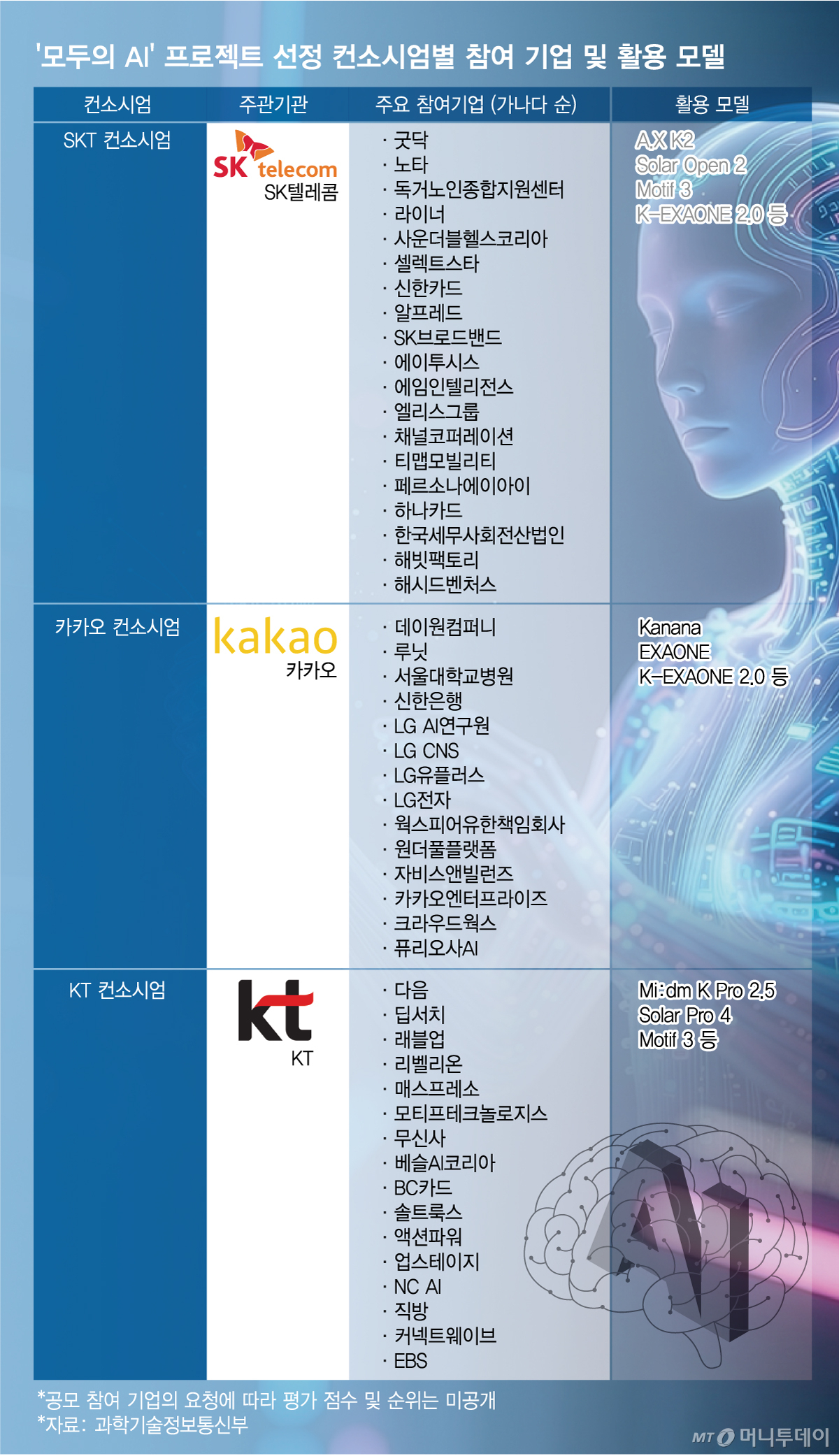
The other three consortia operate on a different track. They are building general-purpose AI agent services for the public, funded at 10 billion won each. Kakao’s consortium includes 15 companies, SK Telecom’s 20, and KT’s 17. The numbers suggest a deliberate strategy to avoid crowning a single winner in the consumer layer. Let them compete. Let the market sort it out. But keep the sovereign layer under tight domestic control.
The GPU play
How does the government actually deliver this funding? Not with direct cash grants. The structure is deliberately indirect, and that design choice matters.
In 2026, the first year of the program, no cash budget was allocated. Instead, each of the three consumer consortia received 512 B200 GPUs as in-kind support. That is NVIDIA’s latest high-performance training chip, the same hardware that defines the frontier of commercial AI capability. The B200 commands a monthly rental rate of roughly 6.6 million won. At that price point, the full 250 billion won annual budget could lease approximately 2,100 units — enough to support an estimated 10 million individual users, according to ministry figures.
From 2027 onward, the model shifts. The 170 billion won earmarked for GPU rental replaces the in-kind support. The remaining 80 billion won funds the operational costs split across the consortia — 30 billion won each for the three consumer tracks and the full 50 billion won for Naver’s security project.
This structure achieves two things simultaneously. First, it ties subsidy to actual infrastructure use rather than blank checks, giving the government leverage to audit performance. Second, it removes the most expensive barrier to domestic AI development — GPU access — while keeping the hardware physically and legally within Korean jurisdiction. The GPUs belong to Korean consortia, not to American cloud providers. That distinction is the entire point.
Why the split matters beyond Korea
The subsidy architecture reveals a strategy that Japan, Taiwan, and the EU are watching closely. South Korea is carving a middle path between total openness to American AI and full autarky. It is accepting that it cannot outspend the United States on frontier model development, so it is concentrating resources where it can: securing domestic deployment capacity and ensuring that the most sensitive AI functions run on Korean models, on Korean hardware, under Korean law.
The five-to-one ratio between Naver and its rivals is the sharpest expression of that logic. The government is not trying to create a level playing field across all AI applications. It is making a targeted investment in one category — security and sovereignty — and accepting competition elsewhere. Naver wins the strategic bet. The others win the volume bet.
Who loses
Foreign AI providers lose the most obvious share. Every Korean who switches from ChatGPT or Claude to a domestically hosted alternative is a user not feeding data into American models and not generating revenue for American firms. At scale — 10 million users, growing annually — that is a meaningful shift in market share for a country of 52 million people.
Smaller Korean AI startups also lose. The consortia are structured around the three telecommunications and platform giants, each pulling in dozens of partner companies. A startup without a seat at one of those tables faces a steep uphill battle. The government is building an ecosystem, but it is one anchored by incumbents.
And there is a quieter loser: the consumers themselves, at least in the near term. A security-specialized model trained on Korean public-sector data may perform less flexibly than global alternatives on open-ended tasks. The trade-off — capability for control — is the fundamental tension in every sovereignty-driven AI strategy.
What happens next
The program’s timeline stretches to 2030. Annual budgets are set. The three consumer consortia have until the end of 2026 to deliver their AI agent services, after which the GPU rental payments begin flowing. Naver’s security model will develop on its own schedule, insulated from the competitive pressure that shapes the other three tracks.
The real test comes in 2027 and beyond, when the subsidy mechanism transitions from infrastructure provision to operational support. At that point, the government will need to decide whether to reward usage metrics, quality benchmarks, or both — and whether to open the security track to additional bidders or reinforce Naver’s position.
South Korea has drawn a line: AI that touches the state stays Korean. Everything else can compete. How that line holds — and whether it proves sufficient — will determine whether this subsidy program becomes a model for other middle-power tech states or a costly experiment in controlled isolation.