South Korea Opens Cloud Doors, But Keeps Data Locked In
Seoul is relaxing cloud security rules to let foreign providers manage public-sector services from overseas — but the data itself must stay on Korean soil. The shift reflects U.S. trade pressure and a desperate need for cloud capacity for AI.
A Calculated Unshelving
South Korea is about to let Amazon, Microsoft, and Google manage parts of the government’s cloud infrastructure from servers outside the country. The data stays put. The controllers move out.
The National Intelligence Service announced Wednesday that it is seeking public comment on revised National Cloud Computing Security Guidelines. The changes take effect in the second half of next year after a transition period. What makes the revision notable is not just the technical shift — it is a clear signal of how Seoul is recalibrating its position between protecting domestic cloud sovereignty and bowing to American trade pressure at a time when the country’s AI ambitions are running out of compute room.
What Actually Changes
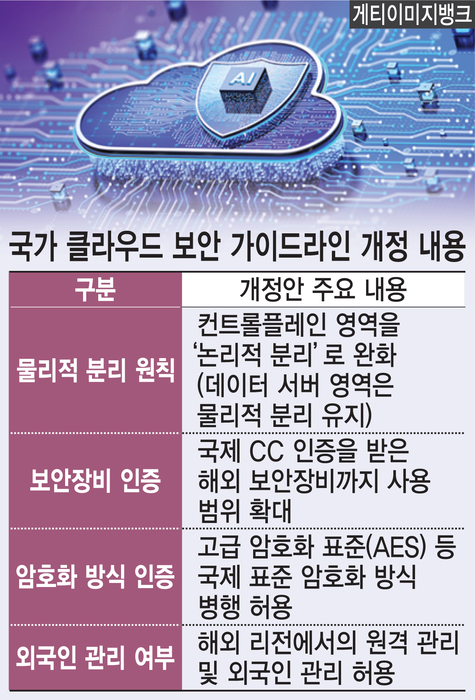
Under the old rules, any cloud provider serving public-sector agencies had to maintain physical separation across two distinct layers. The data plane — where government information actually lives — had to reside on domestic servers. So did the control plane — the systems that provision, monitor, and manage those servers. For foreign cloud operators, the control-plane requirement was effectively a wall. It meant building and staffing a full operational presence inside Korea, often through local subsidiaries, just to bid on government contracts.
The revision tears that wall down, but only for the control plane. Management and monitoring can now be handled through logical separation — software-defined access controls, encryption, and virtualization — rather than physical separation. A foreign operator can run the control systems from a regional hub, potentially in Japan or Singapore, and still serve Korean government tenants.
The data plane requirement is untouched. Government data must remain physically isolated on servers located within South Korea. This is the line Seoul refuses to cross.
Security equipment certification is also broadening. Previously only devices with domestic Common Criteria certification could be deployed in public cloud environments. The revised guideline extends recognition to international CC-certified equipment, meaning hardware and software sourced from non-Korean manufacturers can now enter the procurement chain.
The Trade Pressure Nobody Needs to Name
The direction of this revision was predictable. Washington had been pressing Seoul for months, characterizing South Korea’s physical control-plane requirement as a non-tariff barrier under digital trade frameworks. The demand was straightforward: open the public cloud market or face escalating friction in the broader bilateral technology relationship.
Seoul’s calculus is straightforward. Refusing the change risks deeper trade complications with the United States, its most important security ally and a critical market for Korean semiconductors and electronics. Accepting the change partially satisfies American demands while preserving the one red line that matters most to Korean policymakers: the physical location of government data.
This is a compromise designed to let both sides claim victory. The United States gets market access. South Korea keeps its data onshore.
Who Gains, Who Bleeds
The biggest winner is the hyperscaler trio. AWS, Microsoft Azure, and Google Cloud can now bid for Korean public-sector contracts without constructing full domestic control operations. That cuts capital expenditure and shortens time to market. For agencies struggling to procure cloud capacity for AI workloads, it also means faster deployment — no waiting for foreign vendors to build local infrastructure from scratch.
The second winner is less obvious but arguably more important: the South Korean government’s own AI strategy. The country’s cloud demand has surged because public institutions are migrating legacy systems to cloud-native architectures to support AI transformation. Domestic providers, led by Samsung SDS, LG CNS, and KT, have historically held the public-sector market behind the physical separation wall. With that wall lowered, the government gains access to the scale and AI tooling that hyperscalers offer natively. Without this revision, Seoul would face a capacity crunch just as its national AI agenda accelerates.
The loser is clear. Korean cloud vendors will feel immediate competitive pressure. They built their public-sector positions partly on the assumption that foreign rivals could not easily meet the physical separation requirement. Now they compete against companies with far deeper R&D budgets, broader global service portfolios, and established relationships with U.S. government agencies that already rely on those same providers. The transition timeline — not until the second half of next year — gives domestic firms some runway, but not enough to retool rapidly.
Foreign hyperscalers themselves are not uniformly celebrating. Even with the control-plane relaxation, the continued data-plane physical separation requirement means they must still establish and maintain domestic data centers. The barrier is lower, but it is not gone. Several Western cloud operators have signaled that the revised guidelines still fall short of what they need for full-scale public-sector entry.
The Bigger Picture: Where Korea Stands in the Cloud Cold War
South Korea’s revision lands at an unusual moment in the global cloud order. The United States and China are locked in a technology decoupling that extends into cloud infrastructure, semiconductor design, and AI model development. Seoul finds itself squeezed: it depends on American chip technology and cloud platforms for its own AI ambitions, yet it also harbors legitimate concerns about placing sensitive government data in the hands of companies subject to U.S. extraterritorial surveillance laws.
The physical separation of data is Korea’s answer to that tension. By requiring government data to remain on domestic servers, Seoul creates a legal and geographic buffer against foreign intelligence access. Logical separation for the control plane acknowledges that managing modern cloud infrastructure from a single national jurisdiction is impractical for global providers.
But the arrangement is fragile. If the United States pressures Korea further — on data localization generally, or on the CLOUD Act implications for Korean government data stored on U.S.-affiliated infrastructure — the physical separation requirement could become the next target. Conversely, if Korea’s domestic cloud industry weakens too quickly, political pressure to reverse the revision or impose additional safeguards could mount from industrial policy advocates inside the country.
What Comes Next
The National Intelligence Service plans to publish the final guideline later this month, with implementation beginning in the second half of next year. The transition period will be decisive. How Seoul defines “logical separation” in practice — what encryption standards, what access audits, what oversight mechanisms — will determine whether the revision delivers genuine market opening or merely a thinner veneer over the same restrictions.
Korean cloud vendors are already mobilizing. Expect lobbying, likely through the Korea Cloud Industry Association, to push for stricter definitions of logical separation and faster procurement commitments for domestic providers. The National AI Strategy Committee’s security subcommittee, which includes academia and industry voices, will be a key battleground for those arguments.
For the hyperscalers, the clock is ticking. The revision opens a door, but the terms are narrow. Companies that move fast on domestic data center investment and public-sector partnerships will capture disproportionate share. Those that treat the guideline as a partial victory and delay may find the Korean market consolidating around whichever competitor establishes the deepest agency relationships first.
The story here is not simply that South Korea is opening its cloud market. It is that Seoul is doing so on its own terms, in a way that extracts maximum capability from American cloud providers while maintaining the one constraint that matters to its sovereignty calculations. Whether that balance holds under future U.S. pressure is the question no guideline can fully answer.