Seoul's 10-Minute Whisper With Putin Changes Everything
A brief hallway encounter between Lee Jae-myung and Vladimir Putin at APEC signals Seoul's quiet hedging strategy — engaging Moscow directly while Washington recalibrates its approach to Russia.
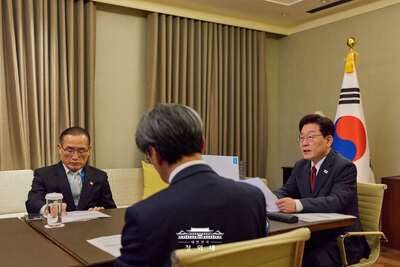
What happens when your ally’s ally becomes someone you negotiate with?
Shenzhen’s APEC reception hall was designed for ceremony, not diplomacy. Yet something quietly consequential unfolded near the exit on November 18.
President Lee Jae-myung had just shared a toast with Xi Jinping. Vladimir Putin was exiting the same room. They crossed paths — or perhaps deliberately did — and spent roughly ten minutes walking and talking. Ten minutes. That is all it took for Seoul and Moscow to map out how far their relationship can stretch without snapping.
The Blue House confirmed what everyone immediately understood: these two leaders discussed North Korea, the Korean Peninsula situation, and the broader deterioration of regional stability. Both expressed agreement on preventing further escalation. Both signaled willingness to find cooperative areas even within an already strained bilateral relationship.
That phrase alone carries enormous weight coming from the current leadership in Seoul.
Who loses when the US blinks toward Moscow
The geometry of great-power diplomacy has always favored those who sit at the table first. The question now is whether South Korea will remain a secondary participant in Washington’s revised strategy toward Russia, or whether it has already decided to secure its own seat.
Trump’s second term appears to be moving toward some form of outreach to Moscow — whether through energy deals, sanctions relief, or a negotiated framework around Ukraine. When Washington shifts its center of gravity eastward toward diplomatic engagement with Putin, every American ally along the Pacific rim faces a decision point. Japan has been clear about its concerns. Taiwan watches silently. South Korea seems to be choosing a different path entirely.
Ten minutes with Putin is not a policy shift on paper. It is something more dangerous: it is a policy adaptation in progress.
The three-presidents problem
During this same APEC gathering, Lee also met with Xi Jinping and Donald Trump. He reportedly delivered Korea’s position on peninsula affairs during each conversation separately. That is the visible record. What remains unclear — and intentionally vague according to the Blue House senior official’s comments — is whether any coordinated discussion among the three powers addresses North Korea specifically, or whether their real agenda centers on nuclear reductions involving Iran and Ukraine instead.
North Korea’s military involvement in Russia’s war against Ukraine complicates everything. If Pyongyang has committed combat forces to Moscow’s campaign, then Seoul faces an enemy state actively strengthening one of its most important partners. Any direct dialogue with Putin about Korean security issues operates in that shadow.
The Russian position, as heard by Lee, apparently covered broad themes: inter-Korean relations, US-North Korea dynamics, and the general trajectory of peninsula tensions. No specific agreement was reached. No formal pathway was laid down. But the fact that Putin received such a comprehensive briefing directly from the South Korean president — rather than through intermediaries or back channels — establishes a new baseline of access.
Why ‘second Yalta’ anxieties miss the mark
Some analysts have floated the possibility that an upcoming US-China-Russia summit could recreate something resembling the 1945 Yalta Conference, where Great Power decisions determined the fate of smaller nations without their consent. The comparison has limitations that the Blue House official acknowledged bluntly: China considers itself a victim of Yalta-era arrangements, not their architect.
The strategic interests of Washington, Beijing, and Moscow diverge too sharply today for such coordination to replicate mid-twentieth-century patterns. But the deeper concern runs elsewhere. It is not about a tripartite agreement that excludes Seoul. It is about the slow erosion of alliance cohesion as individual members pursue parallel tracks with adversarial powers.
Japan knows this pattern intimately. Its own historical encounters with great-power bargain-making at its expense are not abstract memory. Tokyo’s government is watching closely as Seoul moves in directions Washington appears uncomfortable with but cannot easily prevent.
The trilateral test ahead
The US-ROK-Japan trilateral framework, strengthened considerably over the past two years, faces its first real structural stress test. Coordination requires alignment on threat assessment before action. If Seoul concludes that Russia holds leverage over North Korean behavior that Washington refuses to engage with directly, the practical foundation of trilateral unity cracks from within.
Japan’s response will determine whether the partnership adapts or fractures. Historical precedent suggests containment — increased bilateral defense cooperation outside the trilateral umbrella, greater emphasis on Japan-US bilateral mechanisms, and diplomatic pressure on Seoul to rein in independent initiatives. Japan lacks both the willingness and the capacity for公开 criticism of a democratic ally, but strategic patience does not mean strategic passivity.
What happens next
This ten-minute encounter should be read as part of a broader sequence, not a standalone event. Seoul has signalled repeatedly that it views independent diplomatic channels as necessary infrastructure, especially when Washington’s priorities drift. Whether that calculation serves Korean interests in the medium term depends on how aggressively Moscow leverages this renewed contact and what concessions it demands in return.
North Korea’s leadership understands the geometry perfectly. Any friction between Seoul and Washington creates openings in Pyongyang. Moscow’s recent investment in that dynamic is unlikely to diminish simply because two presidents exchanged remarks at an exit door.
The Korean Peninsula may soon face a reality its diplomats have worked for decades to avoid: being discussed by other people’s governments without being present at the table. That moment does not arrive with a single handshake. It arrives incrementally, across a series of calculated meetings like the one in Shenzhen — brief enough to deny, significant enough to matter.