South Korea's Human Wall: Lawmakers Indicted for Blocking Presidential Arrest
Four ruling party lawmakers face indictment for allegedly forming a human wall to block the arrest of former President Yoon Suk Yeol. The case exposes deep institutional fractures in South Korea and raises questions about alliance stability with the United States.
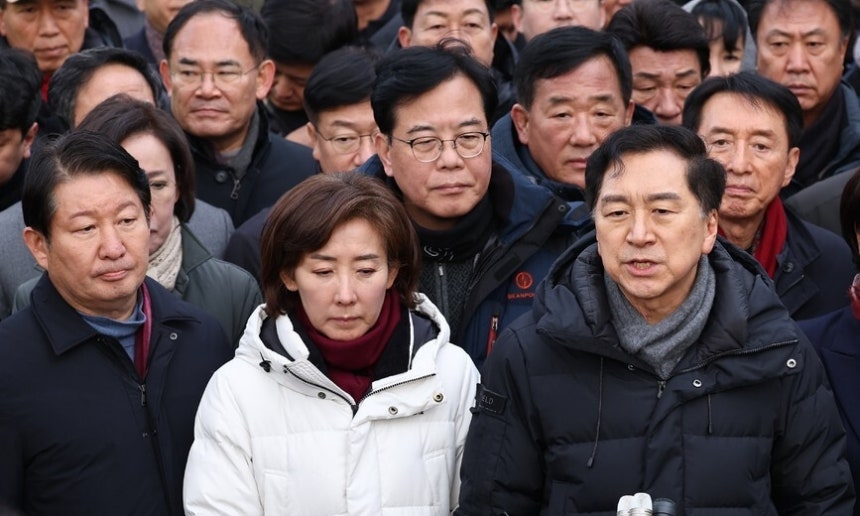
A Line Drawn in Seoul
When four members of South Korea’s ruling People Power Party (PPP) stood shoulder‑to‑shoulder with dozens of supporters to physically block police from executing an arrest warrant against former President Yoon Suk Yeol, they did more than delay a legal process. They drew a line between elected authority and state power—a line that, if crossed, could redefine the country’s democratic contract.
The indictment, disclosed by news agency Newsis on Feb. 23, charges Kim Ki‑hyun, Na Kyung‑won, Kwon Young‑jin, and Yoon Sang‑hyun with special public‑duty obstruction. According to the special investigation team (내란특검팀) led by Special Prosecutor Jo Eun‑seok, the lawmakers arrived at the presidential residence in Hanam‑dong, Seoul, around 4:50 a.m. on Jan. 15 last year. They formed a five‑row “human wall” with 60‑70 supporters and blocked entry for roughly two hours, forcing investigators to retreat until a full contingent could safely execute the warrant at 10:33 a.m.
What makes this case politically seismic is not merely the act of obstruction but the symbolism: sitting lawmakers using their official status to shield a former president from arrest. The prosecution alleges the group coordinated via a chat message posted the day before, calling for volunteers to gather at dawn. They then positioned themselves in front—Kim in the first row, Yoon and Kwon in the second, Na in the third—actively resisting the Constitutional Investigative Agency (공수처) officers.
The Legal Hurdle
Indictment is only the beginning. The central question at trial will be whether the prosecution can prove “violence or threat”—a required element for the obstruction charge. The current bill relies heavily on digital forensics: nearly 94 GB of on‑site video, audio recordings of shouted exchanges, and testimony that the lawmakers collectively exerted “multitude authority” over roughly 50 officials.
But precedent warns against assuming a straightforward conviction. The same special investigation team had previously reviewed similar evidence and declined to indict, citing insufficient proof of physical force or explicit threats. Legal analysts note that shouting “stop the illegal arrest” from behind a human barrier may not meet the threshold for criminal intimidation.
If the court acquits, the ruling party will argue the prosecution overreached; if it convicts, it will set a precedent that could criminalize future political protest. Either outcome will deepen the partisan rift.
Who Wins, Who Loses
For the PPP, these four lawmakers have become instant icons among Yoon’s supporters. Their indictment transforms a legal maneuver into a political martyrdom narrative—one that resonates in a country where nearly half the electorate still views Yoon’s ouster as illegitimate. The party’s leadership, however, faces a dilemma: defend the lawmakers and risk further eroding institutional trust, or distance itself and alienate its base.
For the progressive coalition that forced Yoon’s removal, the case is a test of consistency. The Constitutional Court and parliamentary majority argued that the former president violated democratic norms by attempting to impose martial law. Blocking his arrest now must be framed as a defense of the rule of law, not partisan vendetta. If the courts find the lawmakers’ actions criminal, it validates the entire impeachment process. If not, it weakens the moral authority of the reform bloc.
For ordinary South Koreans weary of political churn, the spectacle reinforces cynicism. Opinion polls already show declining trust in legislative and judicial institutions. The crisis does not occur in a vacuum—it follows years of street protests, impeachment, and a presidency that ended in dramatic confrontation.
Alliance Anxiety
International observers often miss the strategic dimension of this domestic drama. South Korea is the United States’ most important treaty ally in East Asia, hosting roughly 28,500 American troops and serving as a linchpin against North Korean aggression and Chinese expansion.
When a country’s top legal institutions appear unable to enforce an arrest warrant without risking a constitutional crisis, Washington takes note. Defense planners rely on predictable partner governments for joint exercises, intelligence sharing, and extended deterrence commitments. Internal instability—even if temporary—creates uncertainty about South Korea’s ability to sustain a unified security posture.
The U.S. Embassy has publicly urged “respect for the rule of law,” a carefully neutral statement that nonetheless signals concern. Beijing and Pyongyang, meanwhile, watch for signs of diplomatic distraction. A South Korea consumed by political warfare is less likely to escalate tensions on the peninsula—but also less likely to rally firmly around the alliance if crisis strikes.
What Happens Next
The trial will likely take months, with verdicts possible by late 2025 or early 2026. In the interim, the PPP will push for legislative reforms to limit the prosecutorial power of the Constitutional Investigative Agency, a body created after the 2016 Park Geun‑hye impeachment. Several bills have already been introduced in the National Assembly, reflecting the party’s intent to roll back what it sees as politically biased oversight.
President Yoon, now a private citizen, has not commented directly on the obstruction case. His legal team is separately fighting a cascade of corruption charges that could keep him out of prison—or, if convicted, behind bars.
For the global audience, the takeaway is clear: South Korea’s democracy is not broken, but it is visibly strained. The human‑wall incident is a symptom of a deeper disease—how a society handles a leader accused of undermining the very system that brought him to power. The outcome of this case will tell us whether South Korea’s institutions can withstand the pressure, or whether the line between political resistance and constitutional disorder remains dangerously blurred.