Space's Brightest New Stars Are Ruining the Night Sky
A new ESO study warns that 1.77 million planned satellites could make ground-based astronomy impossible. The FCC just approved one company's mirror satellite anyway — and the race is accelerating.
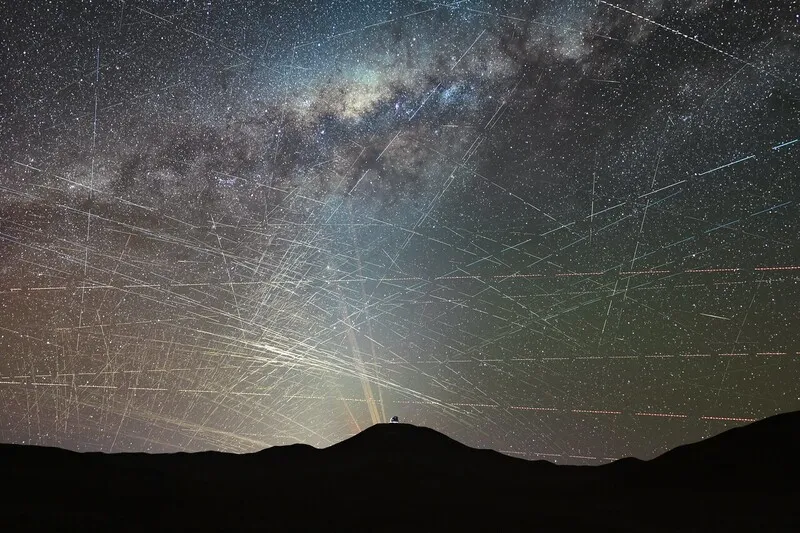
The Night Sky Is About to Change Forever
Ground-based astronomy is facing an extinction-level event. It is not caused by climate change, asteroid impacts, or any natural phenomenon. It is being caused by a spreadsheet — a filing with the International Telecommunication Union.
A study from the European Southern Observatory, published this week in the journal Astronomy & Astrophysics, models what happens when all currently proposed satellite constellations reach completion. The answer is stark: ground-based optical observation becomes critically degraded, possibly untenable. Not in fifty years. Not in twenty. The worst projections involve over 1.77 million satellites crowding low Earth orbit within a single generation.
The trigger was Starlink. SpaceX launched its first internet satellites in 2019, and the floodgates opened. As of now, about 16,100 satellites orbit the Earth according to the European Space Agency. But the plan that has already been approved is merely the beginning. The filings tell a different story entirely.
The 1.77 Million Number
Thirty-three large constellation proposals have been submitted to the ITU. Add them up and you get 1,766,623 satellites. That figure does not include SpaceX’s most recent announcement — a separate plan for 100,000 additional Starlink satellites. It also does not include the 1,000,000-spacecraft proposal from SpaceX for its so-called Space Data Center constellation, which sits in a separate, pending filing.
The breakdown reads like a map of who is racing for orbital real estate:
- SpaceX: 1 million satellites (Space Data Center) — in development
- E-Space / Rwanda: 300,000 satellites (Cinnamon constellation) — proposed
- China: roughly 200,000 satellites across十余个 proposed constellations — advancing
- Reflect Orbital: 50,000 satellites (space mirrors) — in development
- Others: including smaller proposals from various operators
Each number represents not just hardware but a claim on the darkest remaining resource on Earth: the night sky above places like the Atacama Desert in Chile, where the world’s most powerful telescopes sit perched at 2,636 meters.
What the Simulation Actually Shows
The ESO study used simulations to project what two hours of observation at the Very Large Telescope would look like under different constellation scenarios. The result for Starlink alone: dozens of visible satellite trails in a single exposure, increasing sky background by up to 28 percent in affected regions of the field of view. That is not a minor nuisance. For research that depends on detecting faint, distant objects — exoplanets, early galaxies, near-Earth asteroids — a 28 percent increase in background brightness is devastating.
But Starlink is expected to be dimmed. The satellites were designed to be relatively dark, and SpaceX has been adjusting their reflectivity. The newer threat, according to the study, is far brighter.
The Mirror Satellite Problem
Reflect Orbital proposes 50,000 space mirrors — literally enormous mirrors in orbit designed to reflect sunlight onto Earth’s surface. The company aims to have them operational by 2035. Each mirror would illuminate an area of more than 5 kilometers across. Even one such mirror, the study notes, would be four times brighter than a full moon when viewed through a telescope, and as bright as Venus when seen from the ground — even when not aimed directly at the observer.
The cumulative effect would raise the brightness of the entire night sky above observatories by a factor of three to four. In cities with already severe light pollution — Munich, for example — the only stars visible to the naked eye might be these satellites. The Vera Rubin Observatory’s 3.2-gigapixel camera, designed to scan the entire visible sky every few nights, would be compromised by a single satellite trail.
This is not hypothetical. The physics are settled. What is not settled is whether the satellites will actually be launched.
Where the Law Stands
Here is where the story turns into a policy fight — and why Korean coverage of this topic matters. The FCC recently approved Reflect Orbital’s demonstration mirror satellite. The agency justified the decision on grounds of maintaining “U.S. space leadership.” The ESO, working with the Royal Astronomical Society and the International Astronomical Union, had formally opposed the approval, calling optical astronomy an “existential threat.”
SpaceX’s Starlink has already received broad approval and continues expanding. The company’s Space Data Center proposal — one million satellites — remains pending. The Chinese constellations are advancing in parallel. The race is not hypothetical; it is already happening in real time, measured in launches per quarter.
The 100,000 Threshold
Olivier Hainaut, the ESO astronomer who led the study, draws a line at 100,000 satellites. Above that number, he argues, the data loss from satellite interference exceeds what astronomers can tolerate — surpassing even the downtime caused by equipment failures. Below that number, with strict brightness caps, ground-based astronomy might survive.
The specific recommendation is simple: cap satellite brightness at magnitude 7 or below and limit total constellation size to 100,000. A magnitude-7 object is only about two and a half times dimmer than the faintest star visible to the naked eye under ideal conditions. The math is straightforward. The political will is not.
Why This Matters Beyond the Telescope
The consequences extend well beyond academic astronomy. The same instruments that track distant galaxies also monitor near-Earth objects — asteroids that could threaten the planet. Diminished observational capacity means diminished planetary defense. The study also flags ecological and atmospheric impacts: disruption of biological rhythms, air quality effects from launch exhaust and re-entry debris, and the broader question of how much of Earth’s orbital environment we are willing to consume before it is gone.
Hainaut’s framing captures the scale: low Earth orbit is “the sky beach of modern life,” a resource that provides enormous value but is being consumed faster than anyone is regulating it. The analogy is apt. A beach filled with debris is still a beach, but it is no longer swimmable.
What Happens Next
The FCC now holds the decision on Reflect Orbital’s full constellation. The ITU manages spectrum and orbit allocations but lacks enforcement teeth. National regulators act in fragments. There is no global treaty governing satellite brightness or density. The international astronomical community has filed protests. The commercial space industry is proceeding on schedule.
Korean media coverage of this issue reflects a growing awareness in East Asia that orbital space is a shared resource — one that no single country, including the United States, should monopolize. South Korea operates its own astronomical infrastructure and has its own stakes in preserving the night sky. The fact that a Korean newspaper is publishing detailed analysis of an ESO study, with full transparency about the data and the stakes, signals that this is becoming a global conversation, not a Western one.
The next few years will determine whether the night sky remains accessible to ground-based science — or whether future astronomers will inherit a sky full of moving points of light and very little else.