Space Solar Mirrors Could Light the Night or Blind a Nation
A California startup just won FCC approval to beam concentrated sunlight from orbit — a technology that promises clean energy but raises questions about retinal safety, astronomical interference, and the dual-use risks of directing solar power from space.
The Brightest Thing in Your Sky Could Be a California Startup
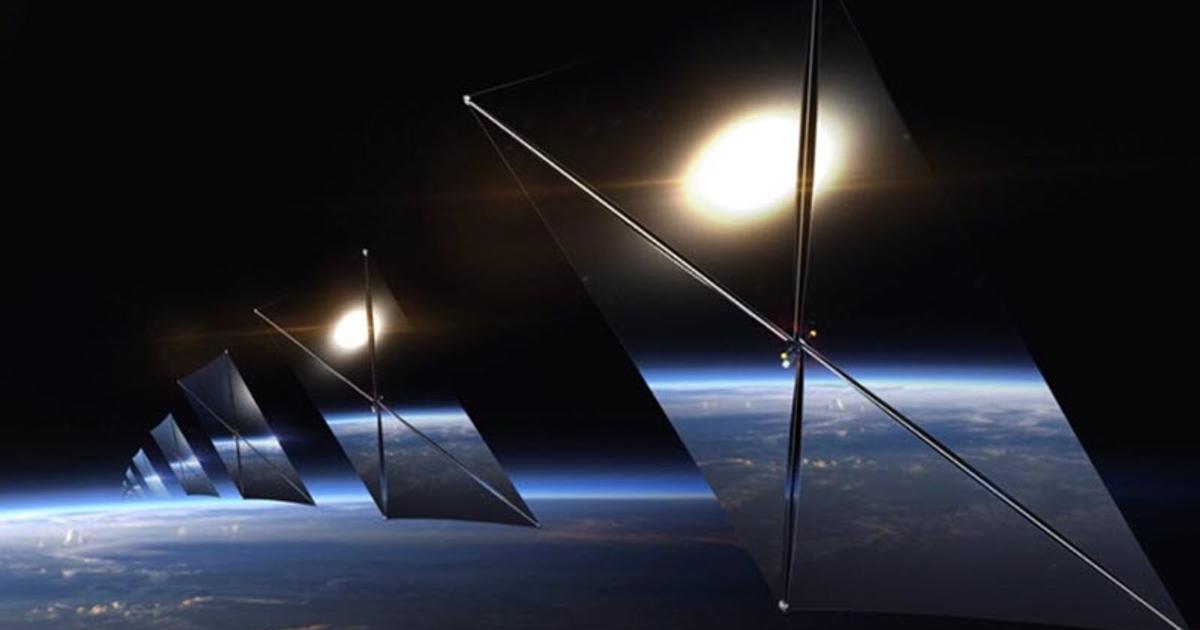
Reflect Orbital just won permission from the Federal Communications Commission to launch a prototype satellite that reflects sunlight directly onto Earth. The company wants to deploy up to 50,000 mirrors in low Earth orbit — each one a programmable beacon capable of illuminating a patch of ground up to five kilometers wide at night. The first test vehicle, named Eärendil-1, is slated for launch in the second half of this year.
The pitch is straightforward enough: use space-based solar mirrors to light remote villages, guide disaster relief, or supplement grid power where solar panels can’t reach at night. Reflect Orbital says its system would operate only with local government approval, at requested times, and at controllable brightness levels. The company frames itself as a climate solution — one that turns the dark into a resource.
The physics, however, are brutally simple. The reflected beam would hit the ground at 0.8 to 2.3 lux. A full moon provides roughly 0.05 to 0.3 lux. That means the satellite’s glow could be ten to forty times brighter than moonlight — concentrated into a narrow beam aimed directly at populated areas.
And aimed at your retina.
What Happens When Someone Looks Up Through a Telescope
The warning from experts is blunt. Eric Bretschneider, an engineering engineer and LED lighting specialist, told NBC that the mechanism of injury is identical to the danger of viewing a solar eclipse without protection. The sun’s rays are simply too intense — the question is not whether someone will suffer permanent vision loss, but when.
Robert Massey, deputy secretary of the Royal Astronomical Society of the UK, put it more directly in a statement to The Verge: an amateur astronomer who happens to point a telescope at the satellite could be blinded in seconds. Not someday. Not maybe. The optics of a telescope gather and concentrate light by design. Point one at a beam that is already tens of times brighter than moonlight, and the damage is immediate and irreversible.
This is not hypothetical. The same concern has haunted every proposal to beam energy from space since the concept was first discussed in the 1970s. But previous iterations were academic exercises or government programs with decades of safety review behind them. Reflect Orbital is a startup. Its prototype is approved for launch with minimal environmental scrutiny and no binding commitment to keep the beam away from observers.
The Regulatory Vacuum Is the Real Story
The FCC approved the launch application. Four environmental groups immediately filed a petition to revoke that decision. DarkSky International, the leading advocacy organization for light pollution, issued a statement calling for transparency, environmental impact assessment, and public accountability before any deployment proceeds. None of those safeguards are in place.
Here is what that omission tells you: there is no existing regulatory framework for directed solar energy from orbit. The FCC’s mandate covers spectrum and launch licensing, not retinal safety or ecological impact. International law — the Outer Space Treaty of 1967, the Liability Convention — addresses state responsibility and damage caused by space objects, but it was written before anyone imagined a private company turning the night sky into a controllable flashlight.
That gap is not an accident. It is a structural feature of current space governance. No treaty requires a company to prove its orbital beam will not blind civilians. No agency evaluates the cumulative effect of thousands of mirrors on night skies across multiple continents. No body exists to mediate between a startup’s commercial ambitions and the rights of astronomers, indigenous communities, or farmers whose land might be illuminated against their will.
The Dual-Use Problem Nobody Is Discussing
The most consequential risk of space-based solar mirrors is not that they will malfunction. It is that they will work exactly as designed.
A satellite capable of concentrating sunlight into a precise, controllable beam is, at its core, a directed-energy system. The same optical architecture that delivers light to a remote clinic can, with different intent, be used to harass, intimidate, or coerce. A beam aimed at a capital city at 2 a.m. is not an energy grid — it is a demonstration of capability. A beam focused on a military installation, even at low intensity, constitutes surveillance and signaling. The threshold between illumination and intimidation depends entirely on who controls the switches.
Reflect Orbital insists it will retain full control at all times, that satellites launch in an off state, and that no light will reach the ground without explicit authorization from local authorities. That is a corporate policy, not a legal guarantee. It offers no protection against unauthorized access, accidental activation, or adversarial takeover. It also raises an uncomfortable question: if the technology can be sold to one government, why not another?
This is the classic dual-use dilemma, played out at orbital altitude. The same innovation that powers clean energy also enables coercive signaling. The difference between a utility and a weapon often comes down to nothing more than intent and oversight — both of which are in short supply here.
Who Wins, Who Loses, and What Comes Next
The winners, for now, are the companies and governments that see space-based solar as a strategic asset. Reflect Orbital has cleared its first regulatory hurdle. Its prototype is approaching launch. If Eärendil-1 performs as expected, the company will move quickly toward the full constellation — thousands of mirrors, global coverage, and a revenue model built on selling darkness to the light-starved.
The losers are harder to name but easier to identify. Amateur astronomers lose the night sky. Professional observatories lose observing time to scattered light. Communities near the satellite’s ground track lose the ability to experience darkness as a natural condition. And civilians who look up — accidentally, knowingly, or through a telescope — lose their vision.
The next twelve months will be decisive. Eärendil-1’s launch and testing phase will determine whether the technology works at scale and whether the safety concerns are real or theoretical. The FCC’s response to the petition to revoke approval will set a precedent for how loosely or tightly space-based directed energy is regulated. Observatories worldwide are watching to see whether their skies remain protected or become collateral damage in the push for orbital solar power.
The technology is real. The appetite for it is growing. The safeguards are not. That imbalance is what makes this moment matter — not just for astronomers or energy investors, but for anyone who cares about who gets to control the sky.