SpaceX's Cell Tower Play Upends Telecom
SpaceX is negotiating for 80,000 cell tower sites to build a fourth nationwide wireless carrier — a move that rewards tower owners like Crown Castle while putting pressure on Verizon, AT&T, and T-Mobile.
SpaceX Just Built a Land Network for a Space Company
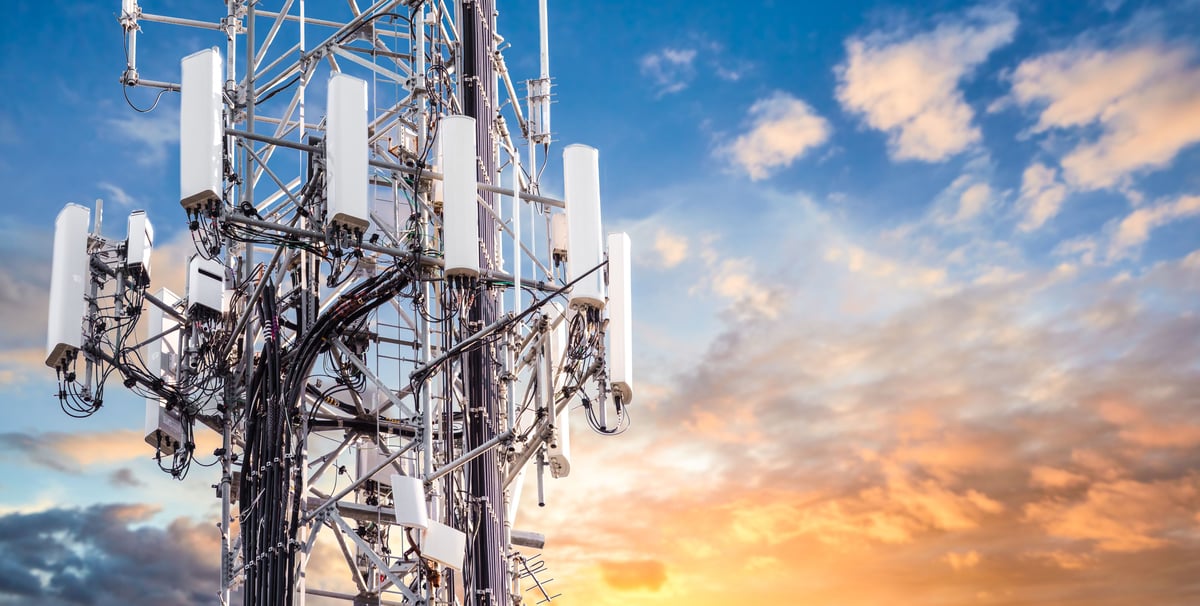
On Thursday, Bloomberg reported that SpaceX is in talks to secure at least 80,000 cell sites across the United States as it aims to become the fourth nationwide wireless carrier. Eighty thousand towers represent roughly half of all purpose-built cell towers in the country. That is not a side bet. That is a land grab.
By Friday, the market had already priced in the drama. Crown Castle rose nearly 9 percent. American Tower gained over 4 percent. Verizon, AT&T, and T-Mobile all fell sharply — AT&T down nearly 8 percent, T-Mobile down nearly 8 percent. The same company that made headlines on October 9 for buying $8 billion in low-frequency wireless spectrum had, within weeks, moved from spectrum buyer to potential tower tenant on a massive scale.
The velocity of the news cycle — from spectrum purchase to tower negotiations to full market reaction — underscores how quickly the telecom sector’s assumptions are being rewritten. Investors are not merely reacting to a story. They are adjusting their entire model for what a fourth carrier could mean.
Why Tower Companies Are the Real Winners Here
Cell tower economics are deceptively simple. The owner builds the tower and rents shelf space to carriers under long-term leases. Add a tenant and you add revenue with almost zero incremental cost. Since Sprint folded into T-Mobile, the tower industry has essentially had three wireless customers per site. A well-capitalized fourth tenant — even one that would be starting from scratch — changes the math for landlords.
Crown Castle was specifically named in reports as a company SpaceX is discussing terms with. If those talks produce leases, each tower on Crown Castle’s network could pick up a new ring of transmission equipment. The same logic applies to American Tower. These companies do not need SpaceX to win customers to make money. They need SpaceX to sign contracts and pay rent.
That is why the tower stocks responded so cleanly. The signal is straightforward: more tenants, higher utilization, limited capex on their end. The second-order effect is more significant than the headline move. Tower companies have spent the last three years managing growth expectations after the Sprint-T-Mobile merger compressed their tenant base. Any credible path back to multiple new tenants — especially one backed by Elon Musk’s capital and ambition — reopens their growth narrative in a way the market had written off.
The Spectrum Purchase Makes the Tower Play Make Sense
SpaceX’s August purchase of low-frequency spectrum — the kind that travels farther and penetrates buildings better — was always going to require large towers rather than small rooftop cells. Low-band spectrum demands height and reach. Small cells are an urban coverage solution. Low-band is a rural and suburban play. The two strategies serve different networks.
For months, SpaceX management described its terrestrial ambitions as rooftop-mounted small cells. The spectrum purchase flipped that narrative. Low-band spectrum makes large towers far more useful. It also makes leasing 80,000 existing towers far more plausible than building 80,000 new ones from the ground up. The pivot is not inconsistent. It is adaptive.
The spectrum deal itself was structured through a secondary market transaction, buying from a consortium that included Liberty Media and other institutional holders. That meant SpaceX did not need to win a FCC auction. It meant the spectrum was already cleared and transferable. The speed of that acquisition — announced October 9 — left competitors with less time to respond. By the time the tower negotiations broke, the strategic posture had already shifted from speculation to execution.
What Happens When a Space Company Becomes Your Phone Provider
The telecom industry has seen a fourth carrier before. Dish Network spent years trying to build a competing nationwide 5G network, signing long-term tower leases along the way. By 2025, Dish’s parent company had sold most of its spectrum and begun shutting the network down. The attempt failed. SpaceX is not Dish. It has deeper pockets, a proven launch cadence, and a brand that carries weight in both tech and policy circles.
But failure is not impossible. Building a competitive network takes years. SpaceX would enter with no wireless subscribers, less spectrum than any of the big three, and a commercial launch not expected until late 2027 at the earliest. Carriers have decades of customer relationships, billing infrastructure, and retail presence to defend. Sprint did not collapse the major carriers. Pricing power has not shifted dramatically since the number of competitors dropped to three. A fourth carrier creates pressure. It does not guarantee collapse.
The real disruption may come from something the big three have struggled to replicate: a vertically integrated model. SpaceX designs rockets, builds satellites, operates ground stations, and now plans to lease towers and sell wireless service. That kind of end-to-end control is foreign to the incumbent carriers, whose businesses are separated across hardware procurement, network operations, and retail distribution. If SpaceX can price aggressively — a common assumption given its cost discipline — even a modest share shift could force margin compression across the sector.
The Regulatory Question No One Is Asking Out Loud
If SpaceX — a company that already operates Starlink satellites and holds significant federal contracts — becomes your phone provider, the regulatory landscape changes. The FCC would need to evaluate whether a space company with government ties deserves preferential spectrum treatment. State regulators would weigh in on tower siting and lease disputes. Antitrust scrutiny would follow any merger or acquisition activity. None of this is unique to SpaceX. But the combination of space assets, terrestrial spectrum, and government contracts creates a novel profile that regulators have not yet handled.
There is also the question of national security. Starlink already provides connectivity to defense and intelligence agencies. A terrestrial wireless network owned by the same company raises eyebrows in Washington. Expect questions about data routing, encryption standards, and whether a private space company should control any portion of America’s communications backbone. These issues do not appear in stock reports. They will shape the timeline and scope of SpaceX’s entry.
What This Means for Investors
The tower companies’ rally looks justified on fundamentals. More tenants means more rent. The risk is that talks fall apart and the market had already priced in a deal that never signed. Crown Castle specifically was named in discussions, but no contract exists yet. Management has not confirmed anything publicly.
The carrier selloff looks overdone on timeline. SpaceX faces a multiyear buildout, subscriber acquisition从零开始, and real execution risk. The big three carriers still hold the majority of spectrum, the vast majority of subscribers, and entrenched distribution networks. A potential competitor on paper is not the same as a competitor in market share.
The smart move is patience. Watch for contract announcements, not stock reactions. The tower plays have a real thesis behind them. The carrier panic does not yet. SpaceX is building something unusual — a network that connects ground and orbit — but the ground portion is still several years away from proving itself.
The Bigger Picture: Convergence Is the New Moat
What makes this move distinct from every prior attempt at a fourth carrier is the convergence angle. SpaceX is not simply entering wireless. It is linking satellite and terrestrial service under one brand. Consumers who already use Starlink for home internet or RV connectivity may find a bundled wireless plan attractive. That cross-sell potential does not exist for Dish in 2025. It barely existed for Sprint in 2013. And it creates a pricing and retention dynamic that incumbents cannot easily replicate without their own satellite assets.
If the tower leases go through and the spectrum deployment executes on schedule, the result is a carrier with a infrastructure advantage no traditional telco can match: direct access to orbital capacity that can fill coverage gaps where towers cannot reach. That is the story the market is pricing in right now. The question is whether it turns into revenue before the buildout drags on and investor impatience sets in.