SpaceX's Double-Catch Attempt: Reusability's Leap Toward Affordable
SpaceX prepares for Flight 15, an unprecedented attempt to catch both Starship stages mid-air—a milestone that could slash launch costs and reshape the space economy.
A Single Weekend That Could Redefine Space Economics
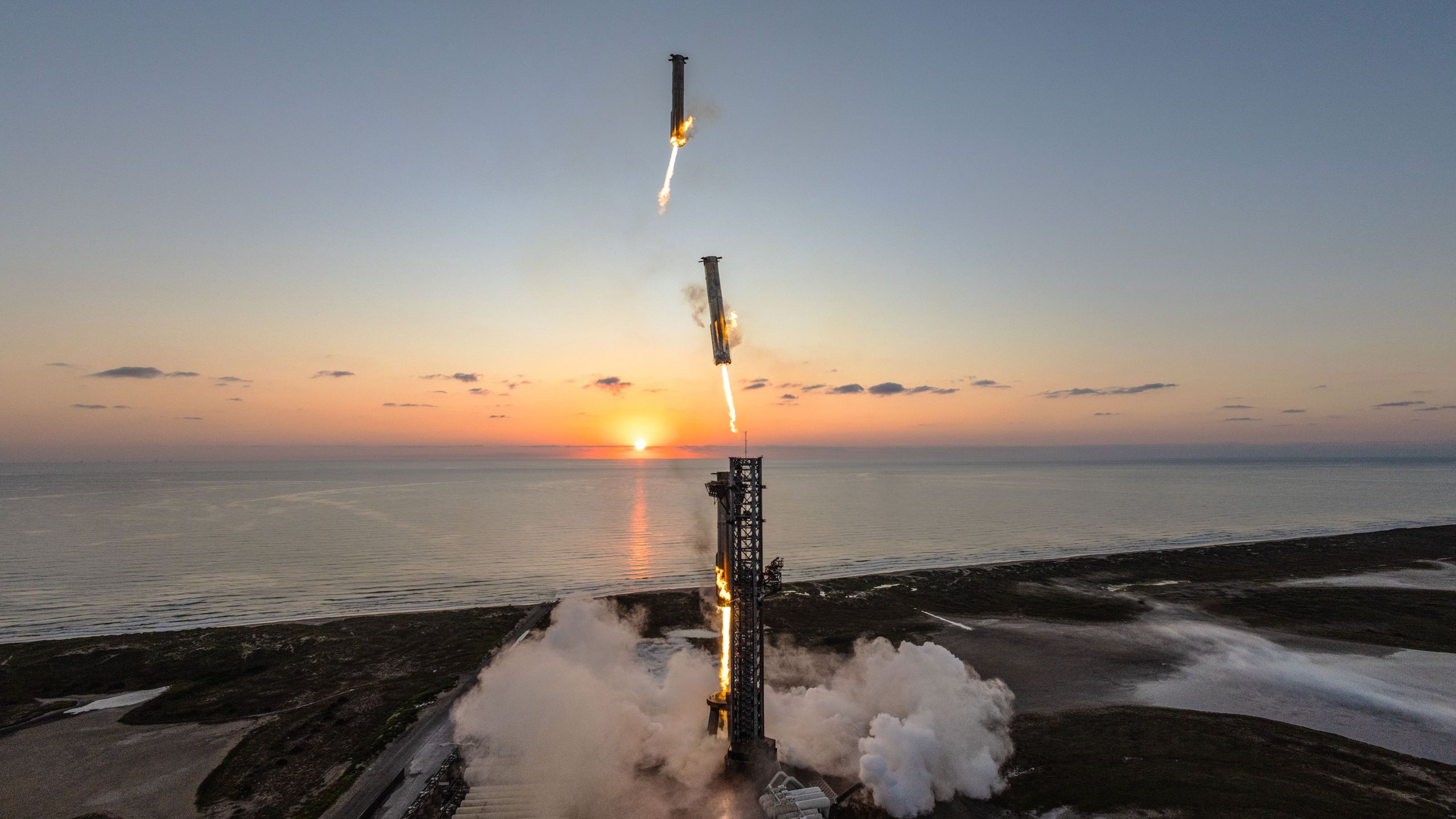
Today’s Starship Flight 15 is not merely another test—it is a live demonstration of whether orbital transport can become as routine as air freight. The aim: recover both the Super Heavy booster and the Starship upper stage by catching them with the launch tower’s mechanical arms, a maneuver never attempted at this scale. Success would mark the first full recovery of a two-stage orbital system, a prerequisite for the rapid turnaround SpaceX envisions.
The window opens at 5:45 p.m. EST from Starbase, Texas. If the plan holds, Super Heavy returns in six and a half minutes, while Starship remains in orbit for more than twenty hours, deploying twenty-six Starlink V3 satellites before attempting its own catch on Saturday afternoon. Any anomaly triggers a fallback to ocean splashdown, but the ambition is unmistakable: minimize handling, maximize reuse.
Super Heavy has already been caught three times by SpaceX, each time demonstrating increasing precision. The mechanical arms—colloquially called “chopsticks”—grab the booster mid-descent, eliminating the need for landing legs and allowing the vehicle to return to processing almost immediately after touchdown. This particular flight adds a second layer of complexity: catching Starship itself requires managing a vehicle traveling at hypersonic velocities through the atmosphere, enduring thermal loads far beyond what the booster experiences.
Why the Chopstick Catch Matters Beyond Drama
Public enthusiasm often treats these landings as spectacular stunts. Beneath the fireworks lies a commercial imperative. Current reusable designs require extensive refurbishment between flights; Starship’s architecture assumes inspection and reflight within hours. Achieving that rhythm depends on recovering vehicles in one piece, intact enough for direct processing. A damaged engine or cracked heat shield forces costly repairs and delays—luxuries that a high-frequency launch cadence cannot afford.
SpaceX’s prior catches of Super Heavy prove the concept at booster level. Catching Starship is harder because it travels faster and farther, enduring higher thermal loads during reentry. The company itself notes that full recovery unlocks “rapidly reusable” operations, a phrase carrying heavy financial weight. Lower per-kilogram pricing could unlock markets now constrained by economics: large constellation deployments, commercial space stations, cargo delivery to the Moon.
The economics are stark. Traditional expendable rockets cost roughly $2,000 to $5,000 per kilogram to reach low Earth orbit. SpaceX has driven those numbers down significantly with Falcon 9 reuse, but Starship promises a further order-of-magnitude reduction if full reusability is achieved. Analysts estimate that successful double-catch operations could bring launch costs below $500 per kilogram—a threshold that fundamentally changes what missions make financial sense.
Consider the secondary implications. Insurance premiums, currently a significant line item for satellite operators, would drop alongside reduced failure risk. Launch slots, already booked months in advance for popular providers, could compress into days or weeks. Satellite manufacturers, who currently design for single-use vehicles with generous mass margins, would need to rethink their approach entirely.
Winners, Losers, and the Stakes for Global Competition
If Flight 15 delivers a double catch, the immediate beneficiary is SpaceX’s launch pricing power. Competitors using expendable or partially reusable systems face pressure to innovate or accept niche roles. Government partners gain confidence that the vehicle can meet Artemis lunar logistics demands. Industries reliant on affordable satellite deployment—from telecom to Earth observation—stand to gain from lower insurance premiums and faster launch slots.
Conversely, failure carries reputational risk and may delay contracts tied to Starship’s availability. NASA and other agencies have aligned their roadmaps around the vehicle’s timeline; setbacks could shift payloads to alternative providers, however limited their capacity. Internationally, rival programs in China, Europe, and India will monitor closely, adjusting investment strategies based on perceived U.S. momentum.
China’s state-led space program, already advancing its own heavy-lift vehicles, would likely accelerate efforts to match SpaceX’s pace. European and Indian commercial actors might seek partnerships rather than standalone development, recognizing the capital advantage Full reusability confers. Even emerging space nations, previously priced out of access, could participate in orbital economies once transportation costs fall dramatically.
What Comes Next Determines the Timeline
The real test extends beyond today’s attempt. Even with a successful catch, proving repeatable reuse requires multiple flights under varying conditions. SpaceX plans a high cadence; each iteration must refine procedures for inspection, refueling, and re-flight certification. Regulatory oversight will also intensify—as vehicles become routine, authorities demand evidence of safety and environmental compliance without stifling innovation.
Should the double catch succeed, investors and customers will anticipate a phased rollout: initial Starlink expansions, followed by cargo missions to the International Space Station, then Artemis lander deliveries. The ultimate goal, articulated repeatedly, is full point-to-point Earth transportation and crewed Mars missions—but those depend on establishing reliable orbital supply chains first.
Second-order effects ripple outward. Manufacturing at scale becomes necessary, pushing suppliers toward automated production lines. Ground infrastructure expands at Starbase and potentially at international sites. Workforce growth accelerates, drawing talent from traditional aerospace into a sector that increasingly resembles commercial aviation more than legacy spaceflight.
For now, the focus is singular: can SpaceX catch what flies, twice, in one mission? The answer will set the pace for the next era of spacefaring commerce.
A successful double catch does not end the story—it begins it. The chopsticks that seize returning boosters and spacecraft represent more than engineering triumph; they signal the transition from an industry defined by single-use hardware to one built on rapid, reliable reuse. Every kilogram saved in launch cost compounds across every future mission, every satellite deployed, every scientific instrument launched. The weekend ahead offers a glimpse of that trajectory, visible against the Florida sky.