SpaceX Just Crashed a Rocket into the Moon — and NASA Took a Photo
A Falcon 9 upper stage slammed into the Moon in August 2026, creating a fresh crater NASA has now imaged. The incident reveals how little oversight governs debris in cislunar space — and what that means for everyone racing to build there.
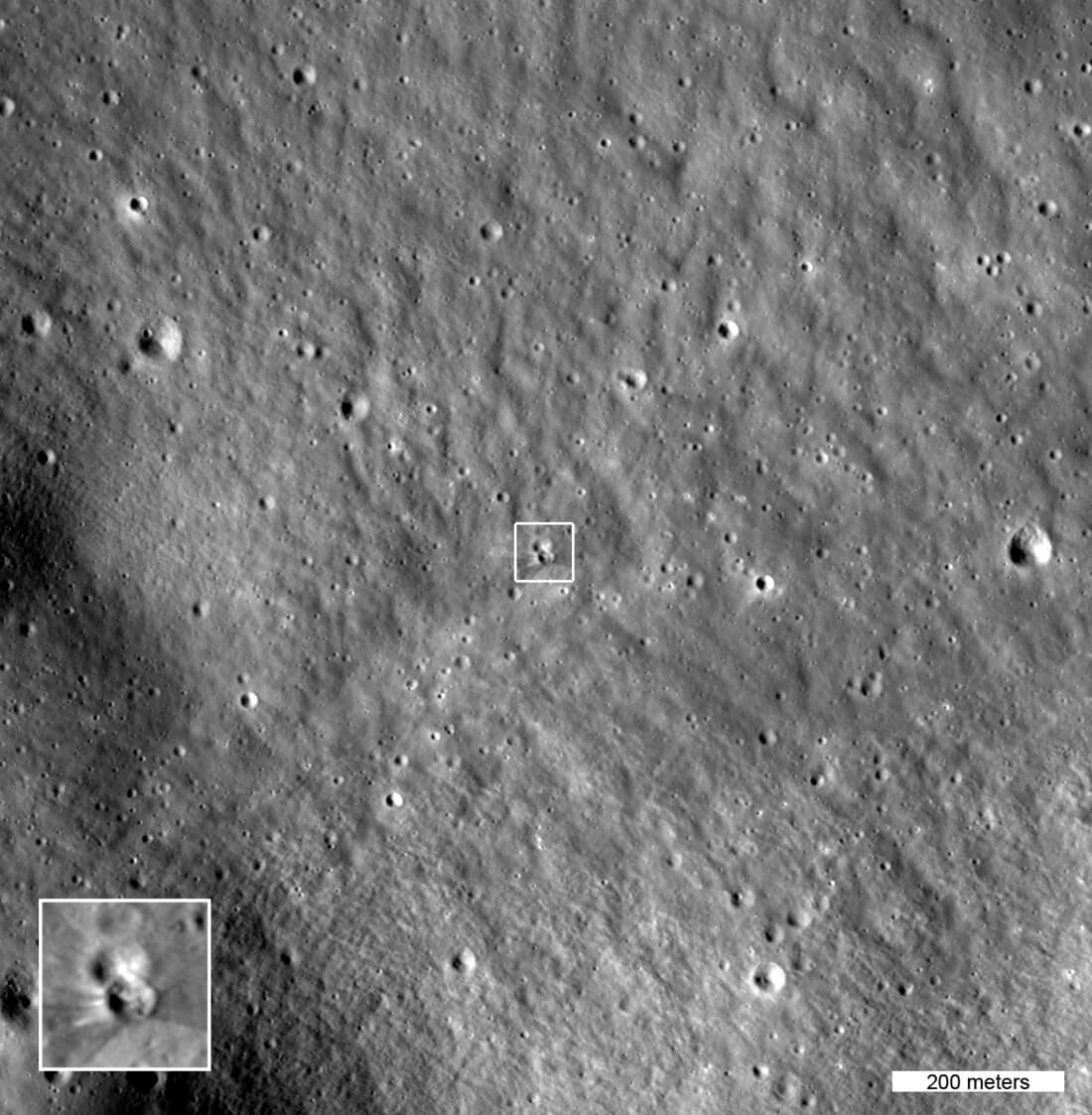
A new crater on the Moon — and nobody really owns it
On August 5, 2026, at 3:35 p.m. Japan Standard Time, a SpaceX Falcon 9 upper stage slammed into the lunar surface. It wasn’t supposed to happen that way. The stage had spent months in transit after launching two commercial landers — Firefly Aerospace’s Blue Ghost and Japan’s ispace RESILIENCE — in January 2025. Its intended fate was a parking orbit, a graveyard trajectory far enough from active landing zones that it would slowly decay over decades. But solar activity during an unusually active period of the sun’s 11-year cycle, combined with gravitational perturbations from Earth and the Moon’s lumpy mass distribution, nudged the stage onto a collision course no one had modeled in real time.
Six days later, NASA’s Lunar Reconnaissance Orbiter captured the fresh crater. It’s roughly 18 meters across and less than 3 meters deep — modest by geological standards, dramatic by human ones. A V-shaped bright ejecta pattern on its southern rim tells the story: the impact came in at a shallow angle of about 31 degrees, spraying regolith in a fan that exposed fresher, less space-weathered material from roughly 45 centimeters below the surface. That exposed layer is a scientific prize. On the Moon, solar wind and micrometeorite bombardment darken and chemically alter the topsoil over millennia. Anything freshly uncovered becomes a time capsule, a chance to read the regolith’s history without centuries of cosmic erosion clouding the signal.
The image is striking not just for what it shows, but for what it implies. An 18-meter crater appeared on the Moon from an object humans built, launched, and then carelessly lost. And no one — not NASA, not SpaceX, not any international body — was really tracking it in the weeks leading up to impact.
The debris problem nobody polices
Meteorites hit the Moon constantly. NASA estimates an impact of similar scale occurs about every six days. The difference is that natural impacts leave no trail of ownership, liability, or policy questions. They are anonymous. This upper stage was not.
It belonged to SpaceX, launched under a NASA contract, carrying equipment from a Korean startup and a Japanese company, and it ended up on the lunar surface without anyone’s explicit authorization. That’s the messy reality of the current cislunar landscape: traffic is real, coordination is thin, and the legal framework hasn’t caught up. The Outer Space Treaty of 1967 holds states responsible for their space objects, including those launched by private companies. Article VIII specifies that a launching state retains jurisdiction and ownership over its registered object. But the treaty, drafted during an era when spaceflight was a government monopoly, says nothing about where you can park or dump rocket stages, what constitutes contamination of a celestial body, or who gets to decide whether a commercial disposal maneuver is acceptable.
The Moon’s South Pole — the target of nearly every current mission, from NASA’s Artemis program to China’s planned crewed landings — is already drawing competition for water ice, scientific value, and commercial potential. A single stray booster may seem trivial. It won’t remain so if every launch adds one more piece of space junk tumbling through the same region. The physics of cislunar space are unforgiving. Unlike low Earth orbit, where atmospheric drag gradually degrades orbits, objects in the Earth-Moon system can persist for centuries or longer. A spent rocket stage doesn’t burn up. It doesn’t drift away gracefully. It sits there, or it crashes, and eventually it becomes someone else’s problem.
How the crash got photographed
The observation chain deserves credit. After NASA’s Center for Near-Earth Object Studies calculated the predicted impact coordinates — using orbital propagators that accounted for solar radiation pressure and the Moon’s gravitational harmonics — South Korea’s Korea Aerospace Research Institute used its KPLO orbiter, nicknamed Danuri, to snap images within hours of the impact. The crater showed up exactly where CNEOS said it would, within about a kilometer. That accuracy is notable. Predicting where an uncontrolled object will hit a rotating, irregularly shaped body like the Moon is not trivial, especially when the object itself has no active guidance and its cross-section changes as solar heating warps its structure.
LRO then returned to the site six days later, capturing the crater from five different angles as its orbital precession shifted the ground track. The resulting mosaic reveals shadow length, ejecta distribution, and subtle color variations that a single pass would have missed. Scientists can use the data to constrain impact models, calibrate future detection algorithms, and study the regolith stratigraphy exposed by the crash. NASA called the episode a training exercise for impact-tracking technology. That framing is deliberate — it positions the event as useful science rather than a failure of planning. But the language also hints at a deeper institutional anxiety: if we’re going to treat predicted impacts as practice, how many more are coming? And how much of that practice will involve objects that were never supposed to be there in the first place?
Second-order effects: the unseen consequences
The immediate scientific value is clear. The secondary effects are harder to quantify but potentially more important. The impact disturbed roughly 2,000 to 3,000 cubic meters of regolith, ejecting material across a radius of about 40 meters. Some of that material will settle on nearby surfaces, potentially coating solar panels, thermal radiators, or optical instruments on future landers operating in the vicinity. Dust adhesion is a well-documented problem on the Moon — electrostatic charging makes it stick to everything — and a fresh deposit of fine, angular regolith is particularly abrasive and difficult to remove.
There is also the question of chemical contamination. Rocket bodies carry residues: unburned fuel, oxidizer remnants, lubricants, and coatings that outgas over time. When an object impacts at lunar velocities — kilometers per second — those materials are vaporized and deposited across a wide area. For scientists studying pristine regolith or planning experiments sensitive to hydrocarbon contamination, that matters. It may not matter for this particular crater site, but as the number of impacts grows, the cumulative effect becomes a real concern.
Then there is the normative effect. When a high-profile company like SpaceX crash-lands a rocket stage on the Moon without facing any regulatory consequence, it signals to other operators that this is acceptable behavior. Not because it is legally permissible — it almost certainly is, under current interpretations — but because there is no social cost. No fines. No reputational damage. No requirement to disclose the trajectory to the international community beforehand. The precedent is set not by law but by inertia.
What this means for the next decade
The Falcon 9 upper stage was never designed for lunar insertion or controlled landing. It’s a workhorse for Earth orbit, and by the time it reached the Moon it was essentially dead weight. Dropping it onto the surface was the path of least resistance. Technically legal, morally convenient, and increasingly common. SpaceX has done this before — multiple upper stages have impacted the Moon over the years, though none have been imaged with the same clarity. The difference this time is visibility. LRO was already in the right place at the right time, and the international coordination between NASA and KARI turned an operational mishap into a scientific opportunity.
But as commercial traffic to cislunar space accelerates — with NASA’s Commercial Lunar Payload Services program scaling up, Japan’s SLIM successors preparing for follow-on missions, India’s Chandrayaan-4 on the horizon, and private operators from the United States, Europe, and the Middle East all targeting the same regions — the accumulation of untracked or improperly disposed hardware will outpace our ability to monitor it. The Moon’s South Pole is particularly crowded. Every mission wants the same terrain: permanently shadowed craters containing water ice, nearby highlands with scientific interest, and elevated ridgelines that provide communications relay. The available good real estate is finite.
The crater itself is small. Its lasting significance lies in what it signals: the Moon is no longer a pristine destination visited by a handful of government missions. It’s becoming a working environment, and working environments accumulate waste. The question isn’t whether another rocket stage will end up on the surface. It’s who will be responsible when one lands on a scientific instrument, a future habitat, or a protected heritage site like the Apollo landing zones — where the footprints of Neil Armstrong and Buzz Aldrin remain undisturbed after more than fifty years.
The winners, the losers, and what comes next
NASA and its international partners win visibility — the LRO images are genuine science, and the tracking exercise sharpens capabilities that will be essential as cislunar traffic grows. SpaceX wins by confirming its upper stages can reach the Moon, even if accidentally, and by demonstrating that a disaster can be turned into a news cycle. Korea wins again as a space-faring partner, with Danuri proving its value in a multinational coordination exercise that put it on the map alongside established lunar observatories.
The losers are harder to name but easier to identify. Future scientists operating near the impact site will deal with altered regolith and potential contamination. Heritage conservationists will face the slow erosion of protected zones as more hardware arrives in the same neighborhoods. And anyone who will inherit a cluttered cislunar environment — future generations of engineers, diplomats, and astronauts — will inherit a problem they didn’t help create and may not have the resources to solve.
There is no formal mechanism today for approving or denying a rocket stage impact on the Moon. No licensing body reviews the debris footprint of a launch. No international registry tracks objects tumbling through cislunar space. The UN Committee on the Peaceful Uses of Outer Space has discussed long-term sustainability guidelines, but they are voluntary. The Artemis Accords, signed by over three dozen nations, include provisions about debris mitigation, but enforcement is absent. Those gaps will matter less tomorrow than they will in five years, when the traffic around the Moon looks very different from what it does now.
The 18-meter crater is a reminder that the rush to the Moon is real, and it is already leaving marks. Not just on the surface, but on the norms that will govern how humanity operates in cislunar space for decades to come. The question is whether we will recognize those marks before they multiply beyond our ability to clean them up.