SpaceX Star Mind: Why 1 Million AI Satellites May Hit Physics, Not Funding
SpaceX is betting that orbit can solve AI's energy crisis — but the harder problem may be waste heat, orbital congestion, and whether regulators ever approve a constellation that size.
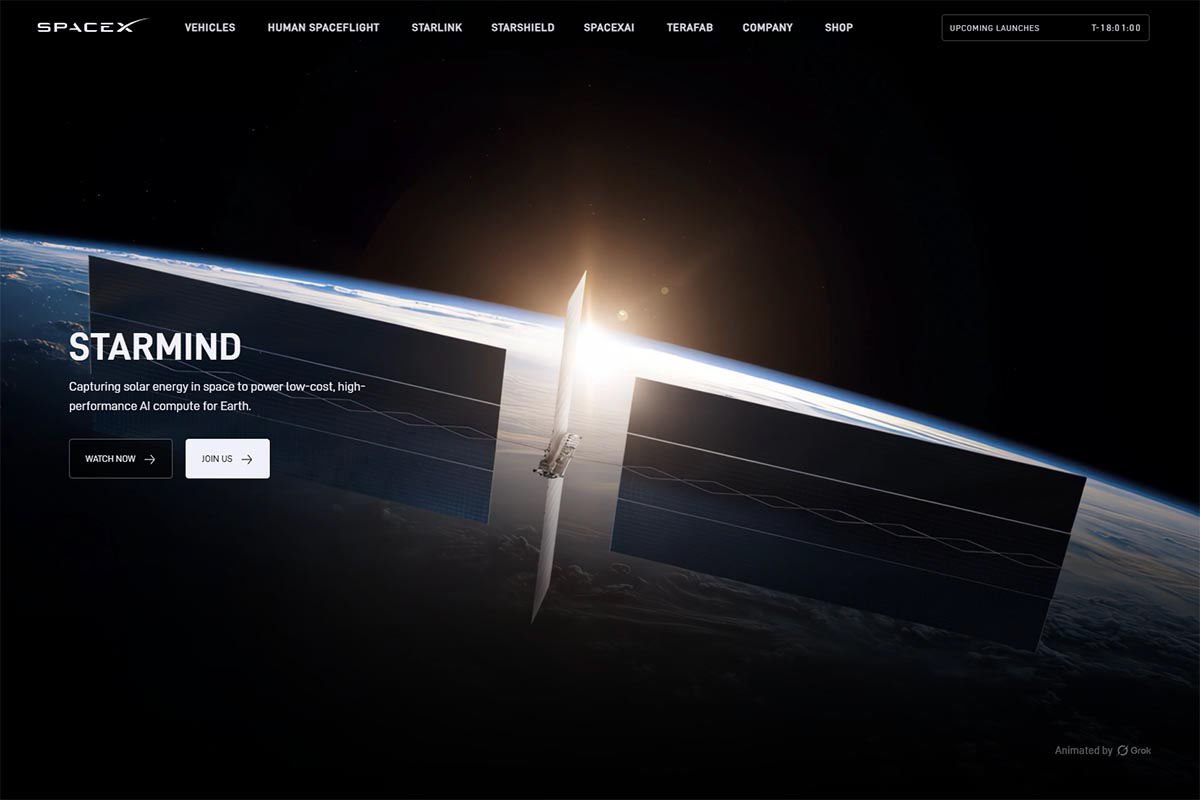
The pitch is audacious. The physics is tighter than it looks.
SpaceX announced Star Mind in August 2026: up to one million AI-capable satellites operating in low Earth orbit, built around NVIDIA’s upcoming Rubin GPU and Vera CPU, each satellite drawing up to 250 kilowatts of power and shedding heat through radiators spanning 30 meters. The vision is simple on paper — pull AI compute out of ground-based data centers choking on electricity and cooling constraints, and run it where sunlight is constant and the void itself becomes a heat sink.
The announcement came just weeks after SpaceX’s June IPO reframed the project as a formal “AI Compute” business, and only months after the company filed with the FCC in January for permission to deploy a million-orbiting data center. But filing a request with the FCC is not the same as getting one. And building satellites that powerful is not the same as keeping them alive in orbit.
What changed since June
Between the IPO and the August update, SpaceX’s design grew significantly. The first-generation AI1 satellite now specifies 75-meter solar arrays and 160 square meters of deployable liquid-cooled radiators — up from an earlier estimate equivalent to a single rack of GB300 GPUs. The new spec matches a full Vera Rubin NVL72 rack. Peak power climbed to 250 kilowatts, with an average of 175 kilowatts.
That jump in power and radiator area tells you something important: the thermal problem stopped being abstract. When you go from tens of kilowatts to hundreds, every watt of waste heat matters. Space is a vacuum. You cannot use convection or conduction to dump heat. Radiation is the only option, and radiation scales with the fourth power of temperature. That means your radiator area must grow fast — or your heat-sink temperature must climb.
A rough calculation, assuming ammonia-based liquid cooling and 250 kilowatts of peak thermal load spread across 160 square meters of two-sided radiator, lands you at an equilibrium temperature of roughly 85 degrees Celsius. Ammonia’s operational ceiling is around 132 degrees. So the numbers work — barely. There is margin, but not much. Any degradation in the cooling loop, any partial deployment failure, any increase in power draw, and the math stops being kind.
This is the quiet constraint on Star Mind. It is not funding. It is not launch capacity, though those are hard problems too. It is the thermodynamics of running server-grade silicon in a vacuum.
The orbit question
SpaceX has not disclosed whether AI1 satellites will fly in sun-synchronous orbit at 600 to 800 kilometers, and if so, whether any will use dawn-dusk configurations that keep solar panels in near-constant light. Several other companies pursuing orbital AI compute have flagged dawn-dusk orbits as a requirement. The silence from SpaceX is notable.
The company did say it plans to deploy satellites at multiple altitudes with different hardware variants. That could be a sign of operational flexibility — or an admission that no single orbit configuration satisfies the power and thermal trade-offs across the entire constellation.
AI1 satellites will connect to the existing Starlink mesh via optical links, using Starlink’s communication layer for data transit while keeping their own comms subsystem minimal, reserved for telemetry and backup. That separation is smart design. But it also means every AI1 satellite depends on Starlink’s continued operation, creating a single point of failure across an infrastructure that is already congested.
Launch, production, and the Starship bottleneck
SpaceX is expanding a former Starlink terminal factory in Bastrop, Texas, into a production and test facility for AI1 satellites. Mass deployment is targeted for 2027, starting with thousands of units.
Each satellite is estimated at over two tons, including propellant. Even with Starship’s 100-ton class payload capacity, you are looking at a modest number of satellites per launch. The 2026 Starship flight test successfully deployed 20 Starlink V3 satellites, which are far lighter than AI1 units. Scaling from that to multi-ton payloads, at the cadence required for a mega-constellation, is an unsolved engineering challenge.
The company has said it will use Starship’s full reusability to drive launch costs down. That claim rests entirely on Starship achieving rapid, repeated flight operations — something still in the test phase as of mid-2026.
Regulation is the first real wall
The FCC filed for one million satellites. Amazon and other operators have already pushed back. The realistic approval is likely far smaller — tens of thousands, at most. That still represents a massive undertaking, but it collapses the vision of a million-node orbital compute fabric into something more like a focused constellation.
Regulatory friction is not unique to SpaceX. Every large constellation faces it. But the scale of Star Mind’s proposal makes it a focal point. If the FCC approves only a fraction of the requested slots, the economics change dramatically. Per-satellite revenue targets would need to rise, or the unit cost would need to fall further, to make the business viable.
Debris is the silent killer
A paper published in July on arXiv by researchers at the University of Birmingham modeled collision risk across 16 planned large satellite constellations, including Star Mind. The finding: at projected deployment sizes, these constellations could push orbital debris density past thresholds where cascading collisions — the so-called Kessler Syndrome — become self-sustaining.
SpaceX has the most operational experience of any company in collision avoidance. Starlink satellites routinely perform avoidance maneuvers. The company has also proposed end-of-life disposal strategies for Star Mind beyond simple atmospheric reentry, including boosting satellites to higher graveyard orbits or even sending them into solar orbit entirely.
But proposed strategies are not proven ones. The Birmingham model assumes passive debris evolution. Real constellations with active avoidance and removal capabilities may fare better. We simply do not have enough data yet to know. SpaceX will need to demonstrate these disposal methods on test satellites before the FCC or any international body will treat them as credible.
The Moon detour
Elon Musk has floated a science-fiction-adjacent longer-term vision: manufacturing Star Mind satellites on the Moon and launching them into orbit using mass drivers instead of rockets, taking advantage of the Moon’s lower gravity. He also mentioned building robotic factories on the lunar surface.
The imagery attached to these proposals — artificial lights visible on the far side of the Moon, viewed from orbit — evokes a future where sustained human presence enables industrial activity beyond Earth. NASA’s Artemis program targets a sustained lunar presence post-2032. JAXA envisions international crews of roughly 40 people on the Moon by the 2040s. Neither timeline supports lunar satellite manufacturing in the near term.
Musk also invoked the Kardashev scale — a measure of civilizational energy consumption — when discussing the vision. That signals something important: Star Mind is being framed not just as a commercial project but as a step in a broader narrative about human expansion into space. The poetic framing matters for fundraising and public support. It does not change the thermodynamics.
What to watch
The first real signal of feasibility will come before 2027. SpaceX launched two test satellites ahead of the original Starlink deployment. A similar proof-of-concept mission for Star Mind — testing radiator deployment, liquid cooling in microgravity, optical inter-satellite links at scale — would be the logical precursor. If those tests do not fly in late 2026 or early 2027, the 2027 mass-deployment timeline is already doubtful.
The second signal is regulatory. The FCC’s initial decision on constellation size will set the economic floor for the entire project. Anything below 10,000 satellites makes the current business model unlikely to work without significant redesign.
The third signal is thermal. No public test of a 250-kilowatt orbital cooling system has been announced. Until one flies, the 85-degree-centigrade calculation remains theoretical.
Star Mind is not impossible. The physics permits it, the technology is plausible, and SpaceX has the launch and operational experience to attempt it. But the gap between a compelling announcement and a functioning orbital compute network is measured in engineering tests, regulatory approvals, and debris mitigation proofs — none of which have happened yet. The dream is bigger than the data.