SpaceX Just Changed the Rocket Economy — and No One Can Stop It
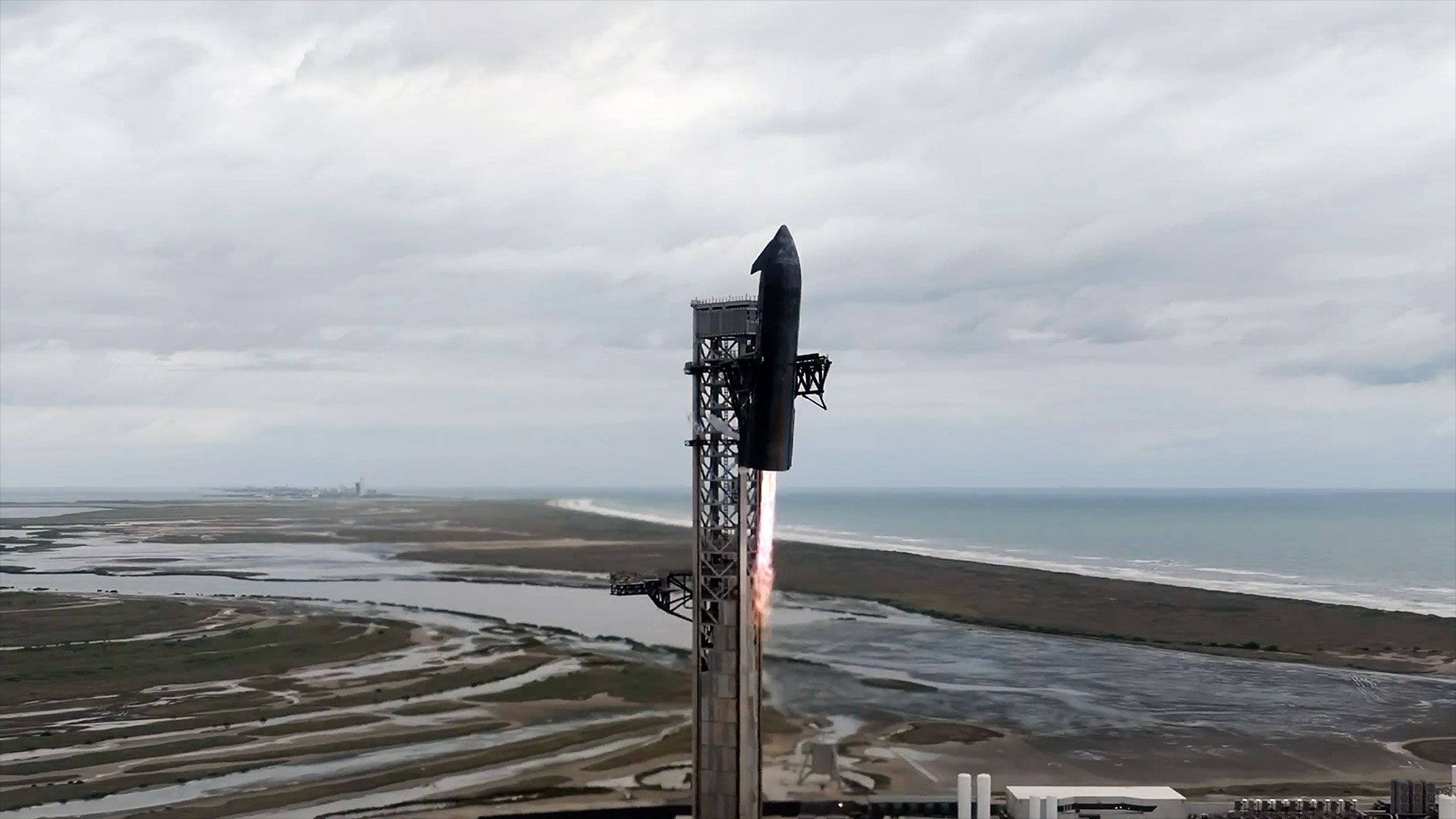
SpaceX caught its Starship upper stage out of orbit for the first time on November 14, completing a milestone that reshapes global launch economics overnight.
The Missing Link Wasn’t What Anyone Expected
On November 14 at 4:20 p.m. EST, Starship Flight 15’s upper stage — Ship 42 — settled gently into the awaiting arms of SpaceX’s launch tower at Starbase in South Texas. The moment lasted maybe thirty seconds before the “chopstick” clamps locked home. Inside the webcast, Jessie Anderson said one of the most incredible engineering feats of all time had just happened right in front of everyone watching.
Dan Huot’s voice cracked when he summed it up. That was the missing link. That was the holy grail of spaceflight, plummeting through fire to be snatched out of the air by steel. We caught a Starship, and now everything changes.
What that actually means for the global launch market is more profound than any single engineer’s poetry can convey.
Why This Is Not Like Any Previous Catch
SpaceX had already recovered its Super Heavy booster three times before this flight using the same mechanical arm system. Those were simpler returns — the booster falls from suborbital trajectory, barely exceeds orbital velocity, and comes back through a thinner slice of atmosphere. The chopstick catch for Super Heavy was always the easier half of the equation.
Ship is a different animal entirely. It flew to orbit. It carried 26 next-generation Starlink V3 broadband satellites there. It completed a full revolution around Earth over roughly 22.5 hours before descending at orbital speeds through the densest part of the atmosphere. The thermal loads on the heat shield were substantially higher than anything the booster experiences, and the precision required to guide a reentering upper stage onto a moving target from a launch tower 130 meters tall demands a level of control authority that most engineers considered impossible until now.
Getting this wrong turns your $400 million vehicle into debris scattered across Boca Chica Beach.
The Real Story Isn’t the Catch — It’s the Cost Curve
Here’s what the casual observer outside aerospace misses: a successful double catch collapses the marginal cost of putting mass into orbit toward the theoretical floor. SpaceX has repeatedly indicated that a fully reused Starship could operate for well under $10 million per flight, compared to its current expendable or partially-reused costs which sit somewhere between $90 and $150 million depending on configuration. At those numbers, the cost per kilogram to low Earth orbit drops to well under $100 — possibly into the $50 range once the company reaches aggressive operational cadence.
No other launcher in history has come close to that economics profile. Falcon 9, the most reliable commercial rocket ever built, delivers payloads to LEO at roughly $2,000 to $3,000 per kilogram. Delta IV Heavy, before retirement, ran closer to $25,000 per kilogram. Ariane 6 hasn’t flown yet and carries price tags still being debated in Brussels.
Starship isn’t incremental improvement. It’s a regime change.
Who Actually Loses When This Works
Blue Origin sits in the most uncomfortable position. New Glenn entered development as the premium alternative to Falcon 9, designed around partial reusability and a service contract model aimed at government and enterprise customers willing to pay a 30 to 40 percent premium over SpaceX. New Glenn’s payload capacity overlaps heavily with Starship’s medium-Earth-orbit niche, and its operational cost structure assumes the status quo holds. It does not hold.
Europe’s ArianeGroup faces an existential question that no amount of subsidies will cleanly solve. The European Space Agency treats strategic autonomy in launch as a non-negotiable pillar of continental policy. But strategic autonomy becomes an expensive abstraction when a single private American company can deliver ten times the payload at a fraction of the price. Arianespace has already cancelled one launch campaign and postponed others. The math is unforgiving.
China’s CNSA has invested tens of billions in its own heavy-lift programs — Long March 9, various commercial efforts from Landspace and iSpace, and a civil-military architecture built around launch independence from American systems. Starship’s economics render most of that spending structurally obsolete unless China achieves comparable reusability at similar cost before 2030. That is not going to happen on the current timeline.
India’s ISRO, Japan’s JAXA, and Canada’s Vector Launch all face the same underlying problem: you cannot compete on price against a system whose cost curve keeps moving downward while yours stays flat or rises.
The Satellite Constellation Arms Race Just Got Faster
Flight 15 deployed another 26 Starlink V3 satellites, bringing SpaceX’s total deployed count past 52 on this vehicle alone. The existing Starlink constellation employs roughly 11,000 satellites. Musk has publicly discussed plans for Starmind — an AI data-center constellation comprising up to one million spacecraft operating in low Earth orbit.
Building and maintaining that infrastructure requires a launch cadence that only full reusability enables. If Starship can turn around between flights in hours rather than weeks or months, the entire economics of space-based infrastructure flips. You stop treating each launch as a capital event and start treating it like cargo shipping — predictable, frequent, and cheap enough to make once-impossible projects routine.
The catch mechanism is the enabler. Every hour you save on turnaround multiplies across hundreds of launches per year. SpaceX has already demonstrated that the chopstick system works for the booster; this flight proved it works for the upper stage returning from orbit. The double-catch capability unlocks the full vision.
What Happens Next
SpaceX will almost certainly attempt another double catch on the very next flight. Dan Huot called it the missing link, and missing links get replaced. The company has been flying Starship with increasing frequency — Flight 14 reached orbit and deployed satellites in September; Flight 15 repeated the pattern and added the historic catch this month. The test cadence is accelerating faster than any previous aerospace program in history.
NASA continues to rely on Starship for its Artemis lunar landing system, and the agency’s timelines depend directly on SpaceX achieving operational reliability. The Commercial Resupply Services contracts already in place generate revenue regardless, but the real strategic value lies ahead: Starship-derived variants handling crewed missions to Mars, cis-lunar logistics, and the satellite constellations that fund the whole operation.
The chopsticks caught a spaceship on Friday afternoon. What they really grabbed was the future of access to orbit, and nothing outside SpaceX is equipped to reclaim it.