Why SpaceX's Starship Catch Matters More Than Just a Demo
SpaceX's tower catch of Starship isn't just a crowd-pleasing stunt. It's a decisive economic shift that rewires launch costs, threatens every rival, and lands hardest on Asian space programs that bet on incremental reuse.
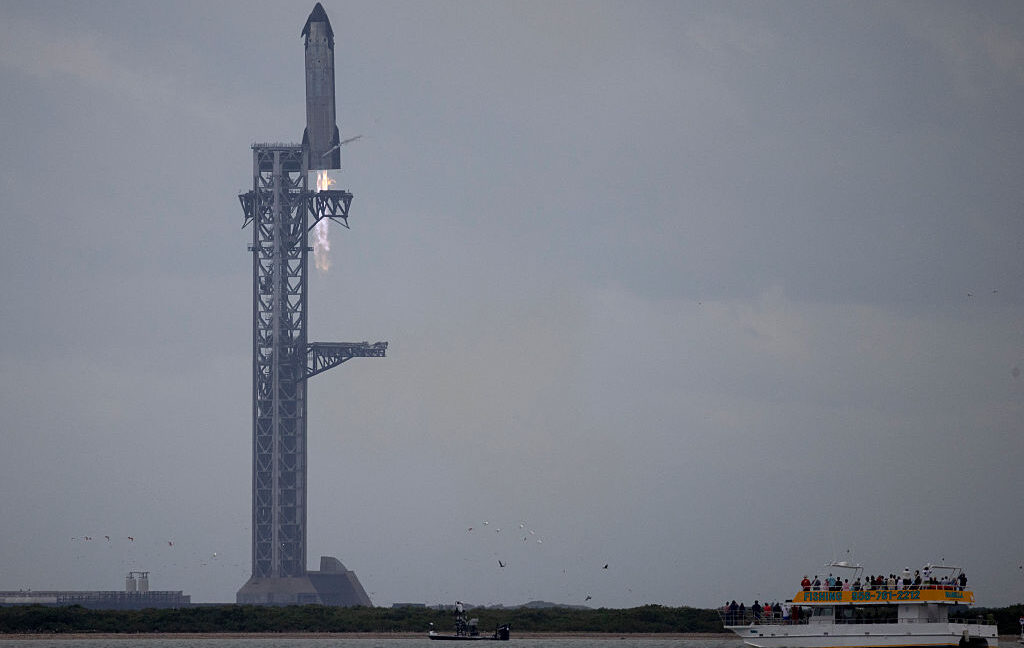
A Chopstick Catch That Reshapes Everything
On a Saturday evening at SpaceX’s Starbase facility in Texas, a 120-meter-tall stainless-steel rocket descended from orbit under its own power, swooped from horizontal to vertical three Raptor engines roaring, and slid into waiting tower arms with margins measured in feet. Two small nubs on the vehicle’s flanks became the only contact points. The upper stage hung there, captured alive.
What looked like theater was, in fact, a quiet revolution in aerospace economics. SpaceX did something that no heavy-lift program in history has accomplished: demonstrated the capture and intended immediate reuse of an orbit-returning booster, the kind of vehicle carrying enough kinetic energy to destroy anything brittle on impact.
The broader implication hits harder outside America than inside it. For observers in Tokyo, Seoul, Beijing, and Bengaluru, this moment recalibrates every timeline, budget projection, and strategic bet they’ve made on their own reusable launch ambitions over the past decade.
The Economics Hidden in Plain Sight
Every reusable rocket sold so far has relied on one of two architectures: recoverable first-stage boosters that burn out in the atmosphere, or full-orbital-capable second stages that splash down or land vertically with parachutes, sleds, or legs. Both require trade-offs. Landing gear adds dead weight. Ocean recovery introduces corrosion and refurbishment delays. Vertical landing needs extra propellant reserved for the final descent burn, reducing payload mass.
Tower capture removes those penalties. The Starship upper stage arrives with structural reinforcement aimed at the catch—not at landing legs. No ocean retrieval fleet follows. No crane-equipped barges wait offshore. The propulsion system remains intact and pressurized, because the vehicle never hits water, never endures a hard touchdown, and never spent fuel budgeting for gravity-turn deceleration from a powered landing profile.
That difference compounds fast.
When a launcher flies once per month instead of once per quarter, operating costs drop sharply. When the same vehicle does two flights in a week, margin improves further. Starship’s tower-capture demo signals that SpaceX intends exactly this cadence, not metaphorically but operationally. The clock starts ticking the moment the arms release.
Payload mass to orbit is also higher without landing hardware and reserve fuel, tightening the gap between theoretical performance and delivered performance. That matters enormously for government contracts, military payloads, and commercial constellations priced per kilogram.
Who Is Losing Their Lead—or Never Had One
Blue Origin faces the most uncomfortable comparison. New Shepard has returned dozens of suborbital flights successfully using a capsule-and-booster split and hover-back landing. New Glenn, its orbital competitor, aims for a first-stage catch via tower arms too. But New Glenn has yet to reach orbit, and its design targets mid-size payloads rather than the multi-hundred-ton class Starship occupies. Jeff Bezos’s company builds carefully. SpaceX built audaciously. The market is beginning to reward the latter in predictable ways.
Rocket Lab sits in a different lane entirely. Its Neutron vehicle, designed for medium-lift markets, plans booster recovery rather than upper-stage capture. That strategy makes economic sense for smaller rockets. What Starship demonstrates, though, is that the logic of reuse scales non-linearly. A vehicle that lifts 100 tons operates on a different financial curve than one that lifts 3 tons. The per-kilogram advantage grows as size increases, precisely because reflight cycles compress.
JAXA, Japan’s space agency, has watched this unfold with growing frustration. The H3 rocket, designed as Japan’s next-generation workhorse, entered service plagued by cost overruns and repeated launch failures. Its total cost per launch remains far above what Starship aims for, even before Starship reaches its planned flight rate. JAXA’s own research into reusable stages and air-launch concepts has produced papers and prototypes, not operational hardware. Meanwhile, SpaceX has been testing openly, learning publicly, and iterating faster than any governmental program can match on raw velocity.
South Korea’s KARI launched its Nuri rocket successfully in 2022 and is developing heavier variants, but none approach Starship’s scale. China’s Commercial Aerospace Corporation has announced long-term reusability goals, yet its current orbital launch record relies on expendable vehicles. India’s ISRO has shown capability with reusable glide vehicles in atmospheric tests, but full orbital return remains unproven.
Each of these programs faced a choice when SpaceX began flying Falcon 9 booster catches in 2015: accelerate investment toward reuse, or differentiate through niche payloads and specialty launches. Most chose differentiation. Few had the budget to choose acceleration aggressively enough.
Why Asia Pays Special Attention
American outlets often frame SpaceX achievements as national triumphs. They rarely mention how those same achievements land in foreign capitals—as reminders of missed windows, delayed programs, and budgets being outpaced before strategies fully mature.
For East Asian governments, the Starship catch reinforces an unwelcome pattern. Japan invested heavily in independent launch capability to avoid dependence on American providers. South Korea poured resources into domestic rocket development after years of relying on foreign services. India positioned ISRO as a cost-effective alternative provider for global clients. Each effort assumed a stable competitive environment where innovation moved at a pace comparable to national bureaucracy.
SpaceX has refused to honor that assumption. Every successful test shortens the planning horizon for everyone else. A vehicle capable of monthly reflights at a fraction of existing per-kilogram costs does not compete gently. It disrupts pricing, forces contract renegotiations, and creates urgency that political timelines cannot match.
There is also a psychological dimension worth noting. Public demonstration matters in aerospace. Governments award contracts based on proven performance, not promising roadmaps. When SpaceX catches a rocket on camera in front of the world, it signals maturity and reliability to buyers who may otherwise hesitate to commit billions to newer entrants or slower-developing state programs.
What Happens Next
The tower catch is not yet routine operations. Transitioning from demonstration to daily flight cadence requires engineering refinements, safety reviews, regulatory approvals, and operational procedures that no amount of spectacle replaces. SpaceX will likely refine the interface, test multiple catch scenarios, and accumulate flight repetitions before committing to aggressive scheduling.
But the direction is clear. The physics favor rapid reuse once capture succeeds reliably. The market rewards it. Competitors must respond or risk irrelevance in segments ranging from mega-constellation deployment to lunar logistics.
For Asian space agencies, the pressure is immediate. Programs already under budget scrutiny will face new questions about whether domestic heavy-lift development remains viable alongside vehicles that operate at dramatically lower cost structures. Partnerships with SpaceX or adaptation of commercial architectures may become necessary strategies rather than optional diversions.
SpaceX has spent nearly twenty-five years building toward this moment. The tower catch proves it can still surprise. Everyone watching from outside Texas now has less time to prepare.