SpaceX Starship Flight 15 and the Double Landing Gamble
SpaceX is attempting the first full recovery of an orbital rocket on Flight 15, catching both the Super Heavy booster and Ship stage. If it works, it redraws the cost-per-kilogram math for every competitor in heavy-lift launch.
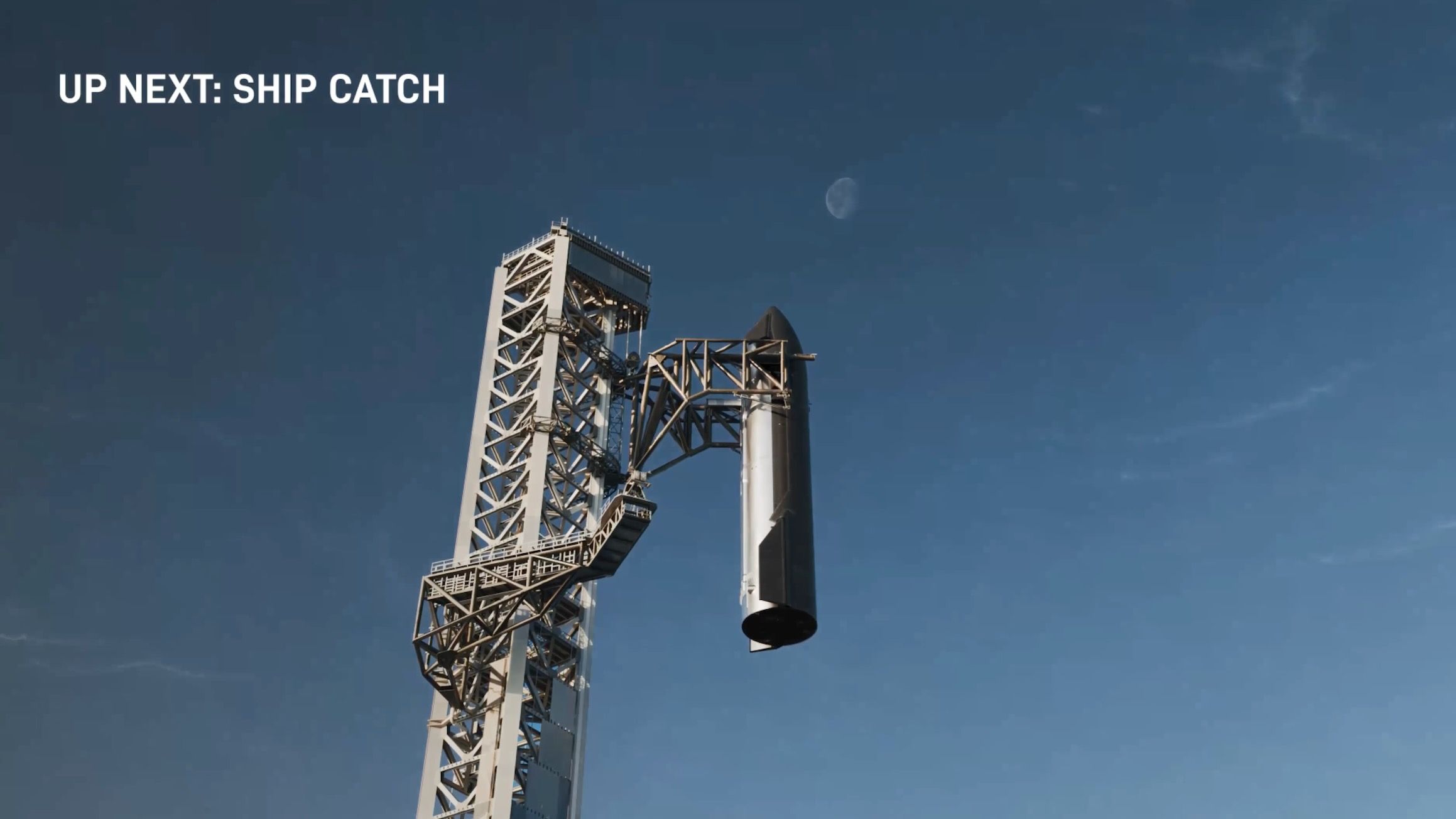
The Double Catch That Changes Everything
On Friday, November 13, at 5:45 p.m. EDT from Starbase in Texas, SpaceX will attempt something that has never been done with an orbital-class rocket: recovering both the Super Heavy booster and the Starship upper stage in the same flight. It is not merely another test milestone. It is a direct shot at rewriting the unit economics of getting mass into orbit—and if it lands, every rival launcher designer needs to update their spreadsheets.
Flight 15 carries 26 new Starlink V3 satellites to orbit as part of its manifest. But the payload is almost secondary to what happens when—hopefully—the ship descends through the atmosphere and is caught mid-air by the metal “chopstick” arms at the launch tower, while the Super Heavy booster returns seconds earlier and lands on the pad for a simultaneous catch. Full vehicle recovery. First time ever for an orbital rocket system.
Why This Is Different From What SpaceX Has Done Before
SpaceX has landed and caught Super Heavy boosters before. Several times now. The booster-side of the equation is approaching routine. What makes Flight 15 novel is that the upper-stage recovery has so far been the soft underbelly of Starship design. The ship arrives from orbit at roughly Mach 25, rides a plasma sheath hot enough to challenge every material in its path, then flips and fires its three Raptor engines on reentry burn before the final landing burn over the Gulf of Mexico.
Catching that airframe with articulated arms requires sub-meter precision at speeds where turbulence alone can push a vehicle off target. Earlier flights have touched down via legs on barge or pad; a clean catch by the tower means the vehicle avoids ground contamination, sustains less structural stress than a hard touchdown, and—critically for economics—keeps the upper stage intact for rapid turnaround without major refurbishment.
If the chopsticks succeed here, Starship transitions from a partially reusable heavy lifter to a fully reusable one. That distinction matters more than the wordplay suggests.
The Unit Economics Nobody Is Discussing Enough
Reusability arguments often conflate the booster with the entire stack. ULA, Blue Origin, and others have all chased first-stage recovery because the booster is the cheap engineering win. The upper stage is where the margin gets carved out—or where the whole model breaks.
A full two-stage catch collapses the dominant cost line item in launch pricing. Historically, the upper stage is discarded after one use even when the booster returns. That discarded structure, engine kit, thermal protection tiles, avionics bay—it represents a meaningful fraction of total vehicle cost on many architectures. Starship is designed around stainless steel construction specifically to reduce that number, but a burned or dented heat shield still costs time and money to replace between flights.
Successful simultaneous recovery means:
- No splashdown salvage operations for either stage.
- Minimal refurbishment cycle between flights.
- Turnaround measured in days rather than weeks or months.
- A per-launch marginal cost curve that drops precipitously as cadence increases.
SpaceX CEO Elon Musk has repeatedly pegged target launch costs at well under $10 million per flight for a vehicle with a 150-ton payload capacity to orbit. That translates to roughly $67 per kilogram—a number no other orbital launcher currently matches, and few are close to. Catching both stages makes that target plausible instead of aspirational.
Who Loses If This Works
ULA’s Vulcan Centaur, built on derived Delta heritage with expendable upper stages, cannot compete on price once Starship reaches cadence. Blue Origin’s New Glenn was always positioned as a mid-tier player between Falcon 9 and super-heavy class. Its roadmap depends on first-stage recovery delivering meaningful savings, not full-stack recovery. One Space Shuttle-level disaster per decade aside, orbital launch economics historically penalized any architecture that threw away half its hardware.
The Ariane 6 program, NASA’s SLS, and China’s Long March 9—all expendable or only partially recoverable—face a structural pricing ceiling they may simply not be able to breach if Flight 15 clears.
Even companies not yet flying a competing heavy launcher should note the implication. The market floor for launch services just moved down dramatically. Pricing power shifts toward whoever controls the highest-cadence, most-recoverable architecture.
What Could Still Go Wrong
Starship has survived nearly a dozen test flights despite spectacular failures. The vehicle has proven it can fly, reach space, and return parts of itself home. It has not yet sustained an undamaged upper stage through full atmospheric reentry, let alone caught it out of the sky. Engine-out scenarios during landing burn, asymmetric thermal loads, guidance drift near the tower—all are plausible failure modes.
Flights 15 and beyond are test campaigns, not operational commitments. Delays happen. Pad constraints at Starbase limit how quickly multiple launches can turn around while infrastructure catches up. The chopstick mechanism itself is unproven in a dynamic catch scenario; earlier static tests do not guarantee acceptance of a 500-ton descending airframe moving at landing speed.
What Happens Next Regardless of the Outcome
Whether Flight 15 ends in a clean grab, a partial damage event, or a scrappy landing on the pad, the trajectory is clear. SpaceX is compressing the timeline for full reusability that competitors assumed would take a decade or more. Every flight gathers data that shrinks the gap between prototype and production vehicle. The Starlink V3 deployment is incremental revenue within an iterative loop that funds further development.
By 2027, if dual-catch success stacks into regular operations, the cost-per-kilogram argument stops being theoretical. Orbital infrastructure projects, lunar cargo missions, and commercial constellation builds that previously required government subsidy or high-risk private investment begin looking like commodities. The winners will be those who can build on top of cheap access to space. The losers will be those who built expensive access and hoped nobody invented cheaper access.
Friday’s attempt is not the end of the road. It is the hinge.