How SpaceX's Orbital Catch Changes the Economics of Spaceflight
SpaceX caught a Starship returning from orbit for the first time. The feat sounds like a stunt but it is actually a fundamental shift in space economics.
The Missing Link Just Clicked Into Place
SpaceX now has a spacecraft that can fly to orbit, survive atmospheric reentry, and return to its launch pad under control. That is not new for orbital vehicles in theory. It is entirely new in practice for a vehicle this size, and the company demonstrated it plainly on Saturday night when two mechanical arms on the launch gantry closed around the Starship upper stage seconds before engine shutdown.
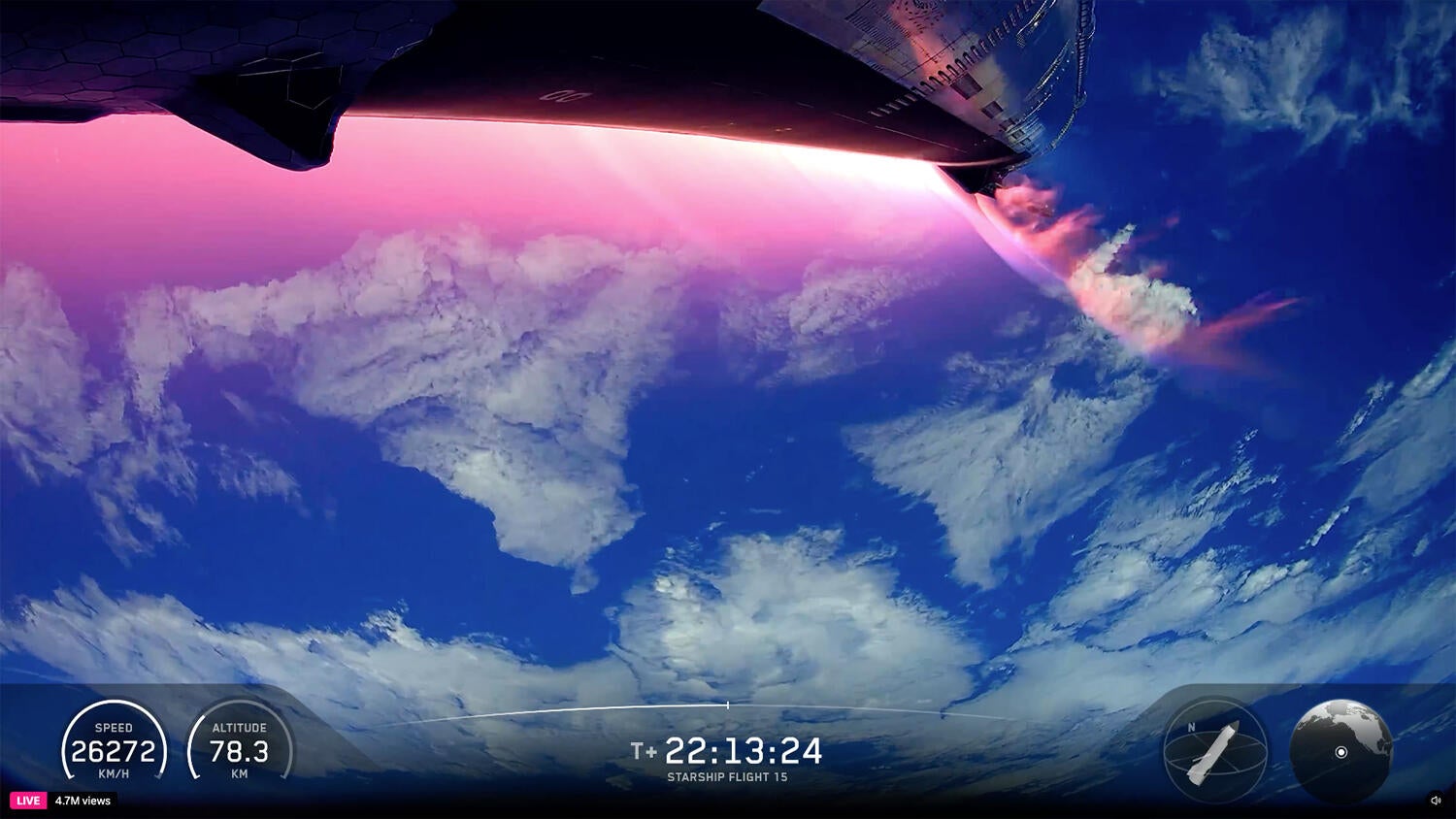
The 22-hour mission ended with the rocket descending from low Earth orbit, belly-first through a fireball of heated atmosphere over northern Mexico, then flipping vertical above the Texas coast while three of its six Raptor engines fired to kill its speed. Mission control erupted. Commentator Dan Huot called it the holy grail of spaceflight. In aerospace terms, he was not far off.
Previous Starship test flights had all ended with planned splashdowns in the ocean. Recovering the upper stage in orbit and bringing it back to land marks a genuine engineering break. It is the logical next step toward full vehicle reusability, the single most important design goal for making repeated access to space affordable.
What Changed — And What Has Not
On paper, full reusability means landing a rocket once per flight and flying it again many times with minimal refurbishment. SpaceX has been refining first-stage booster recovery since 2015. It now lands boosters on barges and at ground pads with consistent reliability. The missing half of the equation has always been the upper stage. That vehicle operates in a very different regime. It stays aloft for hours or days, absorbs severe thermal loads on reentry, and must execute precise engine burns to slow from orbital velocity before landing — all while preserving sensitive cargo areas underneath the heat shield.
Saturday proved the upper stage can do all of that and survive. The Starship completed roughly 15 orbits, crossed Baja California, passed over northern Mexico, then executed the flip maneuver near the launch site. Camera feeds showed the underbelly glowing red-hot as the ceramic heat-shield tiles held their ground. The vehicle fell toward the tower at a steep angle, engines firing, slowing to a near-hover before the robot arms grasped it. Landing precision mattered less than survivability — the real question now is how quickly the vehicle can turn around after such a flight.
Meanwhile, the Super Heavy booster assigned to Friday’s launch suffered a guidance issue, ran out of fuel, and exploded moments before hitting the water offshore. Elon Musk described the problem as slight underperformance of engines, calling those early boosters outdated by newer designs already on test stands. The loss did not derail the upper-stage recovery. SpaceX moved forward with the planned objective anyway.
That tells you something about how the program operates now. Failures are real. They are expensive. But they no longer stop the whole machine.
Who Wins, Who Loses, And Why It Matters Beyond Texas
The winner is anyone shipping mass to orbit. Reusable rockets are cheap because you do not throw away the most expensive part of the launch stack after every flight. A fully reusable Starship would lower launch costs to levels that make mega-constellations, lunar infrastructure, and yes, Mars missions economically plausible rather than purely aspirational. Even if the upper stage lands intact and needs significant refurbishment between flights, the principle is proven. The cost curve begins to bend at that point.
NASA is the second clear beneficiary. The agency wants to land astronauts on the Moon by 2028 using a Starship variant as the lunar lander. That plan requires multiple tanker flights to deliver propellant to an orbiting depot, then a powered descent to the surface. Demonstrating the upper stage can return safely makes the architecture credible. If it could not, the whole project loses its economic rationale.
Competitors face a harder reality. United Launch Alliance, Rocket Lab, and even Blue Origin operate systems where at least one stage dies every flight. No amount of incremental improvement erases that structural cost. Starship’s trajectory, if sustained, forces the industry to ask whether partial reusability will ever be enough to compete on price.
Blue Origin is particularly exposed here. NASA has publicly hedged, saying it is open to using the Blue Moon Mark 2 lander if Starship slips. That hedge exists precisely because Starship’s development timeline has exceeded early expectations. The company’s own New Glenn launcher will likely remain partially reusable as well, which constrains how aggressively it can price against a fully reusable heavy-lift vehicle.
What Comes Next
Recovering a Starship from orbit is not the same thing as operating a high-turnaround commercial service. Several hurdles remain.
Reliability is the first. Crewed certification demands statistically robust recovery rates across many flights. One spectacular catch proves the concept. Ten catches in twelve attempts proves an operational system. SpaceX will need to demonstrate both over the coming year.
Orbital refueling is the second. Every crewed mission to the Moon requires a tanker flight to transfer propellant into orbit before the lander departs for lunar surface operations. No one has performed large-scale cryogenic propellant transfer in microgravity yet. Boil-off, pumping losses, and valve failures are real risks that have not been tested at the scale Starship requires.
Turnaround speed is the third. The current Starship spent 22 hours in orbit. Returning to a reusable configuration in hours rather than months is what separates a prototype program from a transportation system. That clock has not started yet.
SpaceX plans orbital refueling tests in the next several flights. The timeline remains aggressive, and NASA’s openness to alternatives suggests the agency does not assume success.
What is certain is that the gap between the old space economy and the new one widened further on Saturday night. A rocket that flies, survives reentry, and comes home in one piece changes the math of every mission profile downstream. The vehicle is still a prototype. The physics, however, are settled.