Starship Flight 15 misses chopsticks but ships toward Mars economics
SpaceX aborted the Starship booster catch on Flight 15, but Ship still reached orbit and deployed Starlink V3 sats. The real test begins when the upper stage tries to come home.
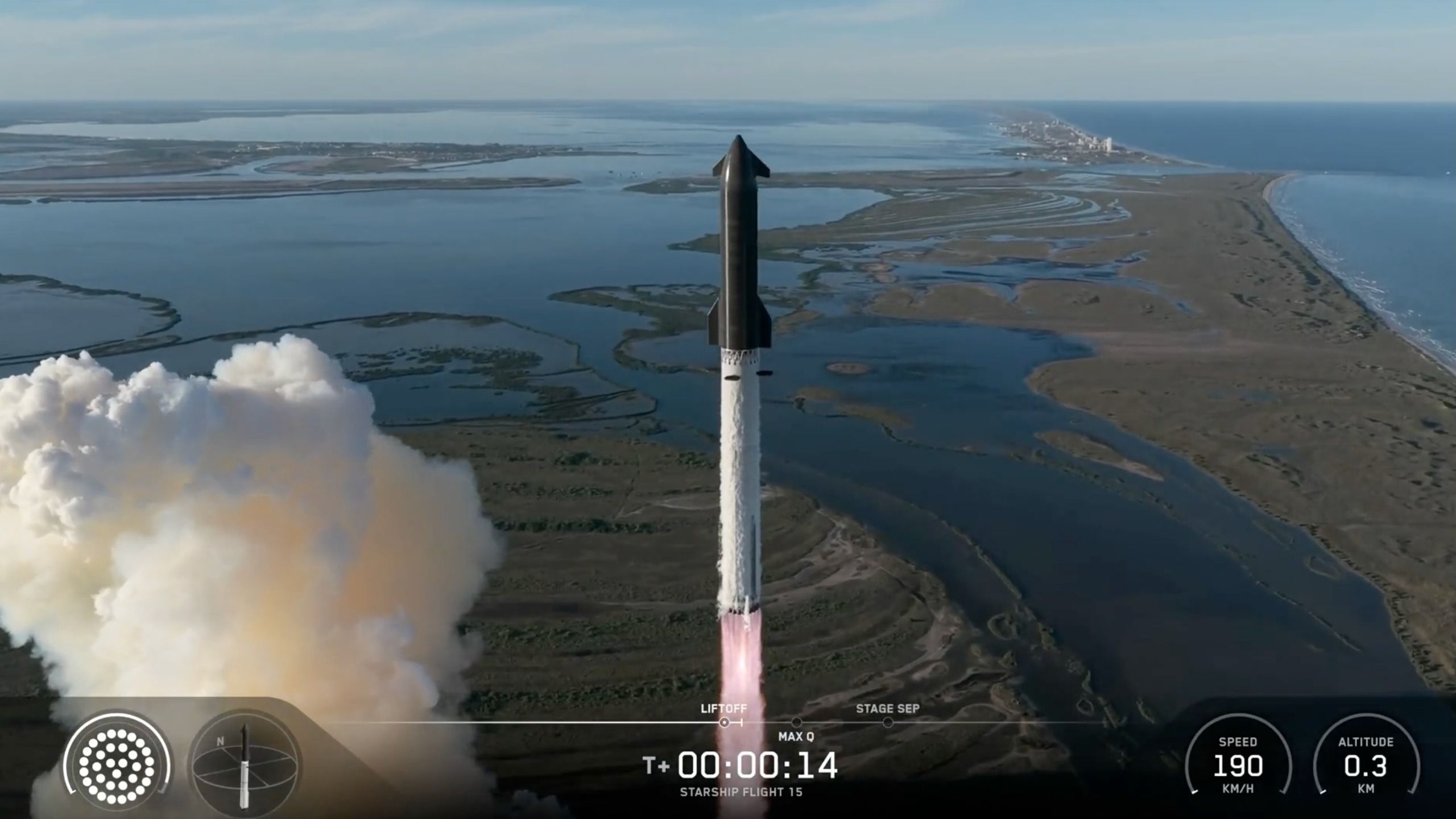
The chopsticks failed. That may be the least interesting thing about Flight 15.
SpaceX launched Starship Flight 15 on November 13 from Starbase in South Texas, and everything went right except the one thing everyone came to watch. The Super Heavy booster climbed out of the atmosphere under 33 Raptor 3 engines, burned through its fuel, separated cleanly, and turned back toward Earth — where the plan was to catch it with the tower’s mechanical chopstick arms. Instead, Mission Control called off the attempt and let the booster splash down in the Gulf of Mexico roughly six and a half minutes after liftoff.
No explanation was offered. The reasons are not clear.
But while everyone focused on the missing catch, Starship’s upper stage did something equally consequential without drawing nearly as much attention: it completed a full orbital test and then parked itself at 170 miles up for a 22-hour loop around Earth. That is the harder part of this equation. Landing a booster between two metal arms is theatrical. Flying a second stage into orbit, surviving reentry heating, and coming back to land precisely where it started is what makes the economics work.
The chopsticks are the moment. The orbit is the machine.
What Flight 15 actually proved
Ship reached low Earth orbit at T+26 minutes and 10 seconds, according to Dan Huot on the SpaceX webcast. Its Raptors fired for about eight minutes during the first burn and then again for roughly 20 seconds to circularize. The orbit insertion was nominal.
Then it did something nobody has ever asked a spacecraft stage to do before: deploy 26 Starlink V3 internet satellites into orbit while on a test flight.
This is deliberate. SpaceX does not fly unproven hardware blindly into production. It loads Starlink missions onto test flights and extracts engineering data from both the launch vehicle and the payload. The three V3 Starlinks equipped with downward-facing cameras took images of the heatshield tiles and underside structure after deployment. Those images will tell engineers whether Ship can survive the next atmospheric pass intact enough to attempt a landing.
Without those camera readings, there is no way to know if the heatshield held. With them, SpaceX gains the same iterative feedback loop that made early Falcon 9 flights useful beyond simply getting to orbit.
Flight 15 was not just a test of Starship as a rocket. It was a test of Starship as a delivery platform for the very constellations it is meant to build.
Why the catch abort matters less than it looks
Booster recovery via chopsticks is a public relations milestone. It is also, practically speaking, optional. SpaceX has already demonstrated that controlled splashdowns recover Super Heavy boosters — and previously recovered three V1 class boosters and reused two of them. A splashdown costs more than a catch. Water damages engine components and plumbing that a clean tower landing preserves. But a splashdown still proves the booster can fly, separate, reverse thrust, and guide itself to a precise ocean zone.
If the chopstick attempt was aborted due to a vehicle anomaly — sensor fault, attitude deviation, timing issue — the underlying capability remains untested but not necessarily compromised. If it was aborted because Mission Control determined conditions were unsafe, that is standard operating procedure and not a technical failure at all.
Either way, the data from Flight 15 continues to flow regardless of how the booster comes home.
What cannot be skipped is the 22-hour journey of Ship back to Starbase. The upper stage is scheduled to circle Earth 14 times before executing a 10-second deorbit burn around T+21 hours and 36 minutes. Atmospheric entry follows roughly 35 minutes later. If systems check out at each contingency window — the first arriving just 10 minutes after Starlink deployment concludes, the second at T+7 hours and 15 minutes, and the final checkpoint at T+20 hours and 41 minutes — then Ship lands upright on the tower approximately 22.5 hours after launch on Saturday afternoon.
That would be the first-ever recovery of a Starship upper stage. Full vehicle reusability, at least once per cycle.
Who wins if Ship lands
A successful catch would validate the most ambitious reuse model in aerospace history. Not just the booster returning — the entire stack. Two stages, both landing, both flying again within hours rather than months. That changes the cost curve in a way incremental improvements never could.
Elon Musk has targeted 10,000 Starship launches per year by 2030. That figure sounds impossible until you recognize it is calculated against a specific demand profile: roughly 100,000 Starlink V3 satellites plus an AI orbital data center constellation ten times larger. Current Falcon 9 operations achieve maybe 100 launches per year across the whole fleet. Scaling from hundreds of launches annually to thousands requires every single component to become reusable. One-shot hardware simply cannot sustain the math.
A successful chopstick catch alone does not prove that number is reachable. A successful Ship recovery alongside it does. That is why Saturday matters more than Thursday’s abort.
NASA also benefits directly. Starship is selected as the crewed lunar lander for Artemis III, with a demonstration mission planned for summer 2027. Reliability on orbital return and precision landing are non-negotiable for a vehicle carrying astronauts to the Moon’s surface. If Ship cannot come home from orbit safely, the Artemis timeline has a problem far bigger than a missed catch attempt.
The Blue Origin angle most reporters miss
Meanwhile, Blue Origin is preparing New Glenn for its own commercial debut. New Glenn is designed from the start to recover and reuse its booster via vertical landing — not chopsticks, but a conventional pad or drone ship strategy. The vehicle’s architecture is more conventional, which means fewer unknowns but also less dramatic innovation in the recovery mechanism itself.
New Glenn’s first launch is expected imminently, and its payload market includes communication satellites similar to the ones Ship carried today. If Starship demonstrates reliable two-stage reusability before New Glenn enters service, pricing pressure on the medium-to-heavy lift segment intensifies dramatically. If New Glenn flies first and reliably, it captures customers waiting for reusable access who cannot afford to wait for Starship’s remaining development milestones.
This is not a race with a clean finish line. Both vehicles have decades of uncertainty ahead. But every successful Starship recovery shifts the perceived risk curve away from Blue Origin’s timeline and toward SpaceX’s ambition.
The numbers behind the narrative
Here is what Flight 15 tells us concretely:
- Starlink V3 satellites now total approximately 52 in orbit across Flights 14 and 15, replacing older V2 models currently numbering over 11,000.
- The V3 batch adds roughly one terabit of capacity, equivalent to 10 Falcon 9 launches.
- Ship spent 22 hours and counting in orbit before its planned return, testing long-duration thermal cycling of the heatshield.
- No Starship upper stage has yet returned to Earth intact; Flight 15 represents the closest attempt so far.
- SpaceX has conducted 15 Starship test flights since the program began, averaging roughly one flight every two months — fast by historical rocket standards but still nowhere near operational cadence.
The gap between five flights and a thousand flights is enormous. The gap between one failed chopstick catch and one successful upper stage return is also enormous, but it is a different kind of gap. One is a publicity problem. The other is an engineering solution.
What comes next
Saturday’s landing attempt, contingent on all system checks passing, will determine whether Starship can transition from an experimental launcher to a working orbital vehicle. If Ship comes home vertically on the tower, SpaceX moves from proving it can reach orbit to proving it can operate a two-stage fully reusable system — the threshold requirement for every future mission Musk has outlined, from Mars to mega-constellations.
If Ship cannot return, or if the heatshield shows degradation, the timeline stretches. Not ending the program. But stretching it.
The chopstick abort on Flight 15 will fade from headlines within a week. The question of whether Ship actually lands intact is the one worth watching.