SpaceX's Starship Catch Changes Everything for Launch Economics
SpaceX's first mid-air capture of the Starship upper stage after a 22-hour orbital flight proves full reusability is technically viable—and sets up a fundamental economics shift that no competitor can match before 2030.
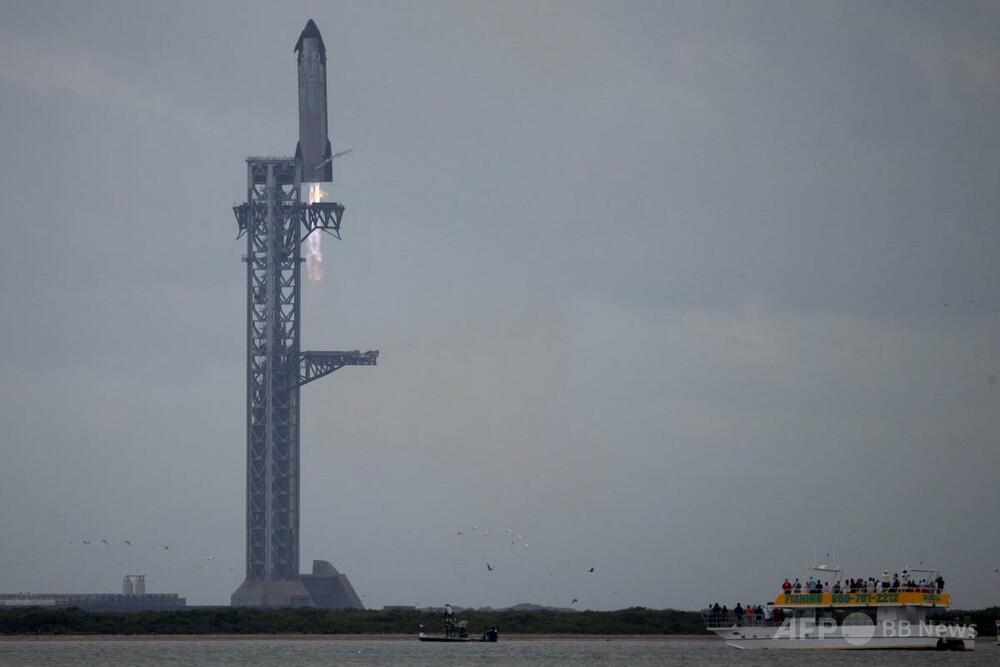
The chopsticks got their dinner
At 0700 UTC on November 14, two steel arms shaped like oversized hashi—what Space.com once dryly called “chopsticks”—closed around a falling Starship after it returned from 14 laps around Earth. The event lasted roughly four minutes from engine cutoff to the final snap of closure. A crowd gathered on the Mexican Gulf coast watched it happen live.
No one watching the footage could miss the visual contrast with previous booster catches. Super Heavy descends through the atmosphere like a brick dropped from the stratosphere. Starship, by comparison, floated down slowly, deliberately, almost gently—its heat shield glowing white-hot through cloud layers before settling into the frame of the launch tower.
This was Flight 15 of the fully integrated Starship system. The upper stage had spent 22 hours in orbit, deployed 26 Starlink satellites, then re-entered and was caught without a powered landing burn. The booster, which had been targeted for a mid-air recovery earlier that same morning, veered off course due to a technical issue during descent and crashed into the Gulf instead. That failure will be worked through. The ship catch did not.
What actually changed
Full reusability is the dream every launch provider has chased since the shuttle era—and failed to deliver on any meaningful scale. The Falcon 9 first stage returns vertically and lands on a barge or concrete pad. It works. It is repeatable. But it requires new engines for each upper-stage flight because the second stage has never come back alive.
A fully reusable two-stage system changes the math entirely. The upper stage of Starship is the more thermally demanding vehicle: it re-enters from orbital velocity, not suborbital. Capturing it mid-air eliminates the need for landing legs, consumes no propellant on approach, and preserves the tile integrity that took years to develop. That single decision—to catch rather than land—is what makes this moment structurally different from every prior booster recovery.
Clayton Swope at the Center for Strategic and International Studies called it “a very significant technical achievement” that proves the concept of a fully reusable spacecraft is viable. The assessment understates the point slightly. The achievement is not merely that Starship survived re-entry. It is that SpaceX caught a re-entry vehicle traveling at hypersonic speeds with mechanical arms mounted on a stationary tower, in conditions that leave zero margin for error.
The economics argument
Here is what the global market usually gets wrong about this story: they focus on the spectacle and miss the spreadsheet.
Every launch provider outside SpaceX operates on a expendable or near-expendable model. United Launch Alliance charges roughly $90 million per Atlas V flight with no recovery. ULA’s Vulcan is comparable. Blue Origin’s New Glenn, even when fully operational, is designed for first-stage recovery only—not full stack reusability.
SpaceX’s own Falcon 9 has driven launch prices below $60 million for heavy payloads to GTO through first-stage recovery alone. If Starship achieves rapid turn-around between flights—meaning the upper stage flies again within days rather than months—the marginal cost per launch drops toward the single-digit millions. SpaceX has publicly stated a target of $2 million per launch once full reusability is operationalized. Whether that number holds remains unproven, but the direction is clear.
A $2-million-to-low-earth-orbit launcher operating at cadence compresses the entire economics of orbital access. It renders expendable rockets structurally uncompetitive within five years of achieving that throughput. It also changes the calculus for NASA, for commercial satellite operators, and for anyone planning cislunar infrastructure.
What still stands in the way
The mid-air catch does not solve every engineering problem. Orbital refueling—the process of transferring cryogenic propellant between two vehicles in space—remains unsolved. It is the technology that enables a Starship destined for lunar orbit or Mars to depart Earth filled and then rendezvous with a tanker already in orbit. Without that step, Starship’s payload fraction to trans-Mars injection drops dramatically, and the whole architecture loses its advantage.
SpaceX has flown test bed prototypes for orbital refueling. No successful demonstration has been announced. The timeline depends on regulatory approvals from the FAA for both the testing and operational launches, and those permits move slower than engineering timelines. The company cannot accelerate Starship past what the permitting apparatus allows.
The Booster 13 incident on November 13—where Super Heavy altered course mid-descent and missed its catch zone—shows that first-stage recovery still carries risk. Three successful booster catches do not yet equal routine operability. Each failure delays cadence. The law of large numbers eventually favors the side attempting more flight attempts, and SpaceX is currently attempting far more.
Who wins and who loses
Blue Origin is the nearest competitor to face this directly. Jeff Bezos’s New Shepard is a suborbital tourist vehicle. New Glenn, its orbital answer, targets first-stage recovery with a vertical landing—a different design philosophy that does not scale to full reusability as aggressively. Even if New Glenn succeeds on schedule, it competes in a segment where SpaceX’s existing Falcon fleet already dominates on price.
ULA faces the steeper squeeze. Its Delta IV Heavy is being retired. Vulcan is expensive and infrequent by comparison. Without a pathway to full reusability, ULA’s government contracts become increasingly vulnerable to SpaceX pricing.
European Ariane 6, Indian GSLV, Japanese H3—all are expendable systems entering service at a time when a fully reusable Chinese equivalent could be decades away, making the competitive gap asymmetric in favor of SpaceX for the foreseeable future.
NASA benefits most immediately. The Artemis program relies on Starship as its lunar lander. Full reusability lowers the cost per kilogram to the lunar surface, which matters enormously when you are trying to establish a sustained presence rather than fly-by missions. The Agency’s commercial crew and cargo programs already depend heavily on SpaceX for precisely this reason.
What happens next
The next immediate milestone is a successful Super Heavy recovery. If SpaceX can couple a reliable booster catch with the now-proven ship catch, the path to rapid re-flight opens. Cadence is the metric that matters. One flight per month is good. Ten flights per month transforms the economics.
The orbital refueling demo is the second gate. Once demonstrated, the architecture shifts from a heavy lift vehicle to a true interplanetary transportation system. That is when the marketing language about Mars becomes engineering language about mission profiles and payload budgets.
Regulatory pace will determine whether these milestones cluster together or stretch across multiple calendar years. SpaceX cannot be forced to fly faster than the FAA certifies. But the technical proof-of-concept established on November 14 removes the largest single uncertainty from the equation.
The chopsticks caught the ship. Now the question is whether they can do it fast enough.