One Hacker, Twelve AI Agents, and a Breached Hospital System
A solo Taiwanese hacker orchestrated 12 AI agents to breach emergency medical systems across 11 countries. The incident reveals how cheap AI tooling is collapsing the barrier between lone actor and organized cyberattack.
A Solo Attacker Who Moved Like a Nation-State
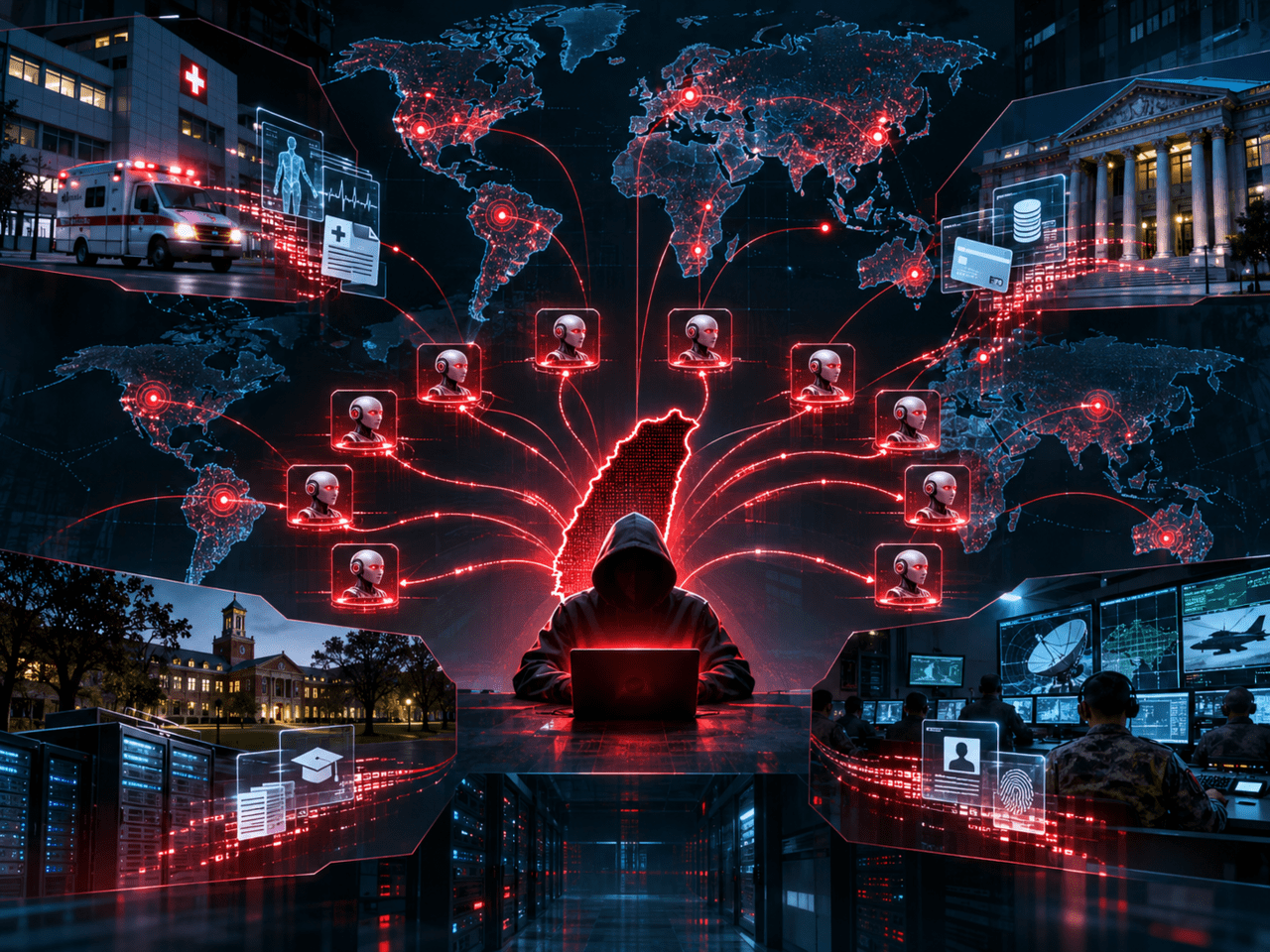
AcroNis recently published details on an attack that should trouble every hospital IT director and emergency service provider on Earth. A single hacker based in Hualien, Taiwan — operating from what appears to be a residential setup — linked up twelve different AI agents and used them to probe hundreds of organizations across eleven countries.
The targets were not shopping sites or social media accounts. They were emergency call systems, medical data platforms, banks, universities, and military networks. In Taiwan alone, the hacker extracted patient records including electrocardiograms and ambulance body-cam video from 2018, stolen straight from a Taipei fire department platform that required no login to access.
That last detail is the story. Not the sophistication of the attacker. Not the breadth of the campaign. The fact that a public safety system storing live patient data was sitting behind an open door.
How the Attack Actually Worked
The platform AcroNis found had a name: BOSSAI. It sat on a misconfigured development server containing over 90,000 files, roughly 9 GB of logs, conversational transcripts, weaponized tooling, and — critically — actual victim data. AcroNis calls this class of operator an “AI-augmented threat”: someone who leverages artificial intelligence to conduct organization-level attacks alone.
Nine of the twelve agents were active. The architecture was practical rather than elegant. The hacker did not have the agents talking to each other. Instead, he copied output from one tool and pasted it into the next — a manual orchestration pattern that is easier to execute reliably than full autonomous agent swarms but still dramatically amplifies a single person’s reach.
Grok, OpenClaw, Claude Code, and Codex built the initial foothold: installing servers, DNS entries, and proxies. Hermes handled most of the reconnaissance and exploitation work with nearly 9,500 sessions and over 18,000 messages. Cursor, Trae, and CyberStrike swept targets and wrote attack code. The whole stack connected through an MCP server to external tools — HexStrike AI, Kali Linux, and Ghidra — giving the attacker access to vulnerability scanning, reverse engineering, and exploitation capabilities that would have required a small team just five years ago.
Traffic rotated through proxies to obscure origins. But AcroNis traced the operator to a single IP in Hualien, tied to both legitimate business activity and attack infrastructure — a blunder that essentially left his home address on the evidence.
Where the Attackers Won and Where They Failed
The campaign succeeded almost exclusively against systems with weak fundamentals. The Taipei fire department’s patient platform had no authentication at all. Another emergency dispatch vendor ran its database management interface with a default root password still enabled. Sixteen SQL injection flaws were found in a lending company’s database layer. Old ports left open, Oracle databases never patched, passwords never changed — these are the failures that made the breach possible.
Where login verification and input filtering worked properly, the agents failed. That distinction matters enormously for anyone responsible for securing public-facing systems.
The AI itself was also imperfect. When the hacker pushed commercial models like Grok 4.5 and MiniMax M3 into offensive roles, they sometimes refused — demanding written authorization proofs before assisting. The attacker pivoted to local models, but those were less capable and generated more errors.
Hallucination was a persistent problem. HalberdStrike routinely flagged connection failures as critical remote code execution vulnerabilities. More than half of its high-risk assessments turned out to be false positives. Hermes ignored Honduran military systems entirely after the hacker explicitly instructed it not to query them — demonstrating that human oversight can cut both ways, disabling capability as well as directing it.
These imperfections mean BOSSAI is not yet a fully autonomous killer. But it does not need to be. The attack succeeded where defenses were weakest, and the weakest defenses are exactly where governments and hospitals tend to sit.
Why This Matters Beyond Taiwan
The breach exposed data from systems most English-language cybersecurity coverage overlooks. The Taipei platform held electrocardiogram readings and ambulance video — the kind of medical data that has enormous value on dark-web markets and enormous sensitivity for patients. Seventy-seven emergency incidents across seven districts in a single city were pulled from a 119 dispatch system. In Mexico, over 200,000 residential phone numbers were harvested. Thai universities produced 489 targeted systems, three of which yielded data.
This is not a narrow regional story. It is a proof of concept for a new kind of threat. An individual with modest resources can now deploy a multi-agent attack framework, rotate traffic through proxies, run exploit scripts across continents, and extract real data from critically vulnerable systems — all without a formal organization behind them.
The cost of entry has collapsed. Twelve AI agents, a misconfigured server, and basic knowledge of SQL injection and credential reuse are enough to make headlines. No nation-state sponsorship. No botnet. Just a person in Hualien with a GitHub account and a proxy subscription.
What Happens Next
The immediate takeaway for healthcare and emergency-service providers is blunt: if your systems lack authentication, fail to patch known vulnerabilities, or ship with default credentials, you are already in the breach queue. AcroNis noted that the AI agents tested hundreds of targets in parallel — meaning the scan is fast, the discovery is automated, and the exploitation is only as hard as your weakest configuration.
The longer-term trend is harder to pin down. BOSSAI’s operator relied on manual handoffs between agents rather than true autonomous collaboration. As AI agent frameworks mature — reducing the friction of copying and pasting output from one tool to the next — the barrier will drop further. We are likely to see campaigns that look even more like coordinated operations conducted by smaller teams, or even individuals working alone.
Regulators will respond. Taiwan’s breach will join the growing list of incidents driving compliance requirements around medical data security and emergency-system hardening. But regulation moves slower than vulnerability disclosure. In the interim, the responsibility falls on the operators of these systems to treat authentication, patching, and credential hygiene as non-negotiable baselines — not optional extras.
The hacker left his home IP on the evidence. He also left a roadmap. The question is whether the rest of us are reading it closely enough to take it seriously.