Tariffs, Troops, and Chips: The US Bargain With Korea
Washington is threatening targeted semiconductor tariffs against Samsung and SK Hynix unless they build fabs in the US — while simultaneously pressing Seoul for Hormuz Strait deployments. The two pressures may be linked.
The Tariff Gun to Korea’s Head
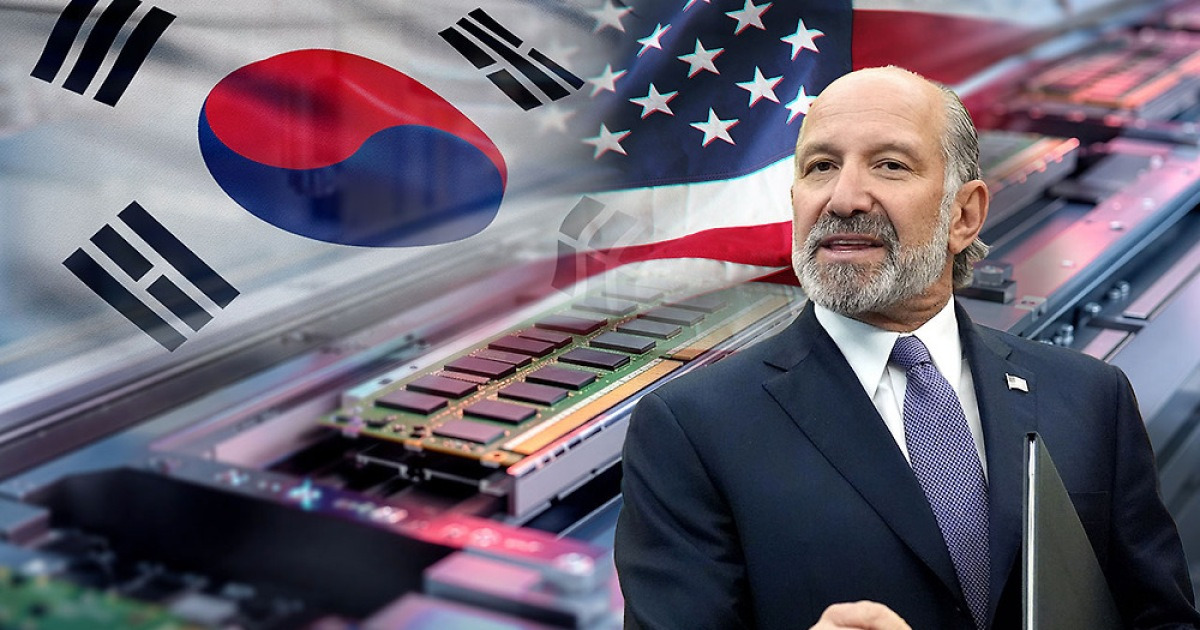
US Commerce Secretary Howard Lutnick did not mince words recently. Targeted semiconductor tariffs are coming, he told reporters, and companies that do not build factories in America will pay a price to access the world’s largest chip market.
When pressed on which companies he meant, he named them directly: Samsung and SK Hynix.
“They will build factories here, and they should,” Lutnick said, according to a South Korean news report. Two months earlier, he had been photographed at a Micron fab construction site saying he wanted to “summon Samsung and SK to build factories.” Nothing happened. So he escalated.
The threat landed on top of an already compressed timeline. Seoul says it will announce its first major US investment commitment this month, after months of negotiations that have produced very little in return.
The stakes go beyond market access. Samsung Electronics accounts for roughly 20 percent of South Korea’s total exports. SK Hynix dominates the high-bandwidth memory market that powers artificial intelligence clusters. A tariff applied selectively to these two firms — rather than broadly across all imports — would function not as a revenue tool but as a surgical lever, designed to force corporate restructuring rather than shift trade balances. That distinction matters. It means Washington is treating Korean semiconductor firms less as commercial competitors and more as infrastructure to be redirected toward American strategic ends.
Industry insiders say the administration has been mapping this scenario for over a year, drawing on lessons from the 2018 steel tariffs and the CHIPS Act subsidy structure. The difference now is that Seoul has far less fallback option than Tokyo or Berlin faced when similar pressures were applied. Korea’s economy is more export-concentrated, its semiconductor sector more geographically anchored, and its security dependency on the United States more explicit.
A Second Front: The Hormuz Question
What makes this moment unusual is that the tariff pressure arrives alongside a second, unrelated-seeming demand. Washington is also pressing Seoul to deploy troops to the Strait of Hormuz — a request that carries enormous geopolitical risk for a country whose security doctrine has always been oriented north, toward the Korean Peninsula.
The two demands are not officially linked. But several Korean economists and policy analysts quoted in the reporting suggest the opposite logic may be work: if Seoul accedes on Hormuz, Washington could offer investment concessions as a reward.
“Trump’s negotiation style is to strike first with a whip, then offer the carrot — and say ‘I’ll take the whip back,’” said Kim Gwang-seok, head of the Korea Institute for Industrial Economy and Trade’s research division, according to the report.
That framing implies the tariff threat is not an endpoint but a negotiating position — one designed to extract maximum concessions before any retreat.
The Hormuz demand itself has not been formally presented in writing, according to multiple diplomatic sources familiar with the discussions. It has circulated through back channels and sideline conversations at multilateral forums, a pattern consistent with the administration’s preference for ambiguity that maximizes leverage. A formal request would trigger domestic political reckoning in Korea — debates over constitutional authority, mission scope, casualty risk, and precedent. An informal one does not. That gap between what is asked and what is admitted is itself a negotiating tactic.
Deployment to the Hormuz would mark the first time South Korea commits combat-capable forces to the Middle East outside of United Nations humanitarian and reconstruction missions. The symbolic weight would reverberate across the region, alarming Beijing and Pyongyang while signaling to Riyadh and Abu Dhabi that Seoul is aligning more closely with Washington’s broader containment architecture. For Korea’s energy security — over 70 percent of its crude imports flow through that strait — the move would be framed domestically as solidarity rather than subordination. The calculation, however, would belong to someone else.
Who Wins, Who Loses
If Samsung and SK Hynix build fabs in the US under tariff duress, the winners are clear: US semiconductor manufacturing capacity grows, Micron gains a more favorable competitive landscape, and Washington gains leverage over the global chip supply chain at a moment when Washington sees China as the central threat.
The losers are less tidy. Korean firms face higher production costs outside Korea, diluted control over their most critical technology, and a precedent that their ability to operate in the world’s biggest market depends on capitulation rather than competition. Korean workers in advanced chip plants lose relative to American workers who gain — a transfer that serves US politics but does not make Korea more secure.
But the second-order losses are harder to quantify and longer-lasting. Every fab moved to American soil weakens the ecosystem that has made Korea the world’s memory-chip capital — the cluster of equipment suppliers, research universities, and specialized labor pools that cannot be replicated by decree. The knowledge spillovers that drive incremental innovation evaporate when production is geographically scattered. Over a decade, that erosion compounds.
Seoul’s government is caught in the middle. Industry Minister Kim Jeong-gwan is currently in the US negotiating, telling reporters that Washington had already committed to treating Korea no worse than rival competitors. That language suggests Seoul is trying to hold the line on non-discrimination even as it caves on investment location.
Domestically, the government faces a trilemma it cannot resolve. Yield on tariffs and preserve investment flows. Resist and trigger capital flight. Compromise on both and alienate the industrial base that underpins the economy. Each path carries political cost. The current strategy — negotiate in public while making private concessions — buys time but deepens the credibility problem when the terms become visible.
The Alaska Pipeline Lie
Adding to the sense that Washington is setting terms by fiat rather than negotiation: President Trump recently claimed that Japan and South Korea are building a pipeline to Alaska. No such project exists. The remark appeared to be an information operation designed to normalize a demand before it was formally made — or to create a sense of irreversible momentum.
This is a known Trump playbook. Announce a fait accompli, then negotiate around it. The Hormuz deployment request may be next in line for the same treatment.
The pipeline claim, however absurd, revealed something about the pressure calculus. By inserting an impossible demand into public discourse, Washington tests Korea’s tolerance for humiliation and establishes a baseline from which real demands can be extracted as “compromises.” If Seoul pushes back too forcefully on the pipeline talk, it looks unreasonable. If it stays silent, the narrative hardens. Either way, the administration gains ground without spending political capital.
Korean media outlets have largely treated the remark as a joke rather than a signal. That dismissal may be a mistake. In transactional diplomacy, the line between satire and strategy is thinner than it appears.
The Hidden Architecture of the Bargain
What is not yet public but increasingly discussed among policy circles in Seoul is the possibility that these two threads — chips and troops — are being woven together into a single package. The logic would be straightforward: Washington offers to moderate or delay tariff action in exchange for Korean agreement to a Hormuz deployment framework, or vice versa. The tariff threat creates urgency; the Hormuz demand creates leverage. Together, they form a bargain that neither side has formally articulated but both are preparing for.
Such a linkage would represent a fundamental reordering of the alliance. The US-ROK partnership was built on a clear division of labor: America provides the security umbrella, Korea contributes forces to the forward defense of Northeast Asia. Introducing Middle East deployments and semiconductor conditionalities collapses that bargain into a broader transactional framework where every Korean concession has a price and every American concession is withheld until payment is made.
Chinese analysts have already begun framing the situation this way in state media, arguing that Korea is being drawn into a wider containment strategy at the cost of its economic sovereignty. The commentary is partly genuine analysis and partly pressure campaign aimed at Seoul’s leadership — reminding them that the alternative to American demands is not neutrality but isolation from both Washington and Beijing.
What Happens Next
Seoul’s deadline this month to announce a first investment deal is the immediate flashpoint. If the government delivers on a facility commitment under tariff threat, it will have chosen economic survival over strategic autonomy — a calculation that may buy time but sets a precedent for every future negotiation with Washington.
If Seoul resists, the tariffs arrive. Samsung and SK Hynix would face a direct hit on their most profitable export channel. The damage would ripple through Korea’s GDP, its trade balance, and its political stability.
Either outcome reshapes the alliance. The question is whether Korea enters this phase as a partner negotiating terms, or as a target absorbing them.
The Hormuz question remains unresolved. If Seoul deploys forces to the Gulf, it signals a strategic reorientation toward Middle East security commitments — something no Korean government has undertaken at this scale. If it refuses, Washington gains another lever. Either way, the chip tariffs are not just a trade issue. They are the opening move in a broader bargain Seoul has not yet agreed to name.
What comes next will depend less on what Washington asks than on whether Seoul has the political cohesion to answer — or the economic resilience to resist. Right now, neither confidence nor capacity is clearly present.