Why Musk's Flying Roadster Changes Everything for EVs
Tesla unveiled a flying Roadster prototype powered by SpaceX rocket technology, with 2028 production planned. The move blurs lines between car, spacecraft, and spectacle — and signals what's coming next for the EV market.
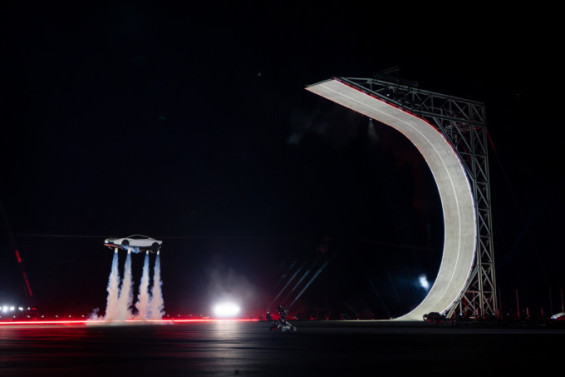
The Roadster That Can Fly
On May 15, Elon Musk stood at a SpaceX rocket test facility in McGregor, Texas, and proved something he spent years denying was possible: a car can fly.
Not metaphorically. Not as a concept sculpture. The Tesla Roadster 2 prototype leapt over a line of stationary Teslas using jet propulsion, executed barrel rolls mid-air, and landed before touching down at 60 mph. It was remote-controlled — Musk was careful about that — but the physics were real.
This matters because the flying Roadster represents the latest pivot in Musk’s strategy of using aerospace technology to reframe what a car can be. For decades, electric vehicles have been judged on range, charging speed, and efficiency. Musk is now suggesting the next frontier isn’t efficiency at all, but altitude.
How We Got Here
Musk called flying cars “ridiculous” in a 2014 interview. By 2017, he announced the Roadster 2 would feature rocket thrusters. Today, he’s delivering on a promise he explicitly rejected three years earlier.
The pattern is familiar: denial, announcement, execution, repeat. It’s also effective. Each cycle reinforces the narrative that Musk operates on a timeline others cannot match — or even imagine.
The Roadster 2 is priced at $200,000 for the base Performance model, with a deposit of $50,000. A higher-tier version with full propulsion systems runs $250,000. The one-seater Rocket variant, featuring what Musk calls a “perfect flight system,” will be limited to select customers.
Production is scheduled for 2028. That’s six years away. Most of what Musk has revealed so far comes from a single demonstration video and a few social media posts.
What This Actually Is
The Roadster 2 is not a flying car in the conventional sense. It won’t replace your daily commute. Musk himself acknowledged this, stating the vehicle “may not be legal everywhere” and isn’t optimized for safety — only for fun.
What it is, instead, is a proof of concept wrapped in theater. The rocket thrusters, the aerial maneuvers, the barrel rolls — these aren’t designed for practicality. They’re designed to make the impossible look routine.
And that’s the point. Musk isn’t selling transportation. He’s selling the future.
The Bigger Picture
The flying Roadster arrives at a moment when the EV industry is hitting a wall. Growth has slowed. Competition is intensifying. Chinese manufacturers like BYD are closing the gap on range and price. Tesla’s dominance, once unchallenged, now faces scrutiny from every angle.
In that context, the Roadster 2 serves a different function than the Model 3 or Model Y. Those cars sustain Tesla’s volume business. The Roadster 2 sustains its mythos.
Musk understands something many automakers miss: people don’t buy cars on specs alone. They buy stories. The Roadster 2 is the most ambitious story Tesla has ever told.
It also leverages SpaceX in a way that no other company could. The thrusters, the testing facilities, the rocket expertise — these are assets unique to Musk’s ecosystem. Competitors can copy ranges and batteries. They can’t easily replicate the infrastructure of a privately funded space program.
Who Wins, Who Loses
Winners: Tesla shareholders, who get a product that generates free global media coverage without traditional advertising spend. Consumers willing to pay $200,000 for a car that flies, even if only occasionally. The broader EV narrative, which gets a boost from a story that sounds like science fiction.
Losers: Traditional automakers, who face a competitor that doesn’t play by automotive industry rules. Regulatory bodies, which will struggle to categorize a vehicle that drives on roads and flies through airspace. Buyers who expected the Roadster 2 to arrive sooner and now face another six-year wait.
What Happens Next
The flying Roadster will spawn imitators. Expect Chinese EV makers to announce similar concepts within months. Legacy automakers will release their own flying car prototypes, even if none reach production. The hype cycle will accelerate.
Regulators will respond with caution. The FAA and international equivalents already lack frameworks for personal flying vehicles. The Roadster 2’s demonstration flights were tightly controlled and remote-operated. Scaling those to consumer use will require entirely new categories of certification and airspace management.
Musk has a track record of pushing timelines beyond their stated delivery dates. The Roadster 2 was first announced in 2017. Production is now slated for 2028 — eleven years later. Whether that date holds remains uncertain.
But uncertainty is part of the strategy. The promise of the future is often more valuable than the product itself.
Why English-Language Readers Should Care
The flying Roadster may seem like a niche curiosity — a $200,000 toy for billionaires. But it reveals something important about where the automotive industry is heading.
Cars are no longer just cars. They’re platforms for integrating battery technology, autonomous driving, and now aerospace capabilities. Tesla is positioning itself not as an automaker, but as a mobility company that happens to build vehicles.
The implications extend beyond Tesla. If a flying car becomes viable — even at the premium end — it changes the calculus for every competitor. Range anxiety gives way to altitude anxiety. Charging stations give way to landing pads. The entire infrastructure of personal transportation faces disruption.
Musk’s greatest trick isn’t building a flying car. It’s making the world believe it was always coming.
And for a company that needs constant novelty to sustain its valuation, that belief is worth more than any prototype.