Tesla's Flying Roadster Signals a Bigger Bet Than You Think
Tesla just unveiled a Roadster that flies, sticks to roads at 4,709kg of downforce, and accelerates 0-100km/h in under one second — powered by SpaceX cold-gas thrusters. But the product moment is secondary to what Musk is betting on: that ground transport is no longer enough for a company that also builds rockets.
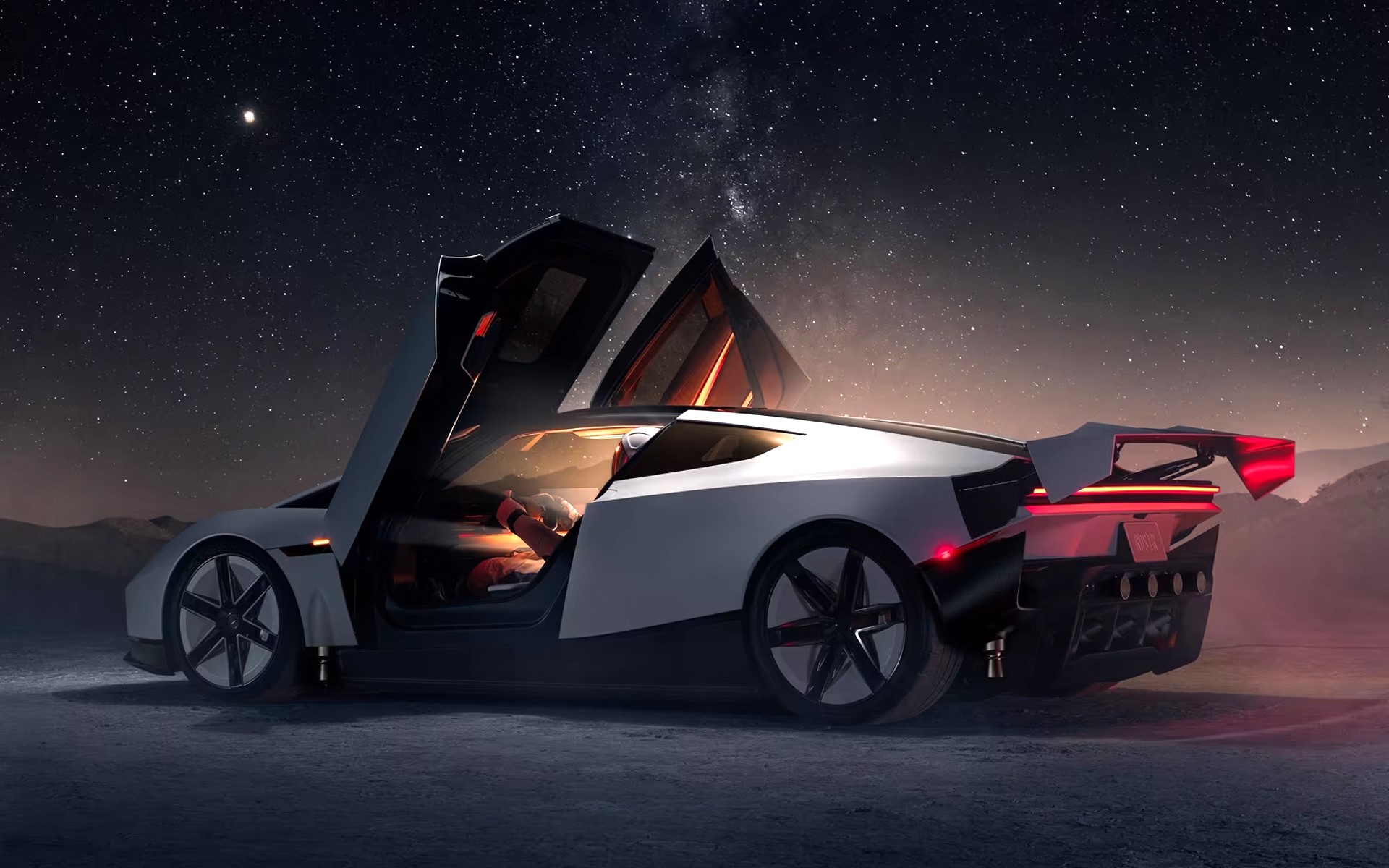
Tesla Just Unveiled a Roadster That Flies. The Product Is Not the Point.
On October 16th, inside a rocket test facility in McGregor, Texas — not a car showroom, not a convention center, but an actual SpaceX test site — Tesla revealed a new Roadster that doesn’t just drive. It generates 4,709 kilograms of downforce, can literally stick to the underside of a road, and performs mid-air rotation maneuvers using cold-gas thrusters.
It is the most technically elaborate product launch Tesla has ever attempted, and it is also the clearest signal yet that the company is no longer just a car manufacturer. It is becoming something else entirely.
What Was Unveiled
Three trims were announced. The base model, called Performance, is a two-seater built for road use with active aerodynamics and a multi-mode air-suction system that maximizes downforce. The Thrust trim, available through limited pre-order, adds a cold-gas thruster array behind the seats, pushing the car from zero to 100 kilometers per hour in under one second. The Rocket trim, by invitation only, is a single-seater capable of forward and upward acceleration as well as lateral rotation in mid-air.
Ten nozzles. Ultra-high-pressure air tanks. Cold-gas thrusters firing in fractions of a second to stabilize the vehicle during descent. The car can flip over a line of five other vehicles mid-air while rotating. It has been demonstrated running upside down at maximum downforce settings. It can hold itself against a vertical surface while completely stationary.
Elon Musk took the stage at the event — a space, not a studio — and gave remarks that were telling in their casualness. He recalled that when the internal team first proposed the Roadster’s functions, he himself thought: this might be insane. He said they persisted anyway.
He also made a declaration that should be parsed carefully. When asked whether the future was autonomous driving, he said the day’s demonstration was autonomous, but long-term, the Roadster would become Tesla’s only manually driven vehicle.
This is a retreat disguised as an announcement. It signals that Tesla’s strategy is pivoting from mass-market autonomous cars to something narrower, more exclusive, and far more expensive.
Why the Tech Doesn’t Matter
Let’s be clear about what was shown. A road car that can generate 4,709 kilograms of downforce is already mechanically extreme. Add cold-gas thrusters capable of mid-air stabilization, and you have something closer to a stunt platform than a practical vehicle. The engineering is impressive. The utility is questionable.
This is not a car designed for everyday driving. It is a technology showcase, a brand moment, and — crucially — a signal to investors and regulators that Tesla operates in a different category than other automakers.
The flying Roadster shares more DNA with SpaceX than with the Model 3. That is the point.
What Musk Is Actually Betting On
In 2018, Tesla sent the original Roadster into orbit aboard a Falcon Heavy rocket. It became a piece of debris in space, visible to astronomers, a novelty for nearly six years. This new Roadster is not going to orbit. It is staying in the atmosphere, operating at the edge of ground transport and aerial maneuvering.
The pivot is from cars to aerospace-adjacent products. Not from vehicles to robots. Not from transportation to AI. From ground transport to something that blurs the line between car and aircraft.
This matters because it changes how Tesla is valued. As a car company, it trades at multiples typical of the auto industry — thin, cyclical, capital-intensive. As a aerospace-adjacent technology company, it could command valuations closer to defense contractors or luxury experiential brands.
The stock dip following the announcement, relatively mild given the technical ambitions displayed, tells you everything. Markets are still deciding whether this is a car or a rocket.
Who Wins, Who Loses
The winners are SpaceX fans, Tesla super-appreciators, and anyone who believes that the boundary between automotive and aerospace is worth dissolving. The limited-production Rocket trim, by invitation only, will go to a small circle of wealthy enthusiasts and strategic partners.
The losers are anyone expecting Tesla to solve autonomous driving, mass-market affordability, or practical transportation. The Roadster will not appear in ride-hailing fleets. It will not replace the Model Y. It is a halo product, a statement of capability, and a bet on exclusivity.
Japanese coverage of the event — which reported technical details English-language desks have not fully absorbed — emphasized the multi-mode suction system, the cold-gas thruster stabilization during descent, and the demonstrations of upside-down road holding. These are not marketing flourishes. They are proof points for a company redefining what its products can do.
What Comes Next
Musk stated that the Roadster would be Tesla’s only manually driven vehicle long-term. That is a declaration of direction: autonomous vehicles are the mass product, and the Roadster exists to prove the boundary-pushing capability of the brand.
The question is whether this pivot from ground transport to aerospace-adjacent performance holds value at scale. Luxury automotive buyers may pay premiums for flying demonstrations. Investors may reward the brand repositioning. But the operational reality remains: this car cannot be manufactured at the volume that drives automotive margins.
Tesla is not just building cars anymore. It is building proof points for a company that also builds rockets. The Roadster is a symbol of that transition — technically magnificent, commercially narrow, and strategically clear.
The stock dip is not about the product. It is about the uncertainty of what a company becomes when it stops being just a car maker and starts being something else entirely.