Tesla's Roadster Is a Rocket Car — And That Changes Everything
Tesla just revealed the second-generation Roadster with SpaceX cold-gas thrusters, a 0.81-second 0-to-60 run, and a design that abandons its 2017 curves for Cybertruck edginess. Here's why this matters far beyond car enthusiasts.
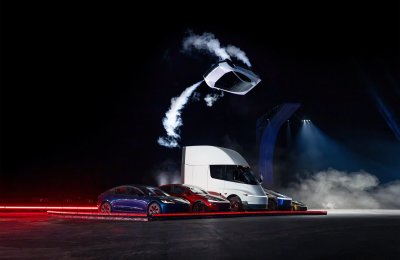
The car that falls from the sky
Tesla did something at its October 15 unveiling in McGregor, Texas, that no conventional automaker could have orchestrated alone. A second-generation Roadster climbed halfway up a circular roller-coaster track, flipped upside down, then fired a burst of compressed air from nozzles embedded in its body — steadying itself before touching down on its wheels. Another demonstration showed five Roadsters lined up side by side, the subject vehicle accelerating toward them, kicking up a plume of gas, and clearing the line like a stunt-plane flyover.
This is not a concept. It is a working demonstrator, produced at a SpaceX test facility, using propulsion hardware Tesla co-developed with SpaceX. And it signals something about where the company intends to go next.
What the Roadster actually is
The specs are staggering. Zero to 60 mph in 0.81 seconds — not an estimate, a claimed figure — with a top speed exceeding 230 mph (roughly 370 km/h). Tesla calls it the most powerful sports car ever made and, notably, the last one it will build that allows manual driving.
The car sits somewhere between a supercar and a stunt rig. The cold-gas thruster system uses ten pressurized-air nozzles distributed across the chassis. At low speeds they provide maneuverability tricks — the mid-air flip, the jump. At high speeds on a track, a suction-fan system underneath the vehicle presses it into the road, allowing it to drive upside down on inverted banked curves. This is aerospace hardware, repurposed.
The design has also shifted dramatically from the 2017 prototype. Where that car carried soft, flowing curves, the new Roadster uses the sharp, faceted language of the Cybertruck. It is a deliberate visual statement: this is not a revival. It is a redefinition.
The nine-year gap matters
The original Roadster concept was revealed in November 2017. Production has now been pushed to 2028. That is a nine-year wait — longer than most consumer product cycles, longer than most car-model generations. Investors grew skeptical. Competitors filled the supercar vacuum. Ferrari, Porsche, Lamborghini kept building their own versions of fast electric and hybrid sports cars.
Tesla chose not to chase them within their rules. Instead, it changed the rulebook. The argument, implicit in everything Tesla has shown, is that a car that can literally jump and fly — even if only for a few seconds, even only under controlled conditions — is a different category of product entirely. Traditional automakers cannot replicate it because they do not own a rocket company.
Vertical integration as product strategy
This is the non-obvious takeaway. The Roadster is not merely a car with thrusters attached. It is proof that vertical integration — controlling both the vehicle and the propulsion technology that lives inside it — creates options that competitors simply do not have. SpaceX designs and builds cold-gas thrusters. Tesla integrates them into a production vehicle. The result is a car that no other manufacturer can build because no other manufacturer owns that kind of cross-industry capability.
The implications extend beyond sports cars. If Tesla can put rocket-derived hardware into road vehicles at scale, it has opened a corridor that traditional OEMs cannot enter without either building their own aerospace division or forming alliances they likely cannot match. This is not a metaphor. It is a structural advantage.
Who wins, who loses
Traditional supercar makers lose on novelty. Porsche and Ferrari still dominate the legacy-performance segment, but they cannot credibly claim what Tesla just demonstrated. Lamborghini’s hybrids remain brilliant engineering; they also remain bound to the physics of tires and engines. The Roadster redefines the conversation.
EV competitors in the performance segment — Rimac, Lotus, the upcoming Ferrari electric models — face a similar problem. They can match acceleration. They cannot match the theatricality or the technology convergence on display here. The Roadster creates a gap that is not about speed alone but about what a car is allowed to be.
Tesla’s own lineup benefits too. The Roadster sits at the top of the brand, the halo that pulls attention to everything below it. A car that can flip, jump, and accelerate in under a second generates more global visibility than any advert.
What happens next
Production is scheduled for 2028. That gives Tesla roughly two years to resolve supply-chain questions, secure regulatory approval for a vehicle that deliberately includes thruster systems, and build demand ahead of delivery. Pre-orders from the 2017 reveal generated over 100,000 reservations, though many were refundable deposits. The real test will come when the car is actually available.
There are also practical questions. How often will the thrusters be used? What maintenance do they require? Can a car that deliberately performs aerospace maneuvers survive daily driving? Tesla has not answered these, and the company has historically been vague on production details until the last moment.
Musk described the Roadster as the last manually driven sports car Tesla will make. That framing suggests a broader intention: that future Tesla performance cars will be autonomous, or at least that the brand’s identity is shifting toward technology rather than traditional driving engagement. Whether that is strategic positioning or a statement of belief remains to be seen.
The bigger picture
What Tesla demonstrated in McGregor is not just a car launch. It is a signal that the boundary between automotive and aerospace engineering is thinning — and that the company willing to build across both domains will set the terms. The Roadster may be niche. The approach is not.
If this model works, if the thruster system proves reliable and the 2028 timeline holds, Tesla will have created a product category that did not exist nine years ago. The question for the rest of the industry is whether they can respond — or whether they will simply watch from the ground while a car flies over them.