The 15% Rule Just Unlocked the Next Wave of Crypto ETFs
The SEC's approval of a 15% non-eligible asset allowance in crypto ETFs opens the door to multi-asset and active funds — not just single-coin trackers. XRP and Solana's mention as eligible examples marks a structural shift that could reshape global crypto fund design.
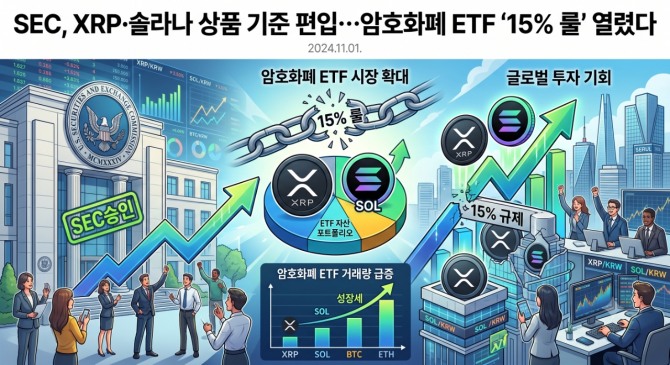
The door just opened wider
The SEC approved a Nasdaq Texas rule amendment on Sept. 5 that allows crypto commodity-based trusts to allocate up to 15% of their portfolios to non-eligible digital assets — coins that don’t individually meet the exchange’s strict listing criteria. Bitcoin, Ethereum, Solana, and XRP were explicitly named as eligible examples. The implication is larger than the percentage.
This is the regulatory scaffolding for multi-asset crypto funds. For the first time, asset managers can build active portfolios that hold a basket of altcoins alongside established coins, rather than being confined to single-coin trackers. The SEC even provided a worked example: a $100 million fund could hold $95 million in BTC, ETH, SOL, and XRP and allocate the remaining $5 million to other digital assets. The active management umbrella — Commodity-Based Trust Shares — is now broadly permissible, not a hypothetical loophole.
Why Korean financial media is watching closely
South Korean publishers are running with this story because the architecture change hits where Korean investors sit: on the altcoin side. Korea’s exchanges have deep liquidity in Solana, XRP, and a wide range of smaller caps. A U.S. fund structure that can actually hold those assets without reclassifying them as securities is a direct pipeline from Wall Street into the markets Korean traders already know. The rule doesn’t just change U.S. product design — it creates a demand channel for the exact coins that dominate Korean trading volume.
Who wins and who loses
Asset managers win immediately. BlackRock, Fidelity, and the emerging crop of crypto-native firms can now file for multi-coin ETFs without begging for individual coin approvals. The compliance burden drops from proving each coin is a commodity to designing a portfolio framework that stays within the 85/15 split. Fund flows that previously would have been split across three or four single-coin ETFs can now consolidate into one product.
XRP and Solana win secondarily. The SEC’s explicit naming of both as eligible examples carries more weight than any single court ruling. Legal scholars caution, as the original reporting notes, that this does not permanently classify all four coins as commodities under federal law — it is a listing-rule determination, not a statutory one. But in practice, naming them alongside Bitcoin and Ethereum in an SEC order signals that the regulator no longer treats them as securities for ETF purposes. That shifts the overton window for every other altcoin filing.
Single-coin ETF sponsors that built their entire business model on exclusivity lose positioning. A fund that only tracks XRP now competes with a multi-asset fund that holds XRP at whatever weight the manager chooses. The moat narrows.
The Goldman Sachs signal
Price action was muted on the news. XRP traded around $1.40, down roughly 4% over 24 hours, pulled lower by rising Treasury yields and a resurgent Fed tightening narrative. But the institutional flow data tells a different story. XRP spot ETFs saw $170 million in net inflows over 11 consecutive trading days. Goldman Sachs disclosed holdings of roughly $87.4 million in XRP ETFs, overtaking Jane Street and Millennium Management as the largest institutional holder. That is not speculative positioning — it is balance-sheet allocation by a firm that moves slowly and measures risk in decades.
Goldman’s move matters because it proves the demand thesis before the new product pipeline even launches. The bank is accumulating exposure through existing single-coin ETFs while the multi-asset framework sits in regulatory gray space. Once the 15% rule gives managers clear authority to build diversified products, Goldman’s position becomes a foundation, not a gamble.
What happens next
Expect filing activity to accelerate within 60 to 90 days. Multiple asset managers are likely to submit forms for actively managed crypto ETFs that combine BTC and ETH as the core 85% with altcoin satellites. The first wave will probably feature Solana, XRP, and perhaps Avalanche or Polygon as the non-eligible slice. Regulatory review timelines for new ETF structures are notoriously opaque, but the path is now structurally open rather than blocked.
For non-U.S. investors, the practical effect is indirect but meaningful. Multi-asset crypto ETFs trade on U.S. exchanges and settle in dollars, which means international pension funds and sovereign wealth funds — the institutions that allocate in large, slow blocks — can gain crypto exposure through familiar regulatory wrappers. The 15% rule removes the primary objection these allocators raise: that altcoin exposure requires holding tokens directly, which introduces custody and compliance risk. A fund that holds altcoins inside an ETF structure transfers that risk to the sponsor.
Korean and Asian exchanges should see a demand bump for the coins that become eligible ETF satellites. Solana and XRP are the obvious candidates. The price impact may lag the filing announcements, but the structural reallocation of institutional capital toward these assets is already underway, as Goldman’s positioning demonstrates.
The legal nuance worth tracking
The SEC order does not resolve the broader question of whether XRP is a security under the Howey test. Court cases and CFTC jurisdictional claims continue in parallel. The 15% rule is a listing-rule determination, not a comprehensive legal classification. If a future court or regulator challenges the commodity status of any named asset, the eligibility framework could face pressure. But until that happens — and the trend lines suggest it won’t happen soon — the practical effect is clear: four digital assets now sit inside the same regulatory box, and the box is big enough to hold more.
The 15% threshold is arbitrary in number but strategic in design. It gives managers enough flexibility to diversify without letting the portfolio drift into unregulated territory. It is a guardrail, not a gate. And guardrails are how markets mature.