Wearable pixel-fibre could replace your phone screen
A washable smart fabric with built-in display and touch sensing could make flat screens obsolete on our bodies — if manufacturers can scale it. The National University of Singapore team published the breakthrough in Nature.
The screen is finally leaving your pocket
For decades, the standard interface has been a flat, rigid slab of glass. Even flexible phones and roll-up TVs still cling to planar geometry. A research team at the National University of Singapore has done something more radical: they have turned a garment sleeve into a fully interactive graphical user interface, and it survives a washing machine.
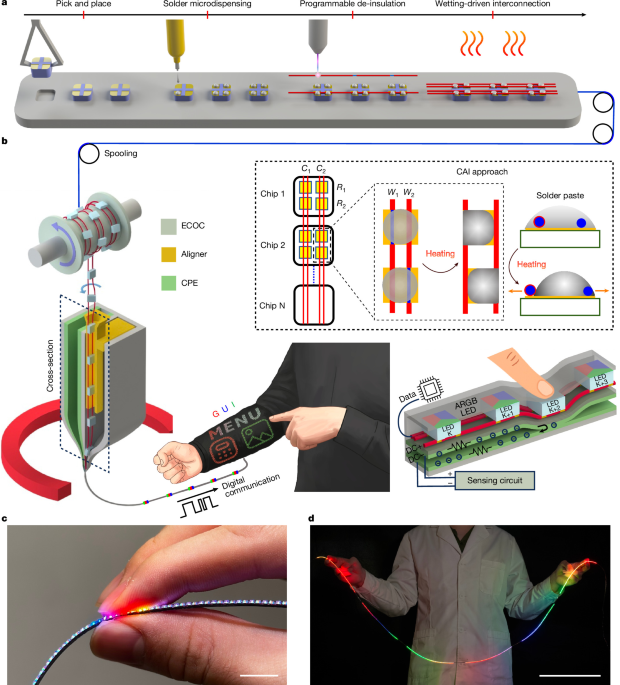
The paper, published in Nature in October 2026, describes a digital pixel fibre — a single thread that combines addressable LEDs, in-fibre circuitry, and a coaxial touch-sensing layer. When knitted into fabric and wired into a garment, it produced a 96-by-54-pixel display running at 30 frames per second with 8-bit colour depth. It played video, ran a calculator app, sensed body temperature, responded to voice commands, and transferred data wirelessly via Bluetooth Low Energy. Then it was washed. And it still worked.
That last detail matters more than the pixel count. Previous attempts at textile-based displays have stalled on durability and wash resistance. The gap has always been dimensional: screens are two-dimensional; fibres are one-dimensional. Bridging that mismatch without sacrificing flexibility or comfort has proven nearly impossible.
This work closes it by making the fibre itself the display backbone, the sensor, and the computational bus. Every pixel is individually addressable along the fibre axis. Touch at any point changes the resistive path in a way the circuit can localize. There is no grid of separate electrodes, no brittle thin-film stack to delaminate. The components sit inside a thermally drawn polymer sheath, protected from moisture, abrasion, and the flexing that comes with real wear.
Who wins, and who loses
The obvious winners are the companies that bet on textile-embedded electronics as a platform rather than a novelty. If this approach scales, it opens a market for clothing that is not just monitored but interactive — sleeves that display notifications, control home appliances, or guide physical therapy without requiring you to pull out a phone.
Automotive designers are another early beneficiary. Current car interiors are packed with rigid touchscreens and physical buttons, both of which conflict with ergonomic and safety goals. A touch-sensing dashboard upholstered in the same material as the seats would reduce clutter and allow interfaces to appear only when needed. The NUS team does not demonstrate this, but the architecture maps directly onto curved, soft surfaces.
Consumer-electronics firms that rely on the smartphone form factor face a quiet threat. Not tomorrow, and not next year. But if garments can host richer interfaces than today’s wearables, the phone ceases to be the default second screen. The disruption is not dramatic enough to alarm Apple or Samsung today, but it is precise enough to matter.
Meanwhile, the researchers behind this work — led by Tural Khudiyev, with first authors Heng Fu and Ziang Li — appear to have solved a materials-science bottleneck that earlier teams could not. Earlier fibre displays, including electroluminescent threads and perovskite quantum-wire LEDs, emphasized brightness or colour range but fell short on integration and washability. This work combines display, sensing, and computation in a single scalable process, which is why it landed in Nature rather than a specialty journal.
The engineering underneath
The pixel fibre is built in three concentric zones. At the core runs the light-emitting element, a micro-LED strip that has been pre-fabricated and then encapsulated during thermal drawing — a process that pulls the strip through a heated furnace while a polymer cladding solidifies around it. That cladding includes a touch-gated resistive path: press anywhere along the fibre, and the local resistance shifts in a readable way. Peripheral multimodal sensors handle physiological, inertial, optical, and acoustic input and output, giving the garment more sensory range than a wrist-worn tracker.
The team knitted these fibres into the forearm portion of a sleeve and wired them to a small controller board. The result supported a two-page menu system, video playback at 25 to 30 frames per second depending on whether audio was active, automatic brightness adjustment, screen autorotation, and a compass readout. All of this ran while the fabric remained flexible, breathable, and waterproof enough to stay operational while fully submerged.
What is striking is the manufacturing logic. Rather than assembling discrete components on a flat panel and then trying to bend the result, the researchers start with a fibre and build outward. The same thermal-drawing step that forms the sensor layer also seals the LEDs. Automated solder micro-dispensing places die into recessed cavities; programmable laser de-insulation strips enamel only where copper pads need exposure. The process is designed for continuous production, not hand assembly.
What still needs to happen
A research prototype is not a product. The most urgent gap is scale. The NUS team demonstrated a relatively small display area on a single garment section. Extending this to full-sleeve or full-garment coverage while maintaining uniform brightness and colour fidelity is a materials-engineering problem that has not yet been solved. The 96-by-54 resolution works for menus and simple video, but it falls well short of smartphone-quality imagery.
There is also the question of power. The prototype uses an external controller board. Integrating a fibre battery — work the same group published in Nature in 2021 on woven lithium-ion fibre cells — would close the loop, but doing so without adding bulk or compromising washability remains an open challenge.
Finally, the ecosystem is nonexistent. Software frameworks, development kits, and design tools for garment-based GUIs do not yet exist at anything like the maturity of mobile operating systems. Creators will need new toolchains before this hardware can support anything beyond demos.
Why this timing matters
The broader wearables market has spent the last decade proving that smart rings, patches, and watches can track health metrics. The next question — and the one this paper answers — is what those devices do with the data they collect. Display and interaction are the missing halves. A garment that can sense your体温 and show you a notification on the same surface where it collected that signal removes the friction of switching between device and display.
The implications reach beyond consumer electronics. Medical monitoring garments, adaptive workwear for industrial settings, and assistive interfaces for people with mobility impairments all benefit from a platform that merges sensing, display, and touch into something you can wear and wash. None of these applications are demonstrated here, but the architecture supports them.
Nature rarely publishes incremental advances. The selection of this paper signals that the field has moved past proof-of-concept into something manufacturable. That shift — from laboratory curiosity to machine-washable reality — is what makes this moment worth watching.